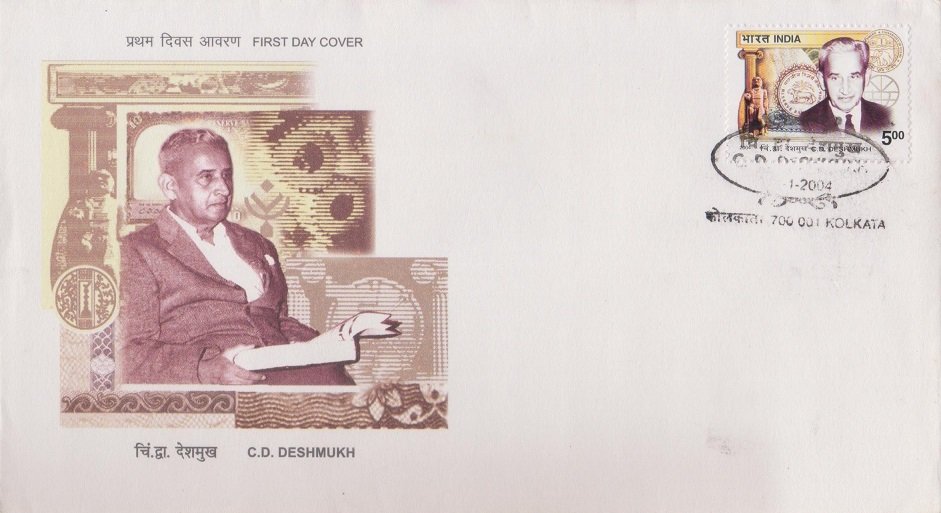
Chintaman Dwarkanath Deshmukh

Technical Data
| Date of Issue | January 14, 2004 |
|---|---|
| Denomination | Rs. 5 |
| Quantity | 400,000 |
| Perforation | comb 13½ x 13 |
| Printer | Madras Security Printers |
| Watermark | No Watermark |
| Colors | Multicolor |
| Catalog Codes |
Michel IN 2015 Stamp Number IN 2051 Yvert et Tellier IN 1780 Stanley Gibbons IN 2192 WADP Numbering System - WNS IN001.04 |
| Themes | Commemoration | Economists | Elephants | Famous people | Men | Politicians | Politics |
Visionary Administrator and Architect of India’s Financial Institutions
Chintaman Dwarkanath Deshmukh, popularly known as C. D. Deshmukh, was one of India’s most distinguished administrators, economists, and scholars. A man of extraordinary intellect and versatility, he combined analytical precision with creative insight and played a crucial role in shaping India’s financial and administrative institutions in the early years of independence.
Early Life and Education
C. D. Deshmukh was born on 14 January 1896. From an early age, he demonstrated exceptional academic brilliance. He later studied at the University of Cambridge, where he graduated with first-class honours in 1915 and won the Frank Smart Prize in Botany.
Deshmukh subsequently appeared for the Indian Civil Service (ICS) examination and secured first rank in the open competitive examination, an achievement considered extraordinary at the time. The eminent nationalist leader Bal Gangadhar Tilak advised him to join the service, believing that an independent India would require capable administrators.
Career in the Indian Civil Service
Deshmukh began his administrative career in 1920 in the C.P. and Berar cadre of the Indian Civil Service. One of his early assignments was conducting the revenue settlement for the Raipur khalsa. Demonstrating remarkable dedication, he personally visited about 2,700 villages within a year to gather data and observations.
His detailed report and recommendations proved immensely valuable for the administration and later became a model for administrative fieldwork that even Indian Administrative Service (IAS) officers studied and emulated.
Later, as Revenue Secretary, Deshmukh introduced several progressive policy measures, including the Debt Reconciliation Act, reflecting his ability to combine administrative insight with economic foresight.
Governor of the Reserve Bank of India
In 1939, Deshmukh moved into the central financial services of the government. In 1943, he became the first Indian Governor of the Reserve Bank of India, a position he held until 1949.
During his tenure, he strengthened the Research and Statistics Department of the central bank and firmly asserted the independence of the Reserve Bank from the Government’s finance department. He also guided India’s post-war monetary policy with great skill.
Deshmukh represented India at the Bretton Woods Conference, where global financial institutions were conceived. He played an important role in India becoming a founding member of the:
- International Monetary Fund
- World Bank
He later served as India’s Governor on the Executive Boards of both organizations.
Finance Minister of India
Recognized for his financial expertise, Deshmukh was appointed Finance Minister of India in 1950. In this role, he successfully implemented measures to control inflation and stabilize prices during a critical period in India’s economic development.
He conducted complex negotiations involving sterling balances, exchange rate adjustments, and wheat loans from the United States, demonstrating both diplomatic finesse and economic competence.
Deshmukh also played an important role in initiating nationalization policies in banking and insurance and contributed significantly to economic planning as a member of the Planning Commission of India, helping shape the First and Second Five-Year Plans.
Contributions to Education and Institutions
After resigning as Finance Minister in 1956, Deshmukh became the first Chairman of the University Grants Commission. He worked to strengthen India’s higher education system and promote academic excellence.
Later, he served as Vice-Chancellor of the University of Delhi from 1962 to 1967.
He was also associated with several prestigious institutions, including:
- India International Centre
- UNESCO
- Indian Institute of Advanced Study
- Administrative Staff College of India
- All India Institute of Medical Sciences, where he chaired the Finance Committee.
Scholar, Linguist, and Cultural Enthusiast
Deshmukh was not only an administrator but also a scholar with wide-ranging intellectual interests. He was a linguist, Sanskrit scholar, poet, botanist, and enthusiastic gardener.
He translated the classical Sanskrit work Meghaduta by Kalidasa into Marathi and composed poetry in both Sanskrit and Marathi.
After marrying Durgabai Deshmukh, he actively supported her social welfare initiatives and public service activities.
Awards and Recognition
For his outstanding contributions to public service, Deshmukh received the prestigious Ramon Magsaysay Award for Government Service in 1959.
Later, in 1975, the Government of India honoured both him and his wife with the Padma Vibhushan for their distinguished contributions to the nation.
Legacy
C. D. Deshmukh passed away on 2 October 1982, leaving behind an enduring legacy as a visionary administrator, financial reformer, and intellectual scholar. His career exemplified integrity, dedication, and a deep commitment to public service.
In recognition of his extraordinary achievements, India Post issued a commemorative postage stamp to honour this multifaceted genius whose contributions helped shape modern India.
First Day Cover