
Constitution of India

Technical Data
| Stamp Set | Constitution of India |
|---|---|
| Date of Issue | January 26, 2020 |
| Denomination | Rs. 10 |
| Quantity | 500,000 |
| Perforation | 13 |
| Printer | Security Printing Press, Hyderabad |
| Printing Process | Wet Offset |
| Watermark | No Watermark |
| Colors | Multicolor |
| Credit (Designed By) | Ms. Gulistaan Ms. Nenu Gupta |
| Catalog Codes |
Michel IN 3655 Stamp Number IN 3210b Yvert et Tellier IN 3332 Stanley Gibbons IN 3728 Phila-India IN 3695 |
| Themes | Documents |
Significance of Constitution Day
Constitution Day, also known as Samvidhan Divas, is observed in India on 26 November every year to commemorate the adoption of the Constitution of India. On 26 November 1949, the Constituent Assembly formally adopted the Constitution, which came into force on 26 January 1950.
On 19 November 2015, the Union Ministry of Social Justice and Empowerment notified the decision of the Government of India to celebrate 26 November as Constitution Day, with the objective of promoting awareness among citizens about the values, ideals, and principles enshrined in the Constitution.
70 Years of the Indian Constitution
The year 2019 marked the 70th anniversary of the adoption of the Constitution of India. Beginning 26 November 2019, year-long nationwide activities were launched to highlight the glorious composite culture and diversity of India and to create awareness about Fundamental Duties.
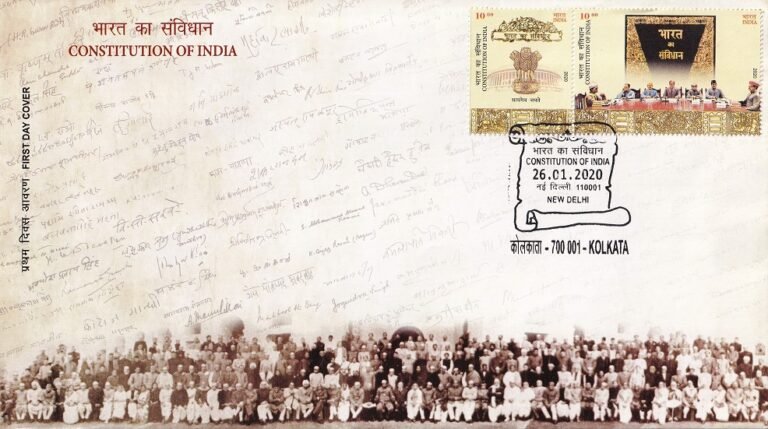
On this occasion, the Hon’ble Prime Minister Shri Narendra Modi urged citizens to uphold the duties enshrined in the Constitution. As part of these celebrations, the Department of Posts announced the release of Commemorative Postage Stamps, with the first set on the theme “Constitution of India” issued on 26 January 2020.
Constituent Assembly and Drafting of the Constitution
The Constitution of India was drafted by a Constituent Assembly elected under the Cabinet Mission Plan of 1946. The Assembly held its first meeting on 9 December 1946, electing Dr. Sachhidanand Sinha as the temporary Chairman. On 11 December 1946, Dr. Rajendra Prasad was elected as the permanent Chairman.
The Constituent Assembly consisted of 299 members, including 15 women, and took less than three years (1946–1949) to draft the Constitution. Of these, 284 members signed the final document. The Assembly constituted 13 committees, including the Drafting Committee under the chairmanship of Dr. B. R. Ambedkar, whose seven-member team prepared the draft based on committee reports.
Artistic Creation of the Constitution
The Constitution of India is unique in that it was handwritten and calligraphed, not typeset or printed, in both English and Hindi. The work was carried out by artists of Shantiniketan under the guidance of Acharya Nandalal Bose, a pioneer of modern Indian art, who designed the decorative borders of every page.
Shri Prem Behari Narain Raizada, a master calligrapher, single-handedly wrote the entire Constitution, a task that took six months. Each section of the Constitution begins with artistic depictions of themes from India’s national history. The 22 illustrations, rendered largely in miniature style, depict India’s journey from Mohenjodaro and the Indus Valley Civilization, through the Vedic period, Maurya and Gupta empires, the Mughal era, and finally the freedom movement. The original copies of the Constitution are preserved in helium-filled cases in the Library of the Parliament of India.
Features of the Indian Constitution
The Constitution of India is the foundational law of the nation, establishing a parliamentary democracy and a sovereign republic with a federal structure. It defines the powers, functions, and responsibilities of the Executive, Legislature, and Judiciary.
It is the longest written Constitution in the world, containing 395 Articles, divided into 22 Parts and 12 Schedules. The Constitution embodies the social, political, and economic vision of India’s founding fathers and reflects their commitment to justice, liberty, equality, and fraternity.
The People as Custodians of the Constitution
Sovereignty in India vests with the people, in whose name the Constitution was adopted. While the Constitution empowers citizens, citizens, in turn, empower the Constitution by respecting, protecting, and upholding its values. The Constitution belongs to everyone—it is nobody’s preserve and everybody’s responsibility.
Philatelic Commemoration
To honour this historic document, the Department of Posts has issued a commemorative postage stamps on the Indian Constitution. The stamps feature artistic elements inspired by the Preamble’s border, celebrating the spirit, heritage, and democratic values of the Republic of India.
First Day Cover
Leave a Comment
You must be logged in to post a comment.