
Centenary of Cooperative Movement in India
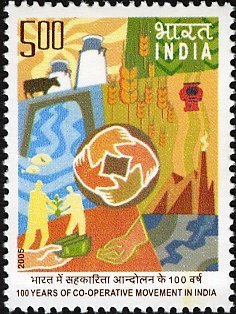
Technical Data
| Date of Issue | May 8, 2005 |
|---|---|
| Denomination | Rs. 5 |
| Quantity | 400,000 |
| Perforation | comb 13¼ |
| Printer | Security Printing Press, Nashik |
| Watermark | No Watermark |
| Colors | Multicolor |
| Catalog Codes |
Michel IN 2090 Stamp Number IN 2107 Yvert et Tellier IN 1855 Stanley Gibbons IN 2274 WADP Numbering System - WNS IN021.05 |
| Themes | Agriculture | Anniversaries and Jubilees | Industry | Stylized Figures / Persons | Stylized Objects | Symbols |
The concept of cooperation has deep roots in Indian civilization. The spirit of collective effort and mutual assistance can be traced back to ancient texts such as the Vedas and Upanishads, where the ideals of working together for the common good were strongly emphasized. Over time, these principles evolved into an organized economic framework known as the cooperative movement.
Origins of the Cooperative Movement
Towards the end of the nineteenth century, rural India faced severe problems of indebtedness among farmers. The lack of access to affordable credit forced many farmers into financial distress. In this situation, the idea of cooperative societies emerged as an effective mechanism through which farmers could pool their limited resources and collectively address common problems related to credit, agricultural inputs, and marketing of produce.
Based on early experiences with such initiatives, the Government enacted the Co-operative Credit Societies Act, 1904, marking the formal beginning of the cooperative movement in India.
First Cooperative Society in India
Under this Act, the first cooperative society in the country was established at Kanaginahal in Gadag District, Karnataka. Known as the Agricultural Credit Cooperative Society of Kanaginahal Village, it was formed on 8 May 1905 under the leadership of Siddanagowda Sannaramanagowda Patil.
The society began with an initial share capital of just ₹2,000 contributed by villagers. The success of this initiative inspired the formation of similar cooperative societies across the country.
Growth After Independence
After India gained independence in 1947, the cooperative movement was recognized as an important institutional framework for promoting economic development and social justice. With the adoption of economic planning, cooperatives were encouraged as a means to strengthen rural economies and empower communities.
Over the decades, the movement expanded dramatically. Today, India has the largest cooperative network in the world, with more than half a million cooperative societies and about 230 million members. These cooperatives cover almost all villages and a majority of rural households.
Contributions to the Indian Economy
The cooperative sector has played a significant role in many areas of the Indian economy, including:
- Credit and banking
- Agricultural marketing and processing
- Distribution and storage
- Dairy and milk production
- Sugar production
- Handloom and handicrafts
- Fisheries
- Housing and tourism
- Labour and healthcare services
Cooperatives contribute substantially to agricultural development. They provide nearly 46 percent of total agricultural credit in the country and produce about 28 percent of the total fertilizer supply while distributing around 36 percent. In the sugar industry, cooperatives account for about 59 percent of production, and they hold nearly 60 percent share in cotton marketing and distribution.
The cooperative model has also been instrumental in making India the world’s largest producer of milk, largely due to the successful cooperative dairy system adopted across the country.
Role of the National Cooperative Union of India
The National Cooperative Union of India serves as the apex body responsible for promoting and strengthening the cooperative movement. It works to guide cooperative institutions and support their development across different sectors.
In the era of globalization and economic liberalization, cooperatives are adapting to changing market conditions. The Government of India has also introduced several measures, including constitutional reforms, to ensure that cooperatives function autonomously, democratically, and professionally.
Commemorative Postage Stamp
To mark the Centenary of the Cooperative Movement in India, India Post issued a commemorative postage stamp celebrating the remarkable contribution of cooperatives in strengthening the economy and improving the quality of life of millions of people across the country.