
Damodar Kosambi
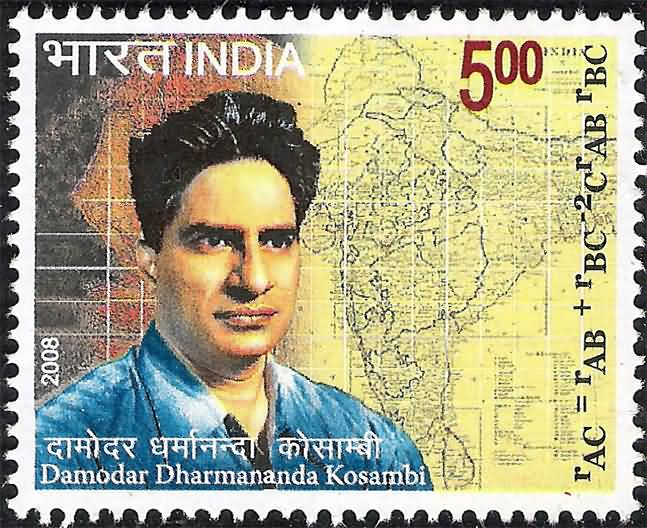
Technical Data
| Date of Issue | July 31, 2008 |
|---|---|
| Denomination | Rs. 5 |
| Quantity | 400,000 |
| Perforation | 13 |
| Printer | Security Printing Press, Hyderabad |
| Printing Process | Wet Offset |
| Watermark | No Watermark |
| Colors | Multicolor |
| Credit (Designed By) | Mr. Suresh Kumar |
| Catalog Codes |
Michel IN 2280 Stamp Number IN 2248 Stanley Gibbons IN 2487 WADP Numbering System - WNS IN024.2008 |
| Themes | Anniversaries and Jubilees | Famous people | Maps | Mathematicians | Men |
Damodar Dharmananda Kosambi was a distinguished mathematician, statistician, Sanskritist, historian, and polymath whose contributions spanned genetics, numismatics, archaeology, and the critical study of ancient Indian texts. He is particularly remembered in genetics for introducing the celebrated Kosambi’s Map Function, a fundamental concept in linkage mapping.
Early Life and Education
Kosambi was born in 1907 at Kosben in Goa. After initial schooling in India, he travelled to the United States in 1918. He studied at the Cambridge High and Latin School and later secured admission to Harvard University in 1924, earning exemption from the entrance examination on merit.
At Harvard, he studied mathematics under the eminent mathematician George David Birkhoff. Although Birkhoff encouraged him to specialize strictly in mathematics, Kosambi’s intellectual curiosity led him to pursue diverse subjects, excelling in all. In 1929, he graduated with a Bachelor of Arts degree summa cum laude and was inducted into the prestigious Phi Beta Kappa Society.
Academic Career in India
Upon returning to India, Kosambi joined Banaras Hindu University as a Professor, where he taught both Mathematics and German. In 1930, he published his first research paper, “Precession of an Elliptic Orbit,” in the Indian Journal of Physics.
In 1931, he married Nalini and joined Aligarh Muslim University. During his two-year tenure there, he produced eight research papers in differential geometry and path spaces, publishing in French, Italian, and German journals owing to his proficiency in European languages.
In 1933, he moved to Fergusson College, Pune, under the Deccan Education Society, where he taught mathematics for twelve years.
Contributions to Mathematics, Statistics, and Genetics
In 1944, Kosambi published a landmark four-page paper titled “The Estimation of Map Distance from Recombination Values” in the Annals of Eugenics. This paper introduced what later became known as Kosambi’s Map Function, a key tool in genetics for estimating recombination frequencies and genetic distances.
He also made a lasting contribution to statistics through the technique now widely known as Proper Orthogonal Decomposition (POD).
Association with TIFR and Scientific Research
In 1945, Kosambi was invited by Homi J. Bhabha to join the Tata Institute of Fundamental Research (TIFR) as Professor of Mathematics. During 1948–49, he travelled to England and the United States as a UNESCO Fellow to study early developments in computer science.
Historian and Peace Activist
Gradually, Kosambi’s interests expanded toward Indian history and culture. His pathbreaking book, An Introduction to the Study of Indian History (1956), revolutionized the methodology of historical research in India by integrating archaeology, numismatics, and socio-economic analysis.
After leaving TIFR in 1962, he focused on historical research, culminating in The Culture and Civilization of Ancient India (1965). He also contributed to archaeology and wrote an influential article on mathematics published in Scientific American in February 1965.
In June 1964, he was appointed Scientist Emeritus by the Council of Scientific and Industrial Research (CSIR).
Kosambi was deeply involved in the World Peace Movement, campaigning tirelessly against nuclear proliferation. His activism took him to international forums in Beijing, Helsinki, and Moscow.
Final Years and Legacy
Damodar Dharmananda Kosambi passed away on 29 June 1966 in Pune. In recognition of his scholarly contributions, he was posthumously awarded the ‘Hari Om Ashram’ Award by the University Grants Commission in 1980.
A rare blend of mathematical genius and historical insight, Kosambi left behind a multidisciplinary legacy that continues to inspire scholars across fields.
Commemorative Postage Stamp
To honour the life and achievements of Damodar Dharmananda Kosambi, the Department of Posts has issued a commemorative postage stamp, celebrating his enduring contributions to mathematics, genetics, statistics, and the study of Indian history.
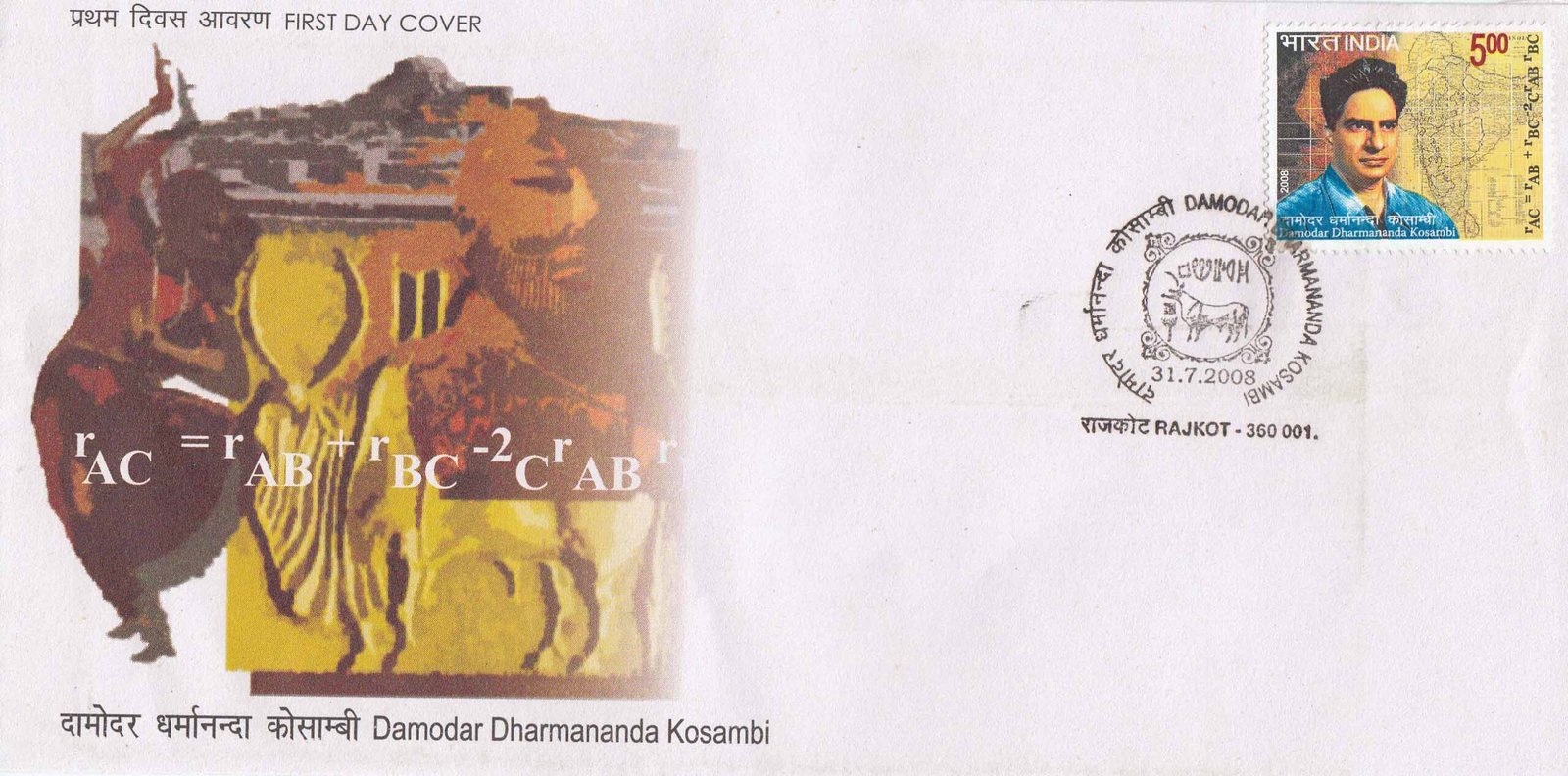
First Day Cover
Leave a Comment
You must be logged in to post a comment.