
Dheeran Chinnamalai (1756-1805)
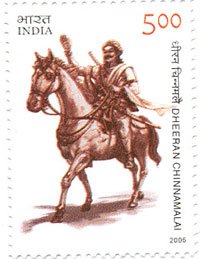
Technical Data
| Date of Issue | July 31, 2005 |
|---|---|
| Denomination | Rs. 5 |
| Quantity | 400,000 |
| Perforation | comb 13¼ x 13½ |
| Printer | Security Printing Press, Nashik |
| Watermark | No Watermark |
| Colors | Multicolor |
| Catalog Codes |
Michel IN 2093 Stamp Number IN 2111 Yvert et Tellier IN 1858 Stanley Gibbons IN 2277 WADP Numbering System - WNS IN024.05 |
| Themes | Animals (Fauna) | Anniversaries and Jubilees | Equestrianism and horse riding | Famous people | Freedom Fighters | Horses | Mammals | Men |
Legendary Freedom Fighter of Tamil Nadu
Dheeran Chinnamalai was one of the earliest and most courageous warriors who resisted British expansion in South India during the late 18th and early 19th centuries. Remembered as a symbol of bravery and patriotism, he fought relentlessly against foreign rule and sacrificed his life for the freedom of his land. His heroic resistance made him a revered figure in the history of India’s freedom struggle.
Early Life and Background
Dheeran Chinnamalai was born on 17 April 1756 at Melapalayam in present-day Erode District to Rathina Sarkarai and Periyatha. He was originally named Theerthagiri. From a young age, he developed the qualities of a warrior and possessed a deep love for freedom and justice.
He later came to be known as “Chinnamalai,” a title he assumed after preventing the collection and transfer of taxes from his region to Hyder Ali, the ruler of the Kingdom of Mysore. His courageous stand against unjust authority earned him admiration and recognition.
Alliance with Tipu Sultan
When Tipu Sultan ascended the throne of Mysore, he learned about Chinnamalai’s bravery and determination. Tipu Sultan supported him in his struggle against the British forces.
With this support, Dheeran Chinnamalai formed a strong fighting force known as the Kongu Army, consisting of around 1,000 brave young warriors from the Kongu region. This army played an important role in resisting British expansion in southern India.
Battles Against the British
Dheeran Chinnamalai participated in several significant battles against the British. His leadership contributed to victories at Chitheswaram and Mazhavalli and in the historic Battle of Srirangapatna.
After the death of Tipu Sultan in 1799, Chinnamalai returned to the Kongu region and established his base at Odanilai. There he constructed a fort and continued his resistance against British rule. Under his leadership, successful battles were fought:
- On the banks of the Cauvery River in 1801
- At Odanilai in 1802
- At Arachalur in 1804
These victories strengthened the spirit of resistance in the region.
Guerrilla Warfare and Capture
To avoid attacks from British artillery, Dheeran Chinnamalai abandoned his fort and adopted guerrilla warfare strategies from the hills of Karumalai in the Palani Hills. Despite his clever tactics and courage, the British eventually captured him through betrayal.
It is said that his cook revealed his location to the British forces. As a result, the brave warrior was arrested and later executed.
Martyrdom and Legacy
Dheeran Chinnamalai was hanged on 31 July 1805 at Sankagiri, now part of Salem District. His martyrdom became a powerful symbol of resistance against colonial rule.
Beyond his military achievements, Chinnamalai believed strongly in harmony among communities and castes. He treated people from all backgrounds with equal respect and worked for social unity. He also participated actively in religious and cultural activities, building shrines at Arachalur, Anoor, Melapalayam, and Sivanmalai.
In addition, he contributed to agricultural development by promoting the cultivation of the Sirumalai plantain variety in the Palani Hills.
Commemorative Postage Stamp
To honor the bravery, sacrifice, and enduring legacy of this legendary warrior, India Post issued a commemorative postage stamp on Dheeran Chinnamalai, recognizing him as an icon of valor and patriotism in India’s freedom struggle.
Leave a Comment
You must be logged in to post a comment.