
Dineshnandini Dalmia
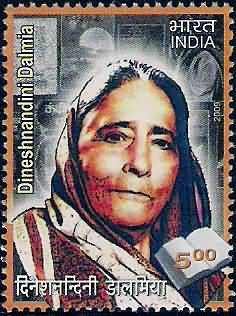
Technical Data
| Date of Issue | October 11, 2009 |
|---|---|
| Denomination | Rs. 5 |
| Quantity | 400,000 |
| Perforation | 13½ |
| Printer | Security Printing Press, Hyderabad |
| Printing Process | Wet Offset |
| Watermark | No Watermark |
| Colors | Multicolor |
| Credit (Designed By) | Sh. Brahm Prakash |
| Catalog Codes |
Michel IN 2412 Stamp Number IN 2352 Stanley Gibbons IN 2633 WADP Numbering System - WNS IN65.2009 |
| Themes | Authors | Books | Commemoration | Famous people | Literary People (Poets and Writers) | Women |
A Trailblazer in Hindi Literature
Padma Bhushan awardee Dineshnandini Dalmia was a distinguished Hindi poet, novelist, and short story writer whose personal and literary journey marked a bold departure from the conventions of her time. Born on 16 February 1928 in Udaipur, she began writing at the young age of thirteen as Dineshnandini Chordia. After her marriage to noted industrialist Ramkrishna Dalmia, she continued her literary career as Dineshnandini Dalmia.
Her early poem “Niraash Aasha” attracted the attention of eminent poets such as Subhadra Kumari Chauhan and Mahadevi Verma. Her first book, Shabnam, created a deep impression and earned her the Sakseria Award, establishing her as a powerful new voice in Hindi literature.
Pioneer of “Gadya Kavya” and Confessional Poetry
At a time when metered romantic poetry dominated Hindi literary circles, Dineshnandini Dalmia broke new ground by pioneering Gadya Kavya—a distinctive form of prose poetry. She also became the first woman poet in Hindi literature to write confessional poetry, fearlessly expressing personal emotions and experiences.
While romanticism influenced her language and emotional intensity, her style stood apart for its originality, depth, and boldness. Through her innovative craft and thematic exploration, she differed significantly from both her predecessors and contemporaries.
Voice of Women and Social Reform
Her works reflect profound sensitivity toward women’s struggles and aspirations. She explored the inner and outer worlds of women in Indian society with rare insight and empathy, earning an unrivalled place in Hindi literature.
As Rajasthan’s first postgraduate woman, she challenged social norms, rebelled against the purdah system, and opposed gender discrimination in education and society. A firebrand author and a quintessential feminist of her era, she lived her convictions through her writing and personal life.
Literary Contributions and Recognitions
Author of over 35 novels and an equal number of poetic works, she remained creatively active across generations, keeping her literary idiom contemporary and relevant. Her notable work Mujhe Maaf Karna received the Prem Chand Award, and her novel Phool Ka Dard was adapted into a critically acclaimed telefilm.
She was the founder member and President of several cultural and literary bodies, including the Institute of Comparative Religion and Literature, Indo-China Friendship Society, and Lekhika Sangh. She also served as Chief Editor of the magazine Richa.
In recognition of her immense contribution to literature, she was conferred the Padma Bhushan in 2006. She received a Doctorate in 2005 from Rani Durgavati University, Jabalpur, and was honoured with the Mahila Sashaktikaran Puraskar in 2001 by the Hindi Sahitya Akademy, Delhi.
Enduring Legacy
Dineshnandini Dalmia’s life story—courageous, unconventional, and creative—has a fictional aura reflected throughout her literary works. She remains a symbol of fearless expression and women’s empowerment in Hindi literature.
A commemorative postage stamp has been issued in her honour, celebrating her remarkable literary achievements and her enduring contribution to Indian literature.
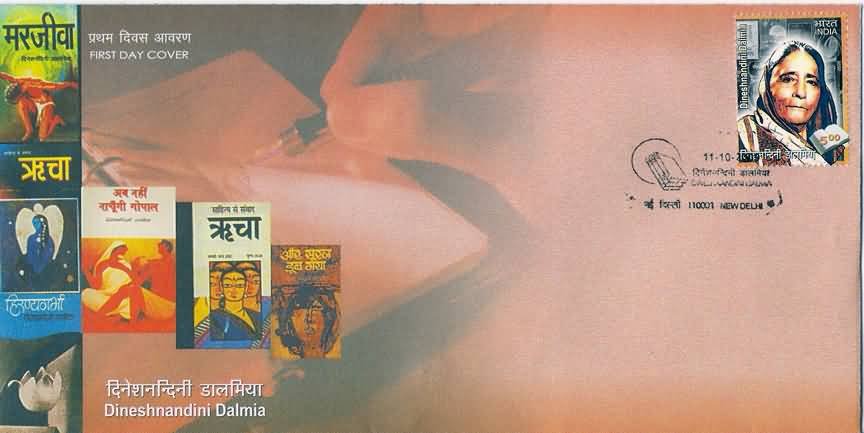
First Day Cover
Leave a Comment
You must be logged in to post a comment.