
Diplomatic Relations Between India and The Republic of Korea
Technical Data
| Date of Issue | December 10, 2003 |
|---|---|
| Denomination | Rs. 30 |
| Perforation | comb 13 x 13½ |
| Printer | Calcutta Security Printers Ltd |
| Printing Process | Offset Lithography |
| Watermark | No Watermark |
| Colors | Multicolor |
| Credit (Designed By) | Sh. Bharati Mirchandani Smt. Alka Sharma |
| Catalog Codes |
Michel IN 2003-2004 Stamp Number IN 2042 Yvert et Tellier IN 1768-1769 Stanley Gibbons IN 2179a |
| Themes | Anniversaries and Jubilees | Architecture | Astronomy | Joint Issues | Observatories | UNESCO World Heritage Sites |
Stamps in this Se-Tenant
Ancient Observatories
Historical and Cultural Ties
India and the South Korea share long-standing ties of friendship rooted in a common Asian heritage. Historical interactions between the peoples of the two countries are believed to date back many centuries. According to the Korean historical chronicle Samguk Yusa, King Kim Suro married a princess from Ayodhya, symbolizing an early cultural connection between the two civilizations.
Another important factor strengthening these ties was the spread of Buddhism from India to Korea. This religious and cultural exchange fostered closer people-to-people contacts and strengthened the historical bond between the two nations.
Modern Diplomatic Relations
Today, relations between India and South Korea are based on shared values such as democracy, freedom, and economic cooperation. Over the years, several institutional mechanisms have been established to promote regular dialogue and cooperation on matters of mutual interest.
India’s Look East Policy also recognizes South Korea as an important partner in strengthening political and economic ties in the Asian region. India also played a constructive role during the Korean War, supporting the United Nations in its peacekeeping efforts on the Korean Peninsula.
Trade and Economic Cooperation
Trade and investment have become key aspects of the bilateral relationship. By 2002–03, total trade between the two countries had reached approximately US$ 2.2 billion, and economic cooperation has continued to grow steadily. South Korean investment in India has also expanded significantly, reaching nearly US$ 3 billion in cumulative approved investments.
Both countries have also developed fruitful cooperation in sectors such as Information Technology, highlighting their complementary economic strengths.
Philatelic Collaboration
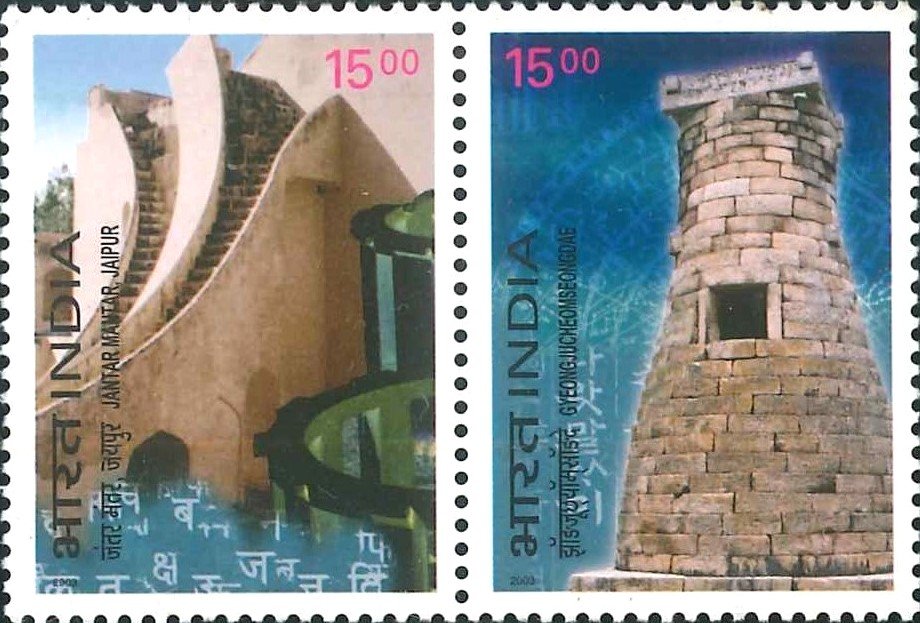
Marking 30 years of diplomatic relations, the postal administrations of the two countries jointly issued a special set of commemorative stamps. This joint philatelic venture symbolizes friendship and aims to promote deeper mutual understanding between the people of the two nations.
The se-tenant stamp set features ancient astronomical observatories from each country, reflecting their historical achievements in astronomy.
Cheomseongdae Observatory – Korea
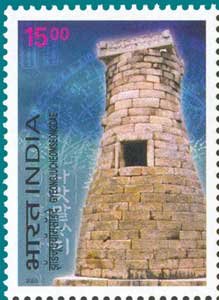
The Korean stamp depicts the Cheomseongdae Observatory, located in Gyeongju. Built in 647 A.D. during the reign of Queen Seondeok of the Silla, the structure stands about 9.17 metres high and is believed to be the oldest surviving astronomical observatory in East Asia.
Cheomseongdae served as an important astronomical observation centre, helping scholars study celestial movements. Astronomy played a crucial role in agriculture by determining farming seasons, and it was also linked to governance, as celestial observations were believed to predict the fortunes of the nation.
Jantar Mantar – Jaipur
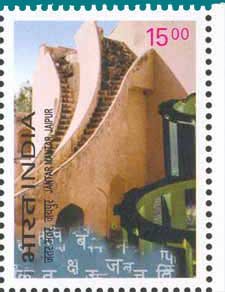
The Indian stamp features the famous Jantar Mantar in Jaipur. The observatory was constructed in 1728 A.D. by Maharaja Sawai Jai Singh II, a ruler with a deep passion for astronomy.
The term “Jantar” is derived from the Sanskrit word Yantra meaning instrument, while “Mantar” refers to a formula or calculation used in astronomical and mathematical studies. Built about 431 metres above mean sea level, the observatory contains several architectural instruments used to observe celestial bodies, prepare astronomical tables, and produce calendars and almanacs.
Located near the City Palace Jaipur, it enabled the astronomer-king to conduct regular celestial observations. The observatory later underwent restoration in 1901 under Maharaja Sawai Madho Singh II and continues to serve as a site for demonstrating astronomical principles.
Commemorative Postage Stamp
To celebrate the 30th Anniversary of Diplomatic Relations between India and South Korea, India Post and its Korean counterpart issued a set of two commemorative postage stamps featuring these historic observatories. This joint issue highlights the scientific achievements of both civilizations and conveys a message of continued friendship, cooperation, and partnership between the two nations in the 21st century.