
Cheomseongdae Astronomical Observatory, Gyeoingju
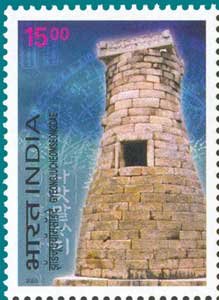
Technical Data
| Date of Issue | December 10, 2003 |
|---|---|
| Denomination | Rs. 15 |
| Perforation | comb 13 x 13½ |
| Printer | Calcutta Security Printers Ltd |
| Printing Process | Offset Lithography |
| Watermark | No Watermark |
| Colors | Multicolor |
| Credit (Designed By) | Sh. Bharati Mirchandani Smt. Alka Sharma |
| Catalog Codes |
Michel IN 2004 Stamp Number IN 2042b Yvert et Tellier IN 1768 Stanley Gibbons IN 2179 WADP Numbering System - WNS IN060.03 |
| Themes | Anniversaries and Jubilees | Architecture | Astronomy | Joint Issues | Observatories | Towers | UNESCO World Heritage Sites |
Introduction
The Cheomseongdae Observatory is one of the oldest surviving astronomical observatories in East Asia. Located in Gyeongju, it represents the advanced scientific knowledge and interest in astronomy that existed in ancient Korea.
Historical Background
The observatory was constructed in 647 A.D. during the reign of Queen Seondeok of the Silla dynasty. Built as an astronomical observation centre, Cheomseongdae played an important role in studying celestial bodies and monitoring the movements of stars and planets.
Standing about 9.17 metres high, the structure is considered one of the earliest scientific installations dedicated to astronomical observations in the region.
Purpose and Use
Cheomseongdae served as an important centre for astronomical studies in the Silla kingdom. Astronomers used the observatory to observe the sky and record the movement of celestial bodies. These observations were useful for several purposes, including:
- Determining the appropriate time for agricultural activities
- Preparing calendars and recording seasonal changes
- Predicting events believed to influence the fortune of the nation
Astronomy and Society
In ancient Korea, astronomy was closely linked with agriculture and governance. Farmers depended on astronomical observations to determine the right time for sowing and harvesting crops. At the same time, rulers believed that celestial phenomena could indicate the prosperity or misfortune of the kingdom. Because of this strong connection between astronomy, agriculture and politics, observatories like Cheomseongdae were of great national importance.
Cultural and Scientific Significance
Cheomseongdae reflects the scientific achievements of the Silla period and highlights the importance given to astronomy in ancient Korean society. The observatory remains an important historical monument and continues to attract scholars, historians and visitors interested in Korea’s scientific heritage.
Philatelic Recognition
To commemorate the 30th anniversary of diplomatic relations between India and South Korea, India Post issued a joint set of commemorative postage stamps featuring ancient observatories of both countries. The Korean stamp depicts Cheomseongdae Observatory, while the Indian stamp highlights the Jantar Mantar in Jaipur.
Conclusion
The Cheomseongdae Astronomical Observatory stands as a symbol of Korea’s early achievements in astronomy and scientific thought. Its historical importance and architectural uniqueness continue to reflect the advanced knowledge and cultural heritage of the Silla kingdom.