
Jantar Mantar Astronomical Observatory, Jaipur
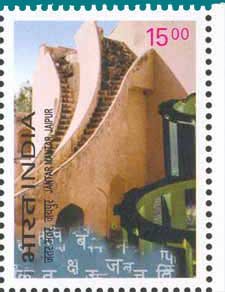
Technical Data
| Date of Issue | December 10, 2003 |
|---|---|
| Denomination | Rs. 15 |
| Perforation | comb 13 x 13½ |
| Printer | Calcutta Security Printers Ltd |
| Printing Process | Offset Lithography |
| Watermark | No Watermark |
| Colors | Multicolor |
| Credit (Designed By) | Sh. Bharati Mirchandani Smt. Alka Sharma |
| Catalog Codes |
Michel IN 2003 Stamp Number IN 2042a Yvert et Tellier IN 1769 Stanley Gibbons IN 2180 WADP Numbering System - WNS IN061.03 |
| Themes | Anniversaries and Jubilees | Architecture | Astronomy | Joint Issues | Observatories | UNESCO World Heritage Sites |
Introduction
The Jantar Mantar at Jaipur is one of the most remarkable astronomical observatories in India. It reflects the advanced scientific knowledge and keen interest in astronomy that existed in India during the early eighteenth century. Built with large masonry instruments, the observatory was designed to study celestial bodies and improve astronomical calculations.
Etymology
The name Jantar Mantar is derived from Sanskrit words. The word “Yantra”, meaning an instrument, evolved into “Jantar” in the local dialect. The word “Mantra” or “Mantar” refers to a formula or calculation used in astronomy, mathematics and even spiritual practices. Together, the term symbolises instruments used for precise astronomical measurements and calculations.
Construction and Location
The observatory was constructed in 1728 A.D. by Maharaja Sawai Jai Singh II, the ruler of Jaipur who had a deep passion for astronomy. It stands about 431 metres above mean sea level and is located near the City Palace Jaipur, enabling the ruler to observe celestial phenomena conveniently.
Purpose of the Observatory
The main objectives behind the construction of the observatory were:
- To popularise the study of celestial bodies
- To carry out precise astronomical observations
- To prepare ephemeris, almanacs and calendars
- To advance scientific knowledge of astronomy
The instruments built at Jantar Mantar were designed to track the movement of celestial bodies and measure time with remarkable accuracy.
Scientific Importance
Jantar Mantar represents a major scientific achievement of its time. Its monumental instruments allowed astronomers to observe the sky and perform calculations related to planetary movements and astronomical events. Because of its advanced design and accuracy, the observatory attracted both Indian and European scholars, becoming an important centre for astronomical studies.
Restoration and Present Significance
The observatory was restored in 1901 under the orders of Maharaja Sawai Madho Singh II. Even today, it remains an important site for demonstrating astronomical principles and is used as a practical learning centre for students and enthusiasts of astronomy.
Philatelic Recognition
To highlight the rich scientific heritage of India and its cultural ties with South Korea, India Post issued a commemorative postage stamp featuring the Jantar Mantar observatory as part of a joint issue celebrating the 30th anniversary of diplomatic relations between India and South Korea. The stamp also showcased Korea’s ancient Cheomseongdae Observatory, symbolising the scientific achievements of both civilizations.
Conclusion
The Jantar Mantar Astronomical Observatory stands as a magnificent example of India’s historical achievements in science and astronomy. Built through the vision of Maharaja Sawai Jai Singh II, it continues to inspire scholars and visitors while preserving the legacy of India’s rich astronomical tradition.