
Dr Guduru Venkatachalam

Technical Data
| Date of Issue | May 8, 2010 |
|---|---|
| Denomination | Rs. 5 |
| Quantity | 300,000 |
| Perforation | 13 |
| Printer | India Security Press, Nasik |
| Printing Process | Photo Gravure |
| Watermark | No Watermark |
| Colors | Multicolor |
| Credit (Designed By) | Smt. Alka Sharma |
| Catalog Codes |
Michel IN 2481 Stamp Number IN 2419 Stanley Gibbons IN 2710 WADP Numbering System - WNS IN026.2010 |
| Themes | Agriculture | Anniversaries and Jubilees | Crops | Famous people | Men | Optical Instruments | Scientists |
Early Life and Education
Guduru Venkata Chalam was born in 1909 into a middle-class family and became deeply involved in social reform activities and the Non-Cooperation Movement of the 1920s. He received his early education in Gudivada and Rajahmundry, completed his graduation and post-graduation at Kakinada, and pursued higher studies at Banaras Hindu University.
As a student, he actively participated in the freedom struggle and was imprisoned for 14 months. After his release, he continued his academic pursuits, undertaking doctoral studies at Banaras Hindu University and the Indian Agricultural Research Institute in Agricultural Botany.
Contributions to Agricultural Science
Dr. Chalam joined the Orissa Agricultural Department as a Research Assistant, where he developed several high-yielding strains of rice. He later became the first Professor of Agricultural Botany at the Orissa Agricultural College. As an Economic Botanist and Paddy Specialist of Orissa, he managed the Japonica/Indica Hybridization Scheme sponsored by the Food and Agriculture Organization (FAO), resulting in the development of promising rice hybrids.
Role in India’s Seed Development Programmes
In 1960, Dr. Chalam joined the Union Ministry of Food and Agriculture and organized major seed production and training programmes in collaboration with the Rockefeller Foundation and the Ford Foundation. He attended the International Seed Testing Seminar in New Zealand and, on his return, brought samples of the Taichung Native-I seed from the International Rice Research Institute.
Despite facing opposition, he championed the introduction of this high-yielding variety in India. As a result, yields of 6000 to 7000 pounds per acre became common in many regions, significantly contributing to agricultural productivity.
Leadership, Publications and Recognition
Dr. Chalam served as the first Member-Secretary of the Central Variety Release Committee, the forerunner of the Statutory Central Seed Committee. He was also a member of the Co-opted Team on Agricultural Implements of the Planning Commission.
An accomplished scholar, he authored over 40 scientific papers and several popular articles. His Telugu book on rice cultivation, Vari Sagu, earned him the prestigious Kavikokila Prize for popularizing scientific agriculture among farmers in Andhra Pradesh. Demonstrating his patriotic spirit, he donated the prize money to the National Defence Fund.
In recognition of his invaluable contributions to India’s agricultural development, Guduru Venkata Chalam was awarded the Padma Shri in 1967 by the Government of India. He passed away on 8 May 1967.
Commemoration
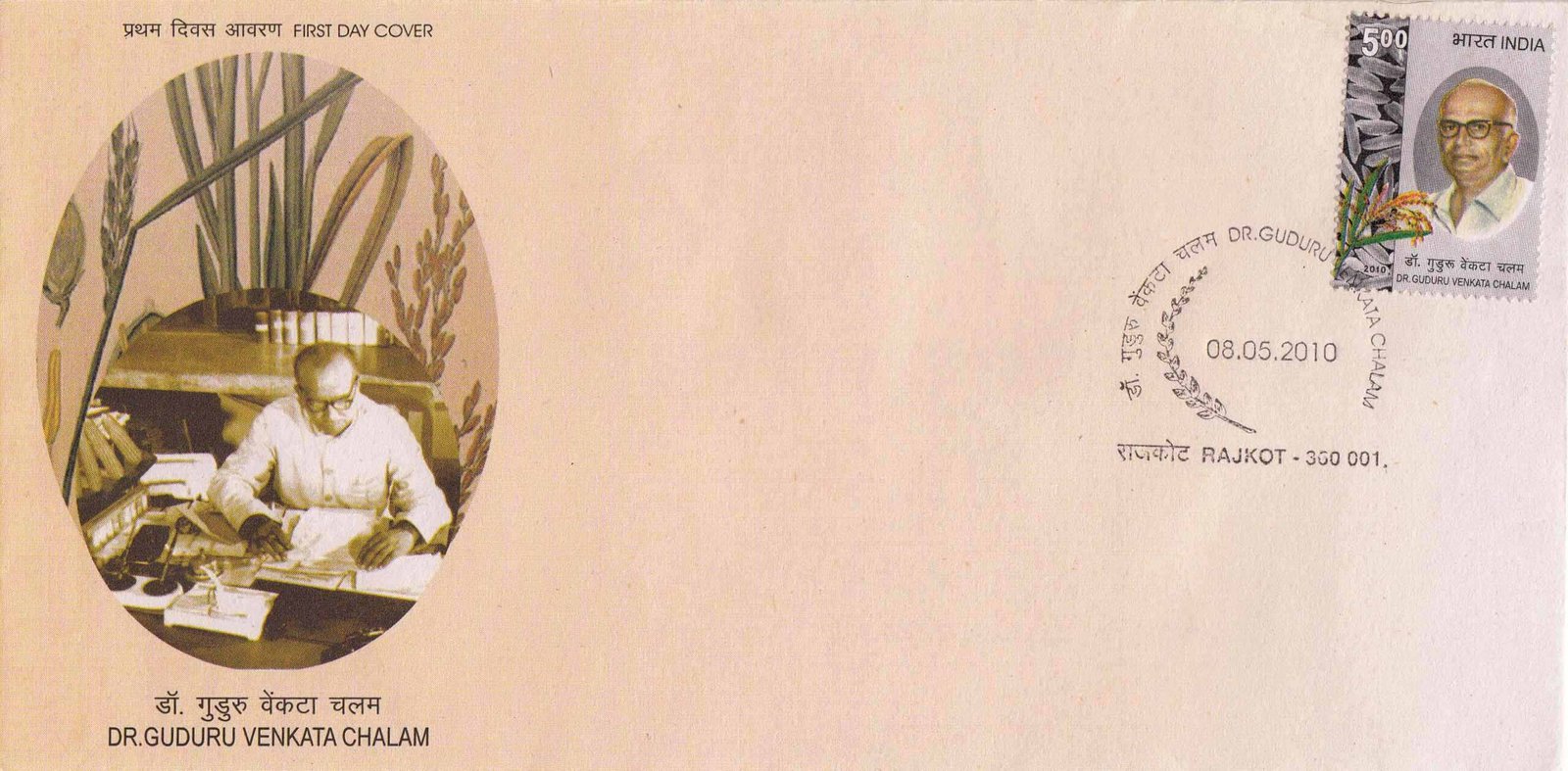
To honour his lasting contributions to agricultural science and national development, the Department of Posts issued a commemorative postage stamp on Guduru Venkata Chalam, celebrating his enduring legacy.
First Day Cover
Leave a Comment
You must be logged in to post a comment.