
Dr. Mahendra Lal Sircar
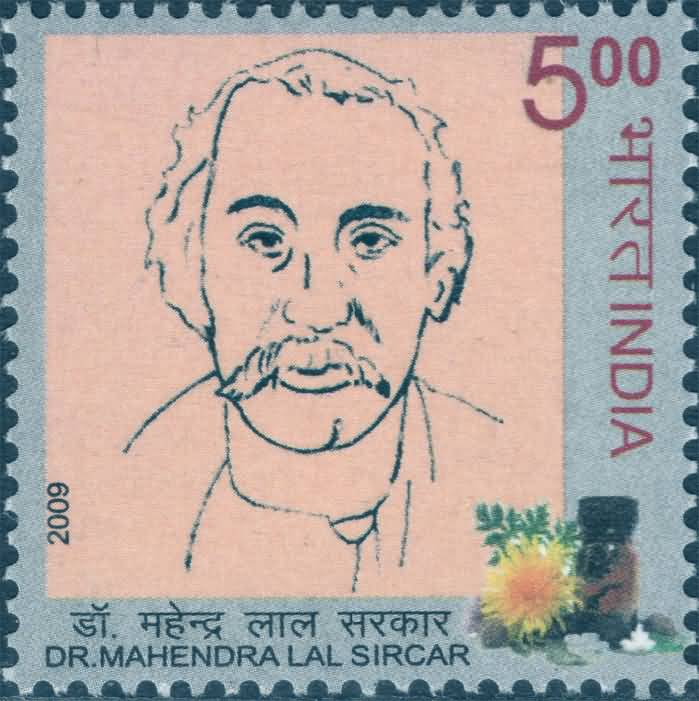
Technical Data
| Date of Issue | November 2, 2009 |
|---|---|
| Denomination | Rs. 5 |
| Quantity | 400,000 |
| Perforation | 13½ |
| Printer | India Security Press, Nasik |
| Printing Process | Photo Gravure |
| Watermark | No Watermark |
| Colors | Multicolor |
| Credit (Designed By) | Smt. Alka Sharma |
| Catalog Codes |
Michel IN 2422 Stamp Number IN 2360 Stanley Gibbons IN 2643 WADP Numbering System - WNS IN074.2009 |
| Themes | Commemoration | Famous people | Men | Physicians |
Physician, Scientist and Institution Builder
Dr. Mahendra Lal Sircar, CIE, MD, DL, was not only one of the greatest homeopaths of his time but also a visionary scientist and institution builder. He was born on 2 November 1833 at Paikpara village in Howrah district near Calcutta (now Kolkata), Bengal Province of British India. Orphaned at an early age, he was brought up by his maternal uncles, Iswar Chandra Ghosh and Mahesh Chandra Ghosh, at Nebutala in Calcutta.
In 1849, he passed the junior scholarship examination and joined Hindu College, studying there until 1854. As the college lacked facilities for science education, he transferred to Calcutta Medical College to pursue medicine. He obtained the IMS degree in 1861 and his MD in 1863 from University of Calcutta, becoming one of its earliest MD graduates.
Turn to Homeopathy
Although trained in Western (allopathic) medicine, Sircar was drawn to homeopathy after reading William Morgan’s The Philosophy of Homeopathy and through his association with Rajendralal Dutt, a leading homeopath of Calcutta.
In a bold move, he publicly declared homeopathy superior to contemporary Western medicine at a meeting of the Bengal branch of the British Medical Association. This stance led to professional ostracism and temporary loss of practice. However, his dedication and skill soon restored his reputation, and he emerged as a leading homeopathic practitioner in India.
Among those he treated were eminent personalities such as Bankim Chandra Chattopadhyay, Ramakrishna, and the Maharaja of Tripura.
Founder of Modern Scientific Institution in India
In 1867, Sircar launched a campaign to establish a National Science Association run and funded by Indians. His vision materialised in 1876 with the founding of the Indian Association for the Cultivation of Science (IACS), where he served as the first Director.
The IACS was India’s first national science association. It established departments in Physics, Chemistry, Mathematics, Physiology, Geology, and Botany. Public lectures and demonstrations were organised to popularise science.
The institution later became the platform for distinguished scientists such as:
- C. V. Raman
- K. S. Krishnan
- Meghnad Saha
Advocate of Women’s Education
At a time when women’s higher education was rare in India, Sircar strongly supported it. He backed Abala Bose in her pursuit of medical studies at Madras Medical College when Calcutta Medical College did not admit women. He also facilitated Sarala Devi Chaudhurani in attending evening lectures at IACS to study Physics.
Honours and Final Years
Dr. Sircar was a Fellow of the University of Calcutta, an Honorary Magistrate, and served as Sheriff of Calcutta in 1887. He was appointed Companion of the Order of the Indian Empire (C.I.E.) in 1883 and was awarded an honorary Doctor of Law degree by the University of Calcutta in 1898.
Suffering from recurrent malarial fever and bronchial asthma in his later years, he passed away on 23 February 1904.
Enduring Legacy
Dr. Mahendra Lal Sircar’s life was dedicated to scientific advancement, medical reform, and social progress. As a pioneering physician and founder of India’s first national scientific institution, his contributions laid the groundwork for the development of modern science in India.
India Post proudly commemorates his remarkable legacy by issuing a commemorative postage stamp in his honour.
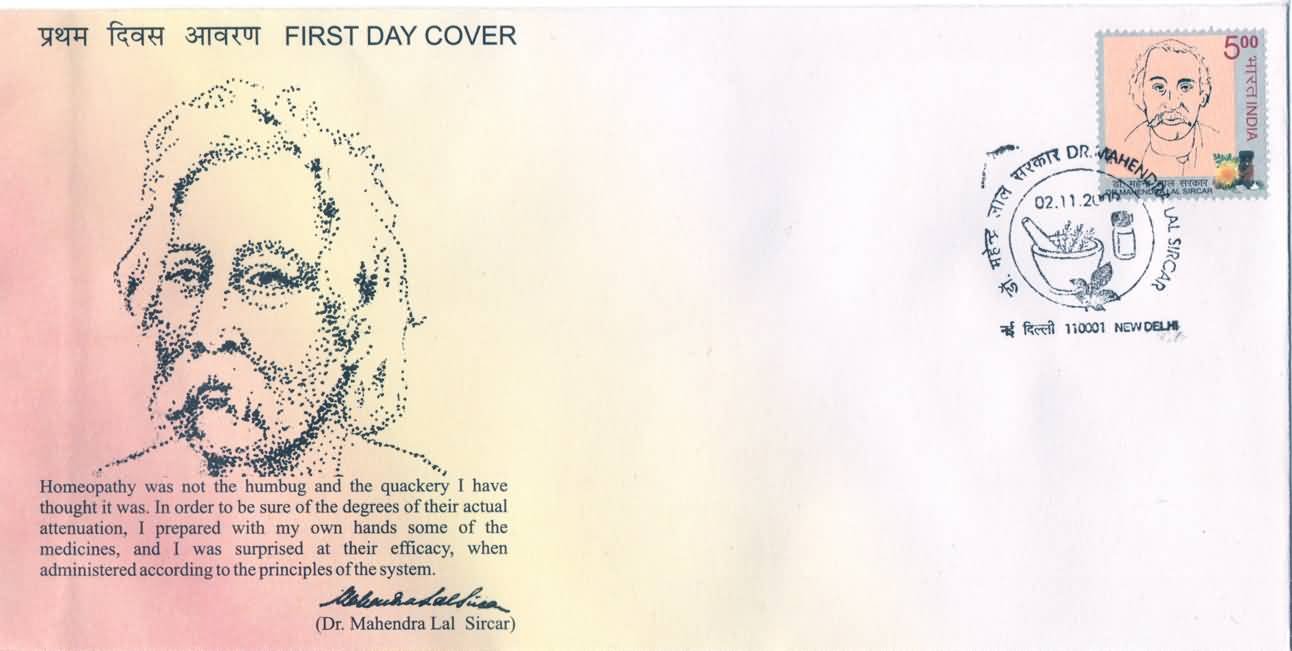
First Day Cover
Leave a Comment
You must be logged in to post a comment.