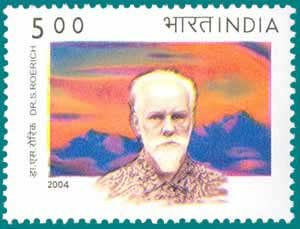
Dr. Svetoslav Roerich (1904-1993)
Technical Data
| Date of Issue | October 27, 2004 |
|---|---|
| Denomination | Rs. 5 |
| Quantity | 600,000 |
| Perforation | comb 13½ |
| Printer | Security Printing Press, Nashik |
| Printing Process | Photogravure |
| Watermark | No Watermark |
| Colors | Multicolor |
| Credit (Designed By) | Sh. Sankha Samanta Smt. Alka Sharma |
| Catalog Codes |
Michel IN 2057 Stamp Number IN 2084 Yvert et Tellier IN 1822 Stanley Gibbons IN 2237 WADP Numbering System - WNS IN043.04 |
| Themes | Anniversaries and Jubilees | Famous people | Men | Painters |
The Russian Artist Who Made India His Home
Svetoslav Roerich was a celebrated painter and cultural figure who built a remarkable artistic bridge between Russia and India. Deeply inspired by India’s culture, landscapes, and spiritual heritage, he spent much of his life in the country and created numerous paintings reflecting its beauty and philosophy.
Early Life and Family Background
Svetoslav Roerich was born on 23 October 1904 in Saint Petersburg. He belonged to a distinguished intellectual family. His father, Nicholas Roerich, was a renowned artist, philosopher, and cultural activist known for his significant contributions to fine arts and humanistic ideas. His mother, Helena Roerich, was also a respected scholar who wrote extensively on spiritual and ethical subjects, including the important role of women in society.
Roerich showed artistic talent from a young age. At just 12 years old, he painted his first portrait of his father, which received great appreciation and marked the beginning of his artistic journey.
Education and Early Career
In 1919, while living in London, Roerich began formal studies in architecture and painting. During this period, he also assisted his father in designing costumes and stage sets for Russian theatre productions.
The family moved to the United States in 1920, where Roerich pursued architectural studies at Columbia University. He later continued his education at the Architectural School of Howard University.
His artistic excellence gained international recognition in 1926, when he won the Grand Prix at an exhibition in Philadelphia celebrating the 150th anniversary of American independence.
Moving to India
After completing his studies in 1931, Svetoslav Roerich moved to India, where his parents had been living since 1923 in Naggar in the scenic Kullu Valley.
He became the Head of the Department studying local pharmacopoeia, flora, and fauna at the scientific institute Urusvati Himalayan Research Institute, established by his father. This institute focused on scientific, cultural, and ethnographic research in the Himalayan region.
Marriage and Life in India
In 1945, Roerich married Devika Rani, a legendary actress often referred to as the First Lady of Indian Cinema and a grand-niece of Rabindranath Tagore.
After the death of Nicholas Roerich in 1947, the couple moved to Bangalore (now Bengaluru). Roerich’s gracious personality and broad outlook helped him develop friendships with many prominent Indian leaders, including Jawaharlal Nehru, Sarvepalli Radhakrishnan, and Sarojini Naidu.
Artistic Vision and Recognition
India deeply influenced Roerich’s artistic vision. Many of his paintings portray the country’s landscapes, majestic mountains, flora, fauna, and cultural heritage. His works often reflect a profound appreciation of Indian spirituality and traditions.
In recognition of his contribution to art and cultural exchange, the Government of India honoured him with the Padma Bhushan in 1961. In the same year, he received an honorary doctorate from the University of Cyril and Methodius in Bulgaria.
Later, in 1987, he was elected a Fellow of the Lalit Kala Akademi, one of the highest honours for artists in India.
Association with Karnataka Chitrakala Parishath
Roerich maintained a lifelong association with the Karnataka Chitrakala Parishath, a major center for visual arts in India. Demonstrating his generosity and commitment to art, he donated 117 paintings, including works by both himself and his father.
To preserve and showcase these masterpieces, the Parishath built two dedicated galleries, creating a permanent exhibition that remains one of the institution’s most valuable collections.
His artistic philosophy and views were later compiled and published in a book titled “Humanism in Art.”
Legacy
Svetoslav Roerich passed away on 30 January 1993. His life and work symbolize a profound cultural connection between India and Russia, reflecting the shared appreciation of art, spirituality, and human values.
In recognition of his extraordinary contribution to art and Indo-Russian cultural relations, India Post issued a commemorative postage stamp in his honour, celebrating the memory of an artist who beautifully united two civilizations through his creative vision.
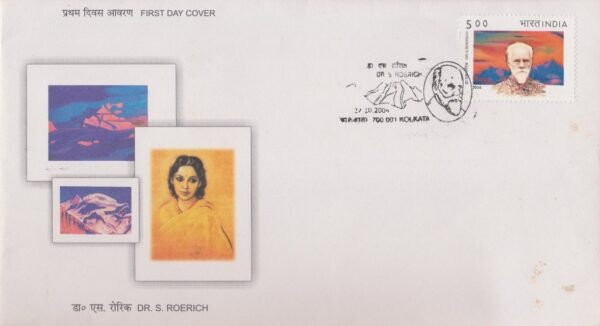
First Day Cover