
Dr. T. S. Soundram (1904-1984)
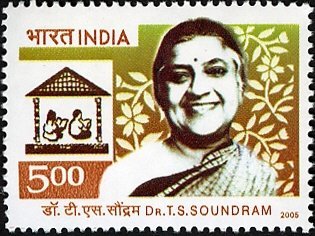
Technical Data
| Date of Issue | October 2, 2005 |
|---|---|
| Denomination | Rs. 5 |
| Quantity | 600,000 |
| Perforation | comb 13¼ |
| Printer | Security Printing Press, Nashik |
| Watermark | No Watermark |
| Colors | Multicolor |
| Catalog Codes |
Michel IN 2098 Stamp Number IN 2116 Yvert et Tellier IN 1863 Stanley Gibbons IN 2282 WADP Numbering System - WNS IN030.05 |
| Themes | Commemoration | Famous people | Politicians | Women |
Pioneer of Women’s Awakening and Social Reform in India
T. S. Soundram was a remarkable leader who played a pioneering role in the awakening and empowerment of women in pre-independence India. A devoted Gandhian, freedom fighter, doctor, social reformer, and parliamentarian, she dedicated her life to uplifting the marginalized and improving the condition of rural communities across the country.
Early Life and Education
Dr. T. S. Soundram was born on 18 August 1904 to T. V. Sundaram Iyengar, a prominent industrialist, and Lakshmi Ammaiyar. According to the social customs of the time, she was married at a young age in 1918 to Dr. Soundararajan, an enlightened and progressive physician.
Tragically, her husband passed away in 1925 while serving victims of a plague epidemic in Madurai. Despite this personal loss, Soundram’s progressive parents encouraged her to pursue higher education. She went on to study medicine at Lady Hardinge Medical College, where she excelled academically.
Association with Gandhi and the Freedom Movement
During her college years in Delhi, she became close friends with Sushila Nayyar, through whom she met Mahatma Gandhi. Inspired by Gandhian ideals, she joined the Indian freedom movement while continuing her medical studies and graduated with distinction in 1936.
While in Delhi, she met Ramachandran, an activist involved in the Harijan movement initiated by Gandhiji. Defying social conventions and her parents’ wishes, she married him on 7 November 1940 with the blessings of Mahatma Gandhi.
Participation in the Quit India Movement
In 1942, Dr. Soundram and her husband actively participated in the Quit India Movement. Recognizing her dedication and leadership, Mahatma Gandhi appointed her as the representative of the Kasturba Gandhi National Memorial Trust in South India.
She was entrusted with establishing a rural institution to serve the most deprived communities by promoting village industries, education, and health services.
Founding of Gandhigram
This vision led to the creation of Gandhigram, formally inaugurated on 7 October 1947. Gandhigram became a major centre for rural development and community empowerment.
Through Gandhigram, Dr. Soundram launched several initiatives focusing on:
- Rural health care
- Education and literacy
- Economic self-reliance
- Social welfare
Among her most cherished projects were Sowbhagya Illam and Sevikashram, which worked for the welfare and empowerment of rural women.
Political Career and National Service
Dr. Soundram also played an important role in public life. She was elected twice to the Legislative Assembly in 1952 and 1957. In 1962, she became a Member of Parliament and was appointed Union Deputy Minister for Education.
During her tenure, she made notable contributions by promoting compulsory and free primary education across India and supporting the development of the National Service Scheme (NSS).
Awards and Recognition
In recognition of her outstanding contributions to social service and national development, Dr. Soundram was awarded the Padma Bhushan in 1962.
Her efforts in raising funds for the National Defence Fund during wartime were highly appreciated, including by Jawaharlal Nehru, the Prime Minister of India at the time.
Legacy
Dr. T. S. Soundram passed away on 21 October 1984. In keeping with her humanitarian values, she had expressed the wish to donate her eyes after her death.
To honour her immense contribution to social reform, women’s empowerment, rural development, and the freedom movement, India Post issued a commemorative postage stamp in her memory.
Dr. T. S. Soundram remains an inspiring figure in India’s history—a pioneer who devoted her life to empowering women, strengthening rural communities, and serving the nation with dedication and compassion.
Leave a Comment
You must be logged in to post a comment.