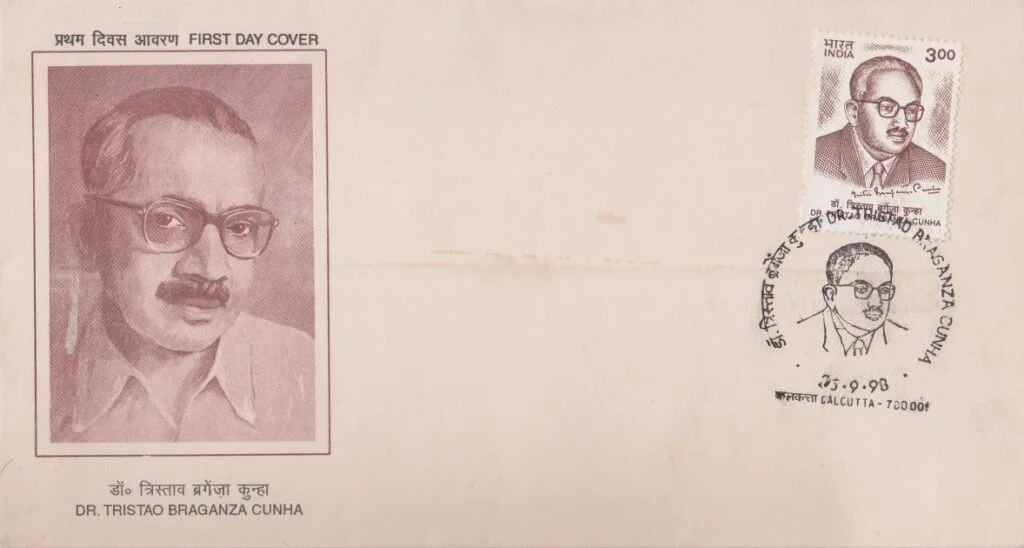
Dr. Tristao Braganza Cunha (1891-1958)
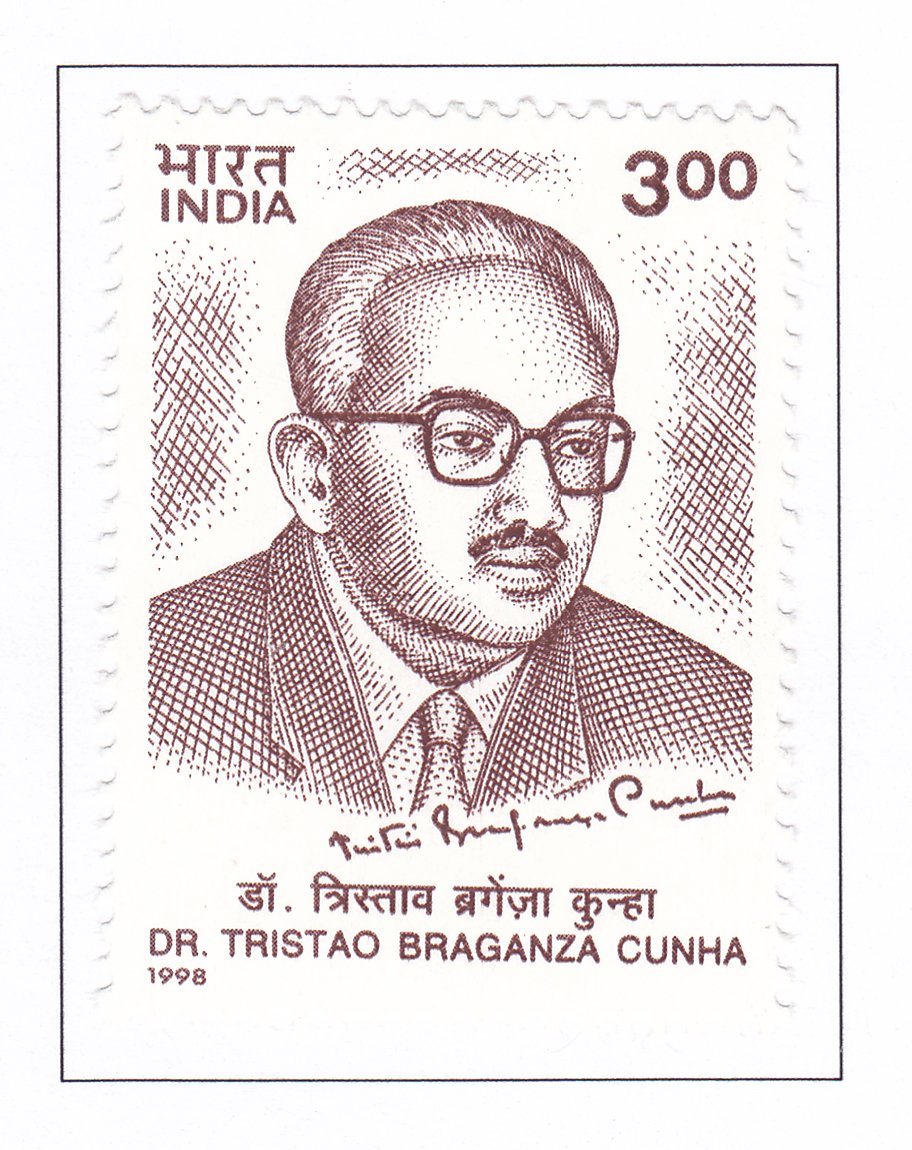
Technical Data
| Date of Issue | September 26, 1998 |
|---|---|
| Denomination | Rs. 3 |
| Quantity | 400,000 |
| Perforation | comb 13 x 13½ |
| Printer | Security Printing Press, Nashik |
| Printing Process | Photogravure |
| Watermark | No Watermark |
| Colors | Chocolate |
| Credit (Designed By) | Sh. Sankha Samanta |
| Catalog Codes |
Michel IN 1648 Stamp Number IN 1708 Yvert et Tellier IN 1413 Stanley Gibbons IN 1811 |
| Themes | Famous people | Men | Optical Instruments |
Father of Goan Nationalism and Freedom Fighter
Tristao de Braganca Cunha is remembered as the Father of Goan Nationalism and one of the foremost leaders of the movement for Goa’s liberation from Portuguese colonial rule. A thinker, writer, humanist, and patriot, he dedicated his life to securing freedom for Goa and its integration with India.
His contribution occupies a significant place in the history of India’s anti-colonial struggle.
Portuguese Rule in Goa
Portugal was the oldest colonial power in India and the last to leave Indian soil.
After the British established control over India, Portugal retained several colonial possessions:
- Goa
- Daman
- Diu
- Dadra and Nagar Haveli
Against this colonial domination, Tristao de Braganca Cunha emerged as the leading voice of resistance.
Early Inspiration and Nationalist Awakening
Tristao de Bragança Cunha was deeply influenced by the rise of Mahatma Gandhi on India’s political stage.
Inspired by Gandhi’s ideals, Cunha resolved to fight for the rights of the people of Goa, who lived under Portuguese oppression.
He actively wrote in French newspapers such as:
- Clarité
- L’Humanité
Through these writings, he supported India’s independence and challenged false colonial narratives, including propaganda around the Jallianwala Bagh Massacre.
Formation of Goa Congress Committee
In 1928, Tristao de Bragança Cunha founded the Goa Congress Committee.
He launched a campaign for:
- Goa’s freedom from Portuguese rule
- Political rights for Goans
- Integration of Goa with India
He firmly believed that Goa was an inseparable part of India and that Goa’s liberation was linked to India’s independence.
At the 43rd Session of the Indian National Congress in Kolkata, he secured affiliation for the Goa Congress Committee.
Civil Disobedience Movement in Goa (1946)
A turning point came on 18 June 1946, when Ram Manohar Lohia launched the Civil Disobedience Movement in Goa.
This inspired Goan nationalists, including Cunha, and triggered a stronger anti-colonial struggle.
Because of his activism, Cunha was targeted by Portuguese authorities.
He was:
- Arrested and beaten on 30 June 1946 after attending a meeting in Margao
- Rearrested on 12 July 1946
- Imprisoned in Aguada Jail
- Tried by a military court on 24 July 1946
He was sentenced to:
- 8 years imprisonment
- Suspension of political rights for 15 years
Later, he was secretly deported to Portugal.
Exile and Return to India
Although released two years early under amnesty, his movements were restricted to Lisbon.
He was not allowed to return to India. However, he managed to secure a tourist passport to Paris and escaped to India on 4 September 1953.
Goa Action Committee and Final Years
Upon arriving in Mumbai, Cunha worked to unite Goan political groups under the Goa Action Committee.
He continued the struggle through journalism and public advocacy by publishing:
- Azad Goem (Konkani newspaper)
- Free Goa (English periodical, first from Belgaum and later Mumbai)
He remained committed to Goa’s freedom until his death on 28 September 1958.
Sadly, he did not live to witness Goa’s liberation in 1961.
International Recognition
As a thinker and humanist, Cunha was respected by notable French intellectuals such as:
- Henri Barbusse
- Romain Rolland
K. M. Panikkar described him as:
“Nationalist India’s first ambassador to France.”
In 1959, he was posthumously honored by the World Peace Council in Stockholm for his contribution to peace and friendship among peoples.
Commemorative Stamp
To honor his sacrifice and contribution, the Department of Posts issued a commemorative postage stamp on the 40th Death Anniversary of Tristao de Braganca Cunha.
Conclusion
Tristao de Braganca Cunha was a fearless patriot who gave voice to Goan aspirations and fought tirelessly against colonial rule. His leadership, writings, and vision laid the foundation for Goa’s eventual liberation. He remains one of the greatest freedom fighters in the history of Goa and India.
First Day Cover