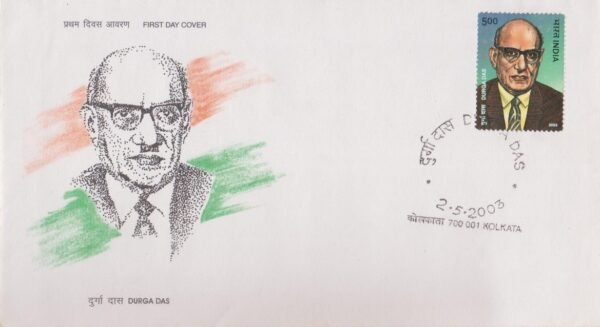
Durga Das (1900-1974)
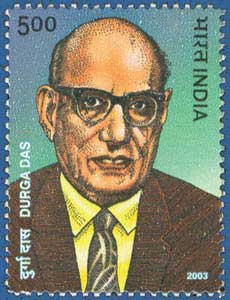
Technical Data
| Date of Issue | May 2, 2003 |
|---|---|
| Quantity | 400,000 |
| Perforation | comb 13 |
| Printer | Security Printing Press, Nashik |
| Printing Process | Photogravure |
| Watermark | No Watermark |
| Colors | Multicolor |
| Credit (Designed By) | Mr. Suresh Kumar |
| Catalog Codes |
Michel IN 1958 Stamp Number IN 2003 Yvert et Tellier IN 1723 Stanley Gibbons IN 2128 WADP Numbering System - WNS IN015.03 |
| Themes | Authors | Commemoration | Famous people | Journalists | Literary People (Poets and Writers) | Literature | Men | Optical Instruments |
Durga Das was a legendary journalist of India who rendered significant service to the national cause through his dedication to journalism. Known for his objectivity, analytical writing and commitment to truth, he played an important role in shaping modern Indian journalism.
Early Life
Durga Das was born in the Jalandhar District of Punjab. From a young age, he developed a strong interest in news reporting and journalism. This passion also drew him towards the Indian Independence Movement, where journalism became a powerful tool to support the national cause.
Journalistic Career
His remarkable career spanned over fifty-five years and can be divided into four major phases.
- From 1919 to 1937, he worked with the Associated Press of India (now Press Trust of India), serving as Chief Parliamentary Correspondent, reporter and editor.
- Between 1937 and 1943, he served as Special Representative and held other roles at The Statesman in Kolkata and Delhi.
- In April 1944, he joined the Hindustan Times as Joint Editor and political columnist, eventually becoming its Chief Editor in 1957.
- Later, on 14 November 1959, he founded the India News and Feature Alliance, a feature agency dedicated to supporting the regional press. He served there as Managing Director, Editor-in-Chief and political columnist.
Journalistic Principles
Durga Das was widely respected for his fairness and objectivity in reporting. His writings were known for their clarity, depth of analysis and constructive editorial insight. As a political columnist, he strongly supported freedom of expression and the importance of dissent in a democratic society. For him, journalism was not merely a profession but a way to serve the nation.
Professional Recognition
Over the years, he held several prestigious positions in the field of journalism, including:
- Chairman of the Press Gallery Committee of the Indian Parliament
- President of the All India Newspaper Editors’ Conference
- Founder-President of the Press Club of India
- Member of the Press Council of India
Literary Contributions
Durga Das also authored important works on Indian politics and international affairs, including:
- India and the World (1958)
- India from Curzon to Nehru and After (1969)
Legacy
In 1969, he established the Durga Das Ratan Devi Trust, which instituted the Durga Ratan Awards to honour excellence in journalism each year. This initiative reflected his lifelong commitment to encouraging high standards in the profession.
Commemoration
To recognise his invaluable contribution to Indian journalism, India Post issued a commemorative postage stamp in honour of Durga Das.
First Day Cover