
Dushyant Kumar
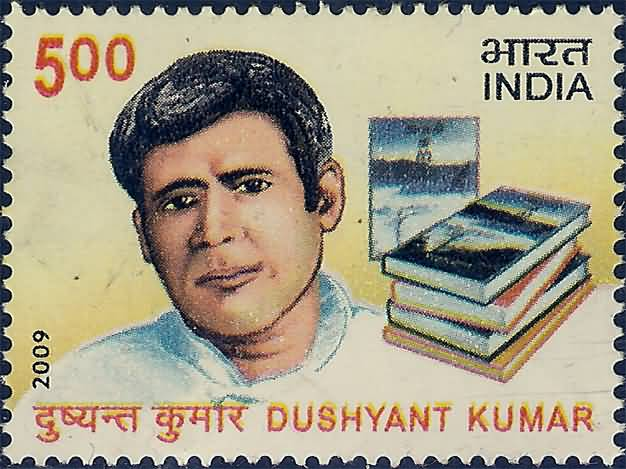
Technical Data
| Date of Issue | September 27, 2009 |
|---|---|
| Denomination | Rs. 5 |
| Quantity | 400,000 |
| Perforation | 13 |
| Printer | India Security Press, Nasik |
| Printing Process | Wet Offset |
| Watermark | No Watermark |
| Colors | Multicolor |
| Credit (Designed By) | Sh. Brahm Prakash |
| Catalog Codes |
Michel IN 2405 Stamp Number IN 2345 Stanley Gibbons IN 2625 WADP Numbering System - WNS IN058.2009 |
| Themes | Authors | Books | Commemoration | Famous people | Literary People (Poets and Writers) | Literature | Men |
The Voice of the Common Man
Dushyant Kumar was born on 27 September 1931 at Rajpur-Nawada in the Bijnor district of Uttar Pradesh, into a landowning agriculturist family. His literary talent was visible from an early age, as he began writing poetry during his high school years. Initially, he composed Geet (lyrical songs), choosing themes that ranged from love and poverty to nationalism and social orthodoxy.
Education and Literary Influences
Dushyant Kumar’s poetic sensibilities matured during his college years, particularly after he joined University of Allahabad, where he completed his M.A. in Hindi Literature in 1954. At that time, Allahabad was a vibrant center of literary activity and marked a turning point in Hindi literature.
During his stay there, he came into contact with eminent literary figures such as:
- Sumitranandan Pant
- Harivansh Rai Bachchan
- Dharamvir Bharati
He also shared close friendships with writers like Kamleshwar and Markandeya.
Professionally, he initially worked with All India Radio and later served in the State Government of Madhya Pradesh.
Poetic Philosophy and Style
Dushyant Kumar firmly believed that poetry achieves its true power only when rooted in real social contexts. He rejected rigid literary schools and dogmas, choosing instead to write in free verse. For him, the “heart” was more important than the “mind,” and “content” more significant than “form.”
He sought a natural, simple idiom that ordinary readers could understand. His poetry aimed at creatively recreating the realities of common life. His collections such as:
- Surya Ka Swagat
- Aawazon Ke Ghere
- Jalte Hue Van Ka Vasant
brought warmth and hope, contrasting with the pessimism prevalent in much contemporary poetry. He famously believed that the reader, not the critic, is the ultimate judge of poetry.
Reinventing the Ghazal
In the early 1970s, Dushyant Kumar revitalized the traditional and intricate form of the Ghazal. Though the ghazal had entered Hindi literature through Urdu and had been written by earlier poets, Dushyant infused it with new life.
Through vivid imagery and powerful language, he addressed both intimate experiences and social realities. He blended simple Hindi and Urdu vocabulary, uniting the literary traditions of both languages. His ghazals gave voice to the struggles of ordinary people and championed democratic and universal human values.
Major Works
Apart from poetry collections, Dushyant Kumar authored:
- The poetry-drama Ek Kanth Vishpayee
- Two novels: Aangan Mein Ek Vriksha and Chote Chote Sawal
- Critical essays and memoirs
His ghazals, compiled in Saaye Mein Dhoop (1975), gained immense popularity. It is often said that after the dohas of Kabir, it is Dushyant Kumar’s couplets that have deeply penetrated public consciousness and remain widely quoted even today.
Legacy and Commemoration
Dushyant Kumar was truly a poet of the common man. His untimely death on 30 December 1975 created an irreplaceable void in Hindi literature.
To honour his literary contribution and enduring impact, a commemorative postage stamp was issued on the occasion of his birth anniversary, celebrating his role in reshaping modern Hindi poetry and the ghazal tradition.
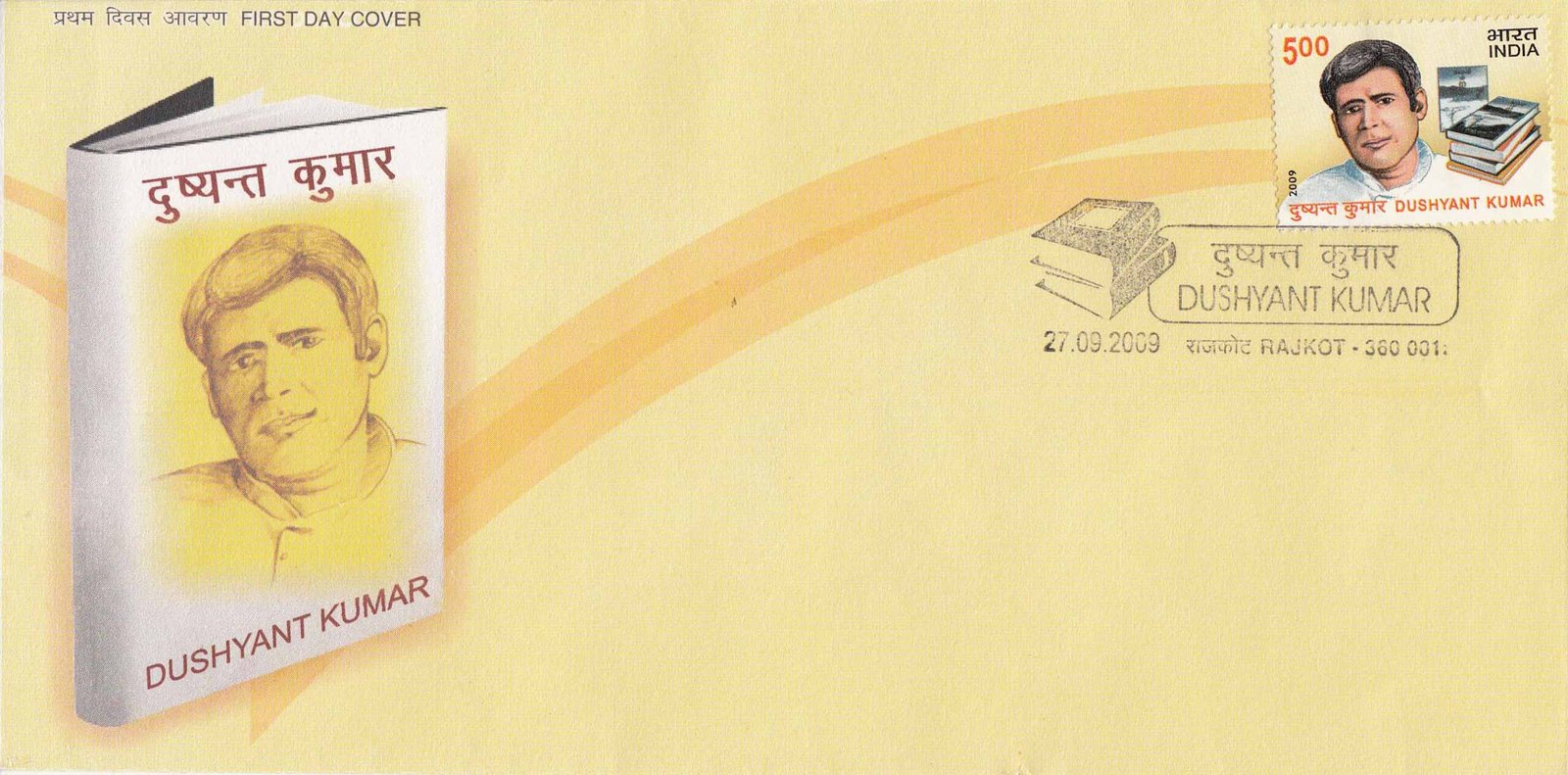
First Day Cover
Leave a Comment
You must be logged in to post a comment.