
Election Commission of India
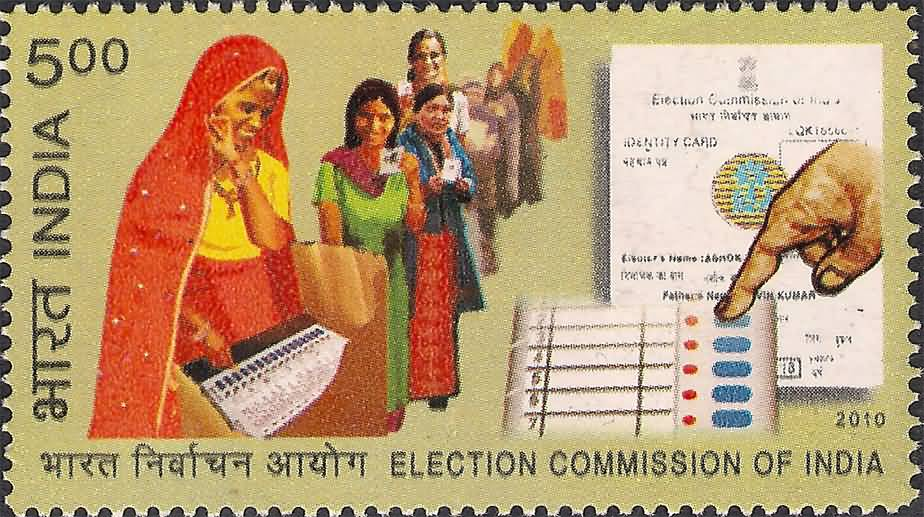
Technical Data
| Date of Issue | January 25, 2010 |
|---|---|
| Denomination | Rs. 5 |
| Quantity | 500,000 |
| Perforation | 13 |
| Printer | India Security Press, Nasik |
| Printing Process | Wet Offset |
| Watermark | No Watermark |
| Colors | Multicolor |
| Credit (Designed By) | Sh. Sankha Samanta |
| Catalog Codes |
Michel IN 2458 Stamp Number IN 2396 Yvert et Tellier IN 2221 Stanley Gibbons IN 2686 WADP Numbering System - WNS IN003.2010 |
| Themes | Anniversaries and Jubilees | Elections | People |
The Election Commission of India (ECI) stands as a cornerstone of India’s democratic framework. Born out of the vision of the Constituent Assembly, it embodies the principle of universal adult suffrage, trusting every Indian citizen to elect their representatives responsibly.
To ensure this democratic ideal, the Constitution under Article 324 established the Election Commission of India, vesting it with the superintendence, direction, and control of elections to Parliament and State Legislatures.
Formation and Early Years
Article 324, the provision creating the Election Commission, came into effect on 26 November 1949, while the rest of the Constitution was enforced on 26 January 1950. The Election Commission office was formally established on 25 January 1950, and Shri Sukumar Sen became the first Chief Election Commissioner on 21 March 1950.
Since its inception, the primary responsibility of the ECI has been to conduct elections to:
- The President of India
- The Vice-President
- The Lok Sabha (Lower House of Parliament)
- The Rajya Sabha (Upper House of Parliament)
- State Legislative Assemblies and Councils
Evolution and Structure
From 1 October 1993, the Commission evolved into a multi-member body, consisting of the Chief Election Commissioner and two Election Commissioners. Currently, the Commission is headed by Chief Election Commissioner Shri Navin B. Chawla, with Dr. S.Y. Quraishi and Shri V.S. Sampath serving as Election Commissioners.
The Constitution safeguards the Election Commission’s independence, insulating it from executive influence. While the secretariat is based in New Delhi, the ECI operates across States and Union Territories through Chief Electoral Officers, who function under the Commission’s direct control.
Functions and Responsibilities
The Election Commission of India plays a critical role in maintaining the integrity of the democratic process. Key functions include:
- Registering political parties and recognizing them as national or state parties
- Adjudicating disputes related to party mergers or splits
- Advising the President and Governors on disqualification of members, except in cases of defection
- Ensuring fair and transparent elections through stringent monitoring and enforcement of electoral laws
Over the past six decades, the ECI has conducted 15 General Elections to the Lok Sabha and 326 State Legislative Assembly elections, ensuring peaceful and orderly democratic transfers of power.
Milestones in Electoral Reforms
The Election Commission has continuously modernized India’s electoral process:
- 1962: Transition from ballot papers to marking system
- Introduction of Electronic Voting Machines (EVMs) for secure and efficient voting
- Shift from multi-member constituencies to single-member constituencies
- Digitization of electoral rolls and issuance of Elector’s Photo Identity Cards (EPIC)
- Over 582 million voters were issued EPICs during the 2009 General Elections
The ECI continues to encourage greater participation, particularly among youth and marginalized communities, through voter education and civil society partnerships.
A Global Benchmark
India’s elections are widely regarded as the largest and most complex democratic exercise in the world, involving an electorate of over 714 million voters in recent Lok Sabha elections. The Commission has successfully managed elections across vast and diverse geographies, climates, languages, and cultures, ensuring every vote counts.
Diamond Jubilee and Continuing Legacy
At its Diamond Jubilee, the Election Commission of India reaffirms its commitment to the vision of India’s founding fathers: empowering the people through free, fair, and transparent elections. Its dedication continues to strengthen the foundations of Indian democracy.
Commemorative Postage Stamp on Election Commission of India
In honor of the Commission’s remarkable journey and its invaluable contribution to Indian democracy, India Post has issued a Commemorative Postage Stamp on the Election Commission of India.
This philatelic tribute celebrates the ECI’s enduring role in upholding the democratic ideals of the nation, ensuring that the voice of every citizen is heard and respected.
First Day Cover

Leave a Comment
You must be logged in to post a comment.