
Greater Adjutant Stork
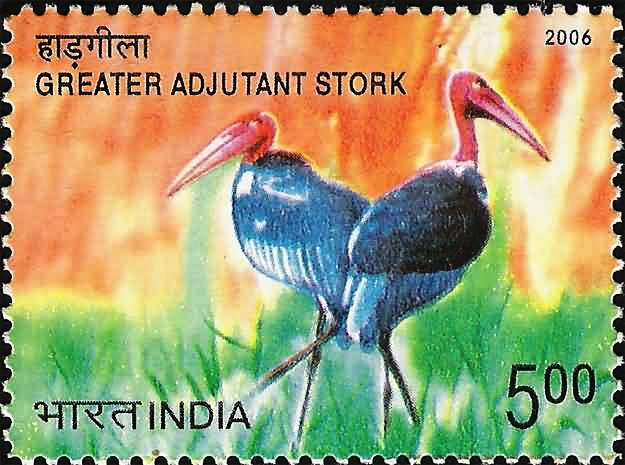
Technical Data
| Date of Issue | October 5, 2006 |
|---|---|
| Denomination | Rs. 5 |
| Quantity | 300,000 |
| Perforation | line13¼ |
| Printer | India Security Press, Nasik |
| Printing Process | Photogravure |
| Watermark | No Watermark |
| Colors | Multicolor |
| Credit (Designed By) | Mr. Suresh Kumar |
| Catalog Codes |
Michel IN 2158 Stamp Number IN 2168a Yvert et Tellier IN 1923 Stanley Gibbons IN 2346 WADP Numbering System - WNS IN038.2006 |
| Themes | Animals (Fauna) | Birds | Storks |
A Majestic Wetland Bird of India
The Greater Adjutant, commonly known as the Greater Adjutant Stork, is a large and impressive wading bird belonging to the stork family Ciconiidae. This rare species is mainly found in the tropical wetlands of northern and north-eastern India, where it inhabits marshes, riverbanks, and floodplain ecosystems.
The Greater Adjutant is a striking bird, typically standing 145 to 150 centimeters tall with a remarkable wingspan of about 250 centimeters. Its large size and distinctive appearance make it one of the most notable wetland birds in the region.
This bird feeds primarily on frogs, fish, reptiles, lizards, and large insects, which it finds in wetlands and surrounding habitats. As a scavenger and predator, the Greater Adjutant plays an important role in maintaining the ecological balance of its environment.
However, the species faces serious threats due to the loss and degradation of wetlands, along with environmental pollution and human disturbances. These factors have contributed to the decline in its population, placing it among the endangered bird species of India.
Philatelic Tribute
To highlight the beauty and ecological significance of such rare birds and promote awareness about wildlife conservation, India Post issued a commemorative postage stamp featuring the Greater Adjutant Stork as part of a special series dedicated to endangered birds of India. The stamp celebrates this remarkable species while reminding us of the urgent need to protect fragile ecosystems and preserve biodiversity.
First Day Cover
