
Evershed Effect
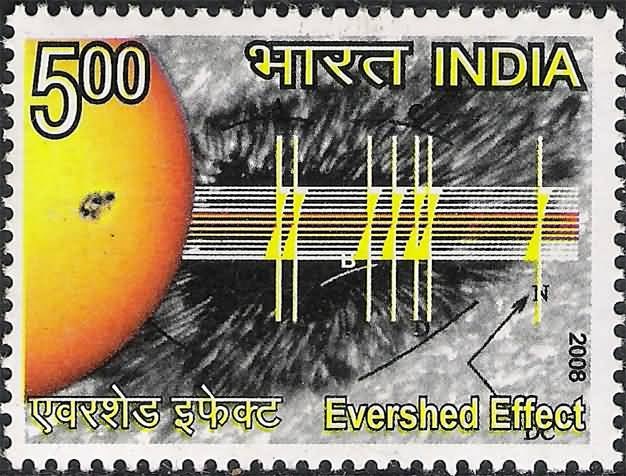
Technical Data
| Date of Issue | December 2, 2008 |
|---|---|
| Denomination | Rs. 5 |
| Quantity | 400,000 |
| Perforation | 14 x 13½ |
| Printer | Security Printing Press, Hyderabad |
| Printing Process | Wet Offset |
| Watermark | No Watermark |
| Colors | Multicolor |
| Credit (Designed By) | Mr. Suresh Kumar |
| Catalog Codes |
Michel IN 2320 Stamp Number IN 2288 Stanley Gibbons IN 2542 WADP Numbering System - WNS IN061.2008 |
| Themes | Anniversaries and Jubilees | Discoveries | Science | Sun |
Centenary of the Discovery of the Evershed Effect
The solar eclipses of 1868 and 1871 played a fundamentally significant role in shaping the development of astrophysics in India. These landmark events inspired the vision to establish a modern observatory at a hill station with ideal atmospheric conditions for solar research. This vision materialized in the establishment of the Kodaikanal Solar Observatory in 1899, which soon emerged as a premier centre for solar studies.
John Evershed and Solar Research in India
John Evershed, one of the foremost solar astronomers of his time, spent the most productive years of his career at Kodaikanal. He served as Assistant Director (1907–1911) and later as Director (1911–1923). Before arriving in India in 1906, Evershed had distinguished himself as a prolific amateur solar observer at his private observatory in Kenley, England, where he recorded over 13,000 solar prominences between 1890 and 1905.
When Evershed joined the observatory, it was already equipped with advanced instruments, including a Cambridge Spectroheliograph. Drawing upon his expertise as an instrument builder, he refined these tools to achieve remarkable clarity in observing the Sun. He soon began detailed studies of sunspot spectra.
Discovery of the Evershed Effect
On the morning of 5 January 1909, under exceptionally steady atmospheric conditions, Evershed observed sunspot spectra that revealed, for the first time, distinct line displacements in the penumbral regions of sunspots. These displacements indicated an outward radial flow of gases within the spots. Further observations two days later confirmed his findings.
This groundbreaking discovery, now known as the Evershed Effect, demonstrated that gases in sunspot penumbrae flow radially outward, parallel to the solar surface. Evershed was also the first to systematically observe sunspots at various positions up to 50 degrees on either side of the Sun’s central meridian, proving that the effect was more pronounced near the solar limb.
The Evershed Effect became the forerunner of numerous major discoveries linking velocity fields and magnetic fields on the solar surface, laying the foundation for the field of solar magnetohydrodynamics. His work firmly established Kodaikanal as one of the world’s leading solar observatories.
Expansion of Solar Studies
In 1913, Evershed visited Kashmir and found its observing conditions exceptionally favourable. He subsequently set up a temporary observatory near Srinagar during 1915–16, producing high-quality photographs of prominences and sunspots.
Over the century following Evershed’s discovery, understanding of solar phenomena and solar–terrestrial relationships has expanded tremendously. These studies have influenced diverse scientific disciplines and enhanced knowledge of the Sun’s impact on interplanetary space and Earth’s environment. Modern space missions have further deepened insights into the complex dynamics of the solar surface.
Commemorative Postage Stamp
To honour the centenary of this pioneering discovery, India Post issued a commemorative postage stamp celebrating the discovery of the Evershed Effect. The stamp pays tribute to John Evershed’s monumental contribution to solar physics and to India’s enduring legacy in astronomical research.
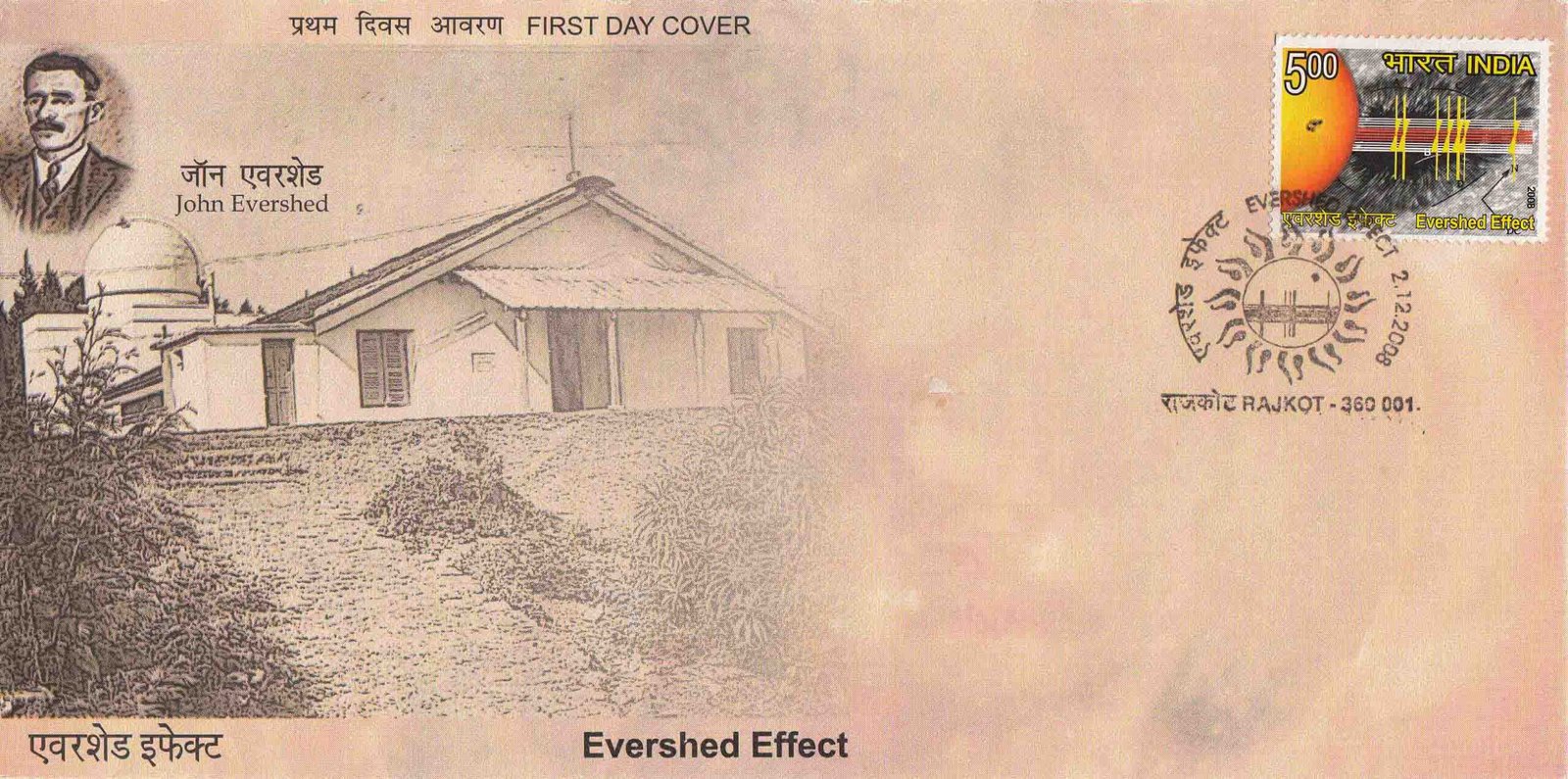
First Day Cover
Leave a Comment
You must be logged in to post a comment.