
Exotic Birds – 2
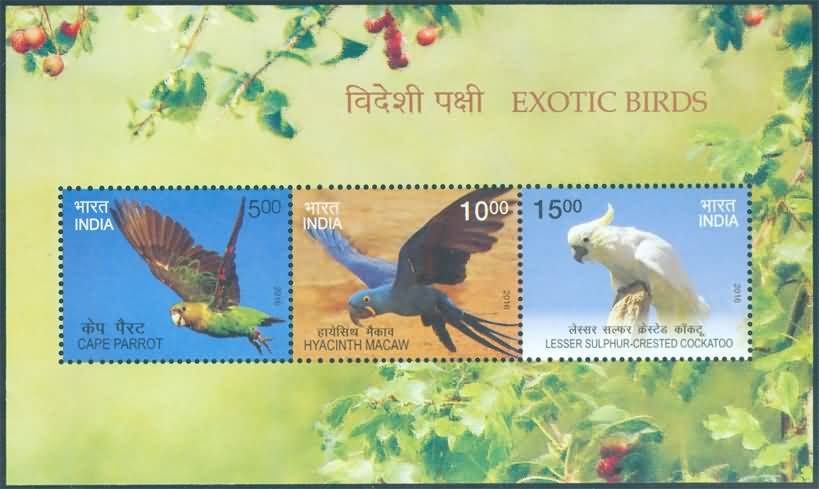
Technical Data
| Date of Issue | December 5, 2016 |
|---|---|
| Denomination | Rs. 30 |
| Quantity | 100,000 |
| Perforation | 13¼ x 13¾ |
| Printer | Security Printing Press, Hyderabad |
| Printing Process | Wet Offset |
| Watermark | No Watermark |
| Colors | Multicolor |
| Credit (Designed By) | Smt. Alka Sharma |
| Catalog Codes |
Michel IN BL150 Yvert et Tellier IN BF136 Stanley Gibbons IN MS3202 |
| Themes | Animals (Fauna) | Birds | Parrots |
Stamps in this Miniature Sheet


Parrots – A Celebration of Colour, Culture & Conservation
Parrots are among the most beloved bird species in the world, admired by people of all ages for their beauty, charm, and intelligence. Frequently featured in folklore, literature, poetry, and traditional arts, parrots have long symbolized love, creativity, and vivid expression. Known for their bright plumage, curved beaks, and zygodactyl feet (two toes forward and two backward), parrots form a diverse order of more than 350 species, including macaws, Amazons, lorikeets, cockatoos, parakeets, and lovebirds.
Found largely in tropical regions—especially Australia, Central America, and South America—parrots thrive on a varied diet of fruits, flowers, nuts, seeds, and insects. Their impressive ability to mimic sounds, including human speech, and their colorful personalities make many parrot species popular pets.
The Department of Posts celebrates this vibrant avian group through the release of a set of six commemorative stamps, each featuring an exotic and often endangered parrot species from around the world.
1. Cape Parrot (Poicephalus robustus)
Habitat & Distribution
Found only in South Africa, this parrot inhabits temperate Afromontane forests and nests in tall, dead yellowwood trees.
Taxonomy
Classification remains debated due to the existence of three geographically separate forms. BirdLife International treats them as subspecies of a single species.
Threats
- Habitat loss
- Psittacine Beak and Feather Disease (PBFD)
- Local poaching and trade
Features
A large parrot with:
- Dark brown to reddish coloration
- Large and powerful beak
- Strong association with yellowwood trees
2. Hyacinth Macaw (Anodorhynchus hyacinthinus)
Habitat & Distribution
Native to central and eastern South America, the Hyacinth Macaw is the largest flying parrot in the world, often called the Gentle Giant.
Conservation Status
- IUCN: Vulnerable
- CITES: Appendix I
Features
- Entirely deep blue plumage
- Long tail and strong curved beak
- Prefers palm-rich woodlands and savannas
Threats
- Habitat destruction
- Trapping for the pet trade
3. Lesser Sulphur-crested Cockatoo (Cacatua sulphurea sulphurea)
Habitat & Distribution
Found in East Timor, Indonesia, and the Solomon Islands, preferring wooded and cultivated landscapes.
Conservation Status
- IUCN: Critically Endangered
- CITES: Appendix I
Features
- White plumage
- Yellow crest
- Bluish-white orbital skin
- Black beak
There are six subspecies, including the distinct Citron-crested Cockatoo. Habitat loss and illegal trapping have devastated populations.
Conclusion
The commemorative stamp set on Exotic Birds highlights not only the charm and beauty of these rare parrot species but also the urgent need for global conservation. Many of these birds face critical threats from habitat loss and the illegal wildlife trade. By celebrating them through philately, the Department of Posts helps raise awareness about protecting these precious avian treasures.
Leave a Comment
You must be logged in to post a comment.