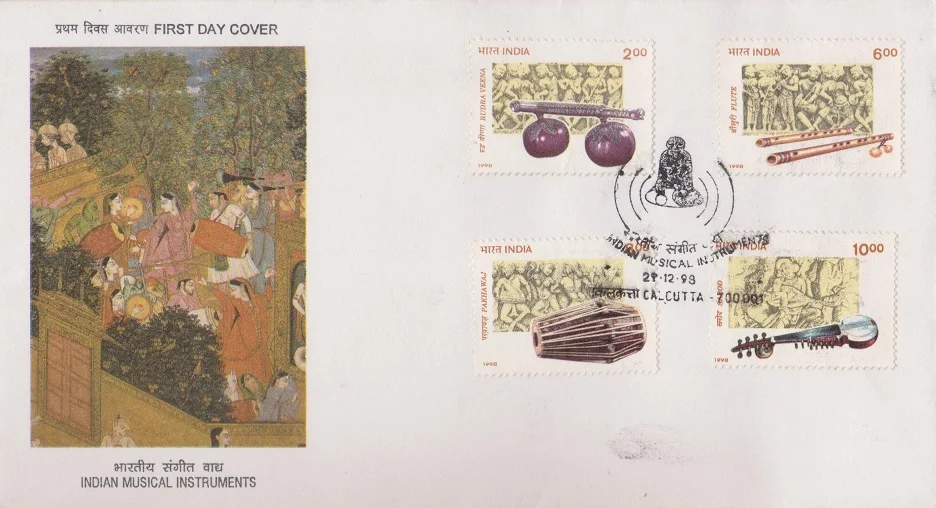
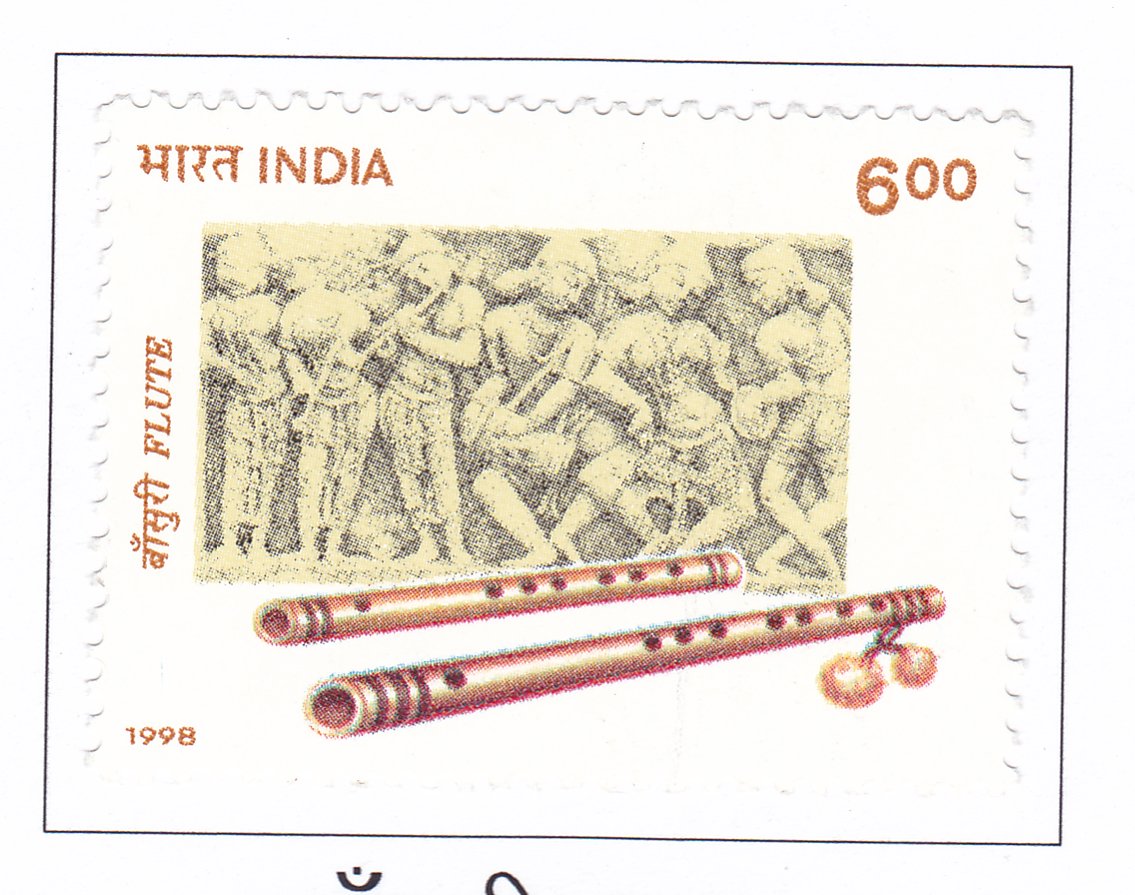
Flute
Technical Data
| Stamp Set | Indian Musical Instruments |
|---|---|
| Date of Issue | December 29, 1998 |
| Denomination | Rs. 6 |
| Quantity | 700,000 |
| Perforation | comb 13½ x 13 |
| Printer | Security Printing Press, Nashik |
| Printing Process | Photogravure |
| Watermark | No Watermark |
| Colors | Multicolor |
| Credit (Designed By) | Sh. Sankha Samanta |
| Catalog Codes |
Michel IN 1664 Stamp Number IN 1722 Yvert et Tellier IN 1429 Stanley Gibbons IN 1827 |
| Themes | Musical Instruments |
The Timeless Wind Instrument of India
The Flute (Bansuri) is one of the oldest and most enchanting musical instruments of India, known for its soothing sound and deep cultural significance. As a key example of Sushira Vadya (wind instruments), the bansuri has played an essential role in Indian classical and folk music traditions for centuries.
Origin and Classification
The Flute (Bansuri) falls under the category of wind instruments described in the Natya Shastra, compiled by Bharat Muni.
In this classification, Sushira Vadya instruments produce sound through the vibration of air. The bansuri, made from a hollow bamboo tube, creates music when air is blown across its openings.
Historical Background
The flute is among the most ancient musical instruments in India. Early depictions of wind instruments can be found in prehistoric art, including the Bhimbetka Rock Shelters, where trumpet-like instruments are illustrated.
Over time, the bansuri evolved into a refined instrument used in both classical and folk traditions, becoming deeply embedded in India’s musical heritage.
Structure and Design
The Bansuri is simple yet elegant in design:
- Made from a single piece of bamboo
- Contains a blowing hole and multiple finger holes
- Produces different notes by controlling airflow and finger placement
Its minimalistic structure allows for a wide range of tonal expressions and subtle musical variations.
Musical Characteristics
The Flute (Bansuri) is known for:
- Soft, melodious, and expressive tones
- Ability to perform slow and intricate passages (Alap)
- Versatility in both classical and folk music
The horizontal flute is especially suited for creating smooth, flowing melodies, making it a favorite among musicians.
Cultural and Artistic Significance
The Bansuri holds a special place in Indian culture:
- It is closely associated with classical dance and music traditions
- The gesture of playing the flute is commonly depicted in various dance forms
- It symbolizes harmony, simplicity, and spiritual expression
Its presence in art, sculpture, and performances reflects its timeless appeal.
Representation in Commemorative Stamps
The cultural importance of the Flute (Bansuri) has been recognized by India Post, which featured it in a commemorative stamp series on Musical Instruments of India.
This series highlights:
- The diversity of Indian musical instruments
- Their historical roots and artistic value
- The continuity of India’s musical traditions
Conclusion
The Flute (Bansuri) is a symbol of India’s musical soul, blending simplicity with profound artistic expression. As one of the oldest wind instruments, it continues to enchant listeners and remains an integral part of India’s rich cultural and musical heritage.
First Day Cover