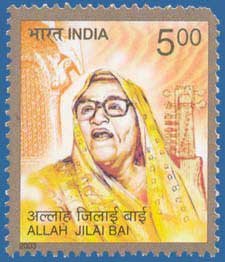
Allah Jilai Bai
Technical Data
| Stamp Set | Personality Series |
|---|---|
| Date of Issue | December 28, 2003 |
| Denomination | Rs. 5 |
| Quantity | 400,000 |
| Perforation | comb 13 |
| Printer | Calcutta Security Printers Ltd |
| Watermark | No Watermark |
| Colors | Multicolor |
| Catalog Codes |
Michel IN 2012 Stamp Number IN 2047 Yvert et Tellier IN 1777 Stanley Gibbons IN 2189 WADP Numbering System - WNS IN068.03 |
| Themes | Famous people | Optical Instruments | Singers | Women |
The Voice of Rajasthani Folk Music
Early Life
Allah Jilai Bai was one of the pioneering figures of Indian folk music. She was born on 1 February 1902 in the princely state of Bikaner, located in present-day Rajasthan, into a traditional family of musicians.
According to a popular account, when she was born someone tried to poison her. Her mother prayed fervently to the Almighty, and the child miraculously survived. Because of this divine blessing, she was named Allah Jilai Bai. Her mother was a singer in the royal court of Ganga Singh, a ruler known for his patronage of arts and culture.
Training and Musical Education
From a very young age, Allah Jilai Bai accompanied her mother to the royal court where music was performed during festivals such as Holi, Diwali, Teej and Gangaur. Occasionally, the young girl also sang along with her mother.
Her melodious and captivating voice soon attracted attention. At the age of eight, she was placed under the guidance of Ustad Hussain Bakhsh at the Court School of Maharaja Ganga Singh known as “Guni Jankana”. Here she received formal training in classical and semi-classical forms such as Dadra, Thumri and traditional Rajasthani music.
Although she also learnt dance, she later gave it up as she believed it might affect her singing.
Musical Style and Achievements
Allah Jilai Bai became especially renowned for her mastery of Maand and Lok Sangeet, the traditional folk music of Rajasthan. Her performances were admired for their emotional depth and powerful expression.
Among her most celebrated songs are Mharo Rangeelo Rajasthan and Kesariya Balam, Aao Ni Padharo Mhare Des, both of which remain iconic pieces of Rajasthani folk heritage.
In addition to Maand, she also performed other musical forms such as Dadra, Thumri, Meera bhajans, Ghalib’s ghazals, and seasonal songs like Hori and Kajri, demonstrating remarkable versatility.
Awards and Honours
Her immense contribution to folk music earned her widespread recognition and several prestigious awards. In 1975, the Rajasthan Sangeet Natak Akademi honoured her with a Manpatra and conferred on her the title “Swar Sadhika.”
She was also awarded a Sammanpatra by the Bharatiya Lok Kala Mandal in 1978 and received the Rajasthan State Award in 1980.
In recognition of her outstanding contribution to Indian music, the Government of India honoured her with the prestigious Padma Shri on 26 January 1982.
Legacy
Allah Jilai Bai passed away on 3 November 1992 at the age of 90. Her powerful voice and dedication to folk traditions played a crucial role in preserving and popularising the rich musical heritage of Rajasthan.
Commemorative Postage Stamp
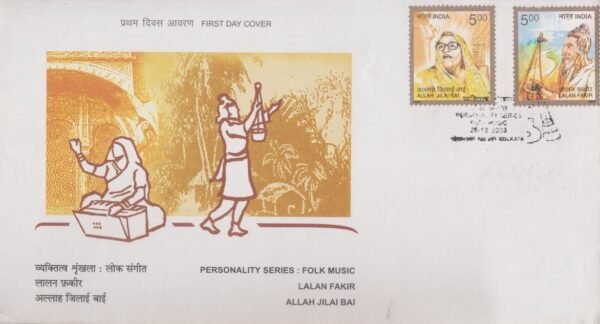
To honour her remarkable contribution to Indian folk music, India Post issued a commemorative postage stamp featuring Allah Jilai Bai as part of the “Personality Series: Folk Music.” The stamp celebrates her legacy as one of the greatest exponents of Rajasthani folk music.
First Day Cover