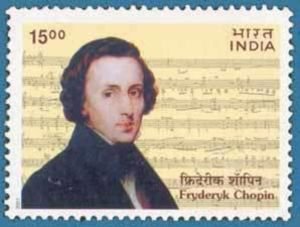
Fryderyk Chopin
Technical Data
| Date of Issue | May 4, 2001 |
|---|---|
| Denomination | Rs. 15 |
| Quantity | 400,000 |
| Perforation | comb 13 |
| Printer | Calcutta Security Printers Ltd |
| Printing Process | Offset Lithography |
| Watermark | No Watermark |
| Colors | Multicolor |
| Credit (Designed By) | Ms. Nenu Gupta |
| Catalog Codes |
Michel IN 1831 Stamp Number IN 1890 Yvert et Tellier IN 1598 Stanley Gibbons IN 1997 |
| Themes | Anniversaries and Jubilees | Composers | Famous people | Men | Music | Musicians |
The Legendary Polish Composer and Piano Genius
Fryderyk Chopin (1810–1849) was a renowned Polish composer and pianist, widely regarded as one of the greatest composers of piano music in history. His works continue to captivate audiences with their emotional depth, lyrical beauty, and technical brilliance.
Early Life and Musical Talent
The extraordinary musical talent of Fryderyk Chopin became evident during his childhood. Growing up in Warsaw, he quickly gained recognition as a prodigy. Known as “little Chopin,” he performed in local salons and charity concerts, earning admiration and even comparisons with Wolfgang Amadeus Mozart.
His formal training at the Warsaw Conservatory helped refine his natural abilities and laid the foundation for his future success.
Rise to Fame as a Piano Virtuoso
Chopin gave his first major concert as a piano virtuoso in Vienna in 1829. His performances in Vienna and Warsaw between 1829 and 1830 received widespread critical acclaim, establishing him as a rising star in the world of classical music.
Move to Paris and Artistic Growth
In 1831, following political unrest in Poland, Chopin moved to Paris. The uprising against Russian rule deeply affected him, and his relocation marked the beginning of a new phase in his life.
In Paris, he built a successful career as a private teacher and salon performer. His refined personality, delicate health, and artistic aura contributed to his growing reputation as a distinguished and enigmatic musician.
Personal Life and Relationship with George Sand
Chopin was romantically involved with the French novelist George Sand. Their relationship lasted nearly nine years and coincided with his most productive creative period. However, differences eventually led to their separation in 1847, which had a significant emotional impact on him.
Declining Health and Final Years
After his separation from George Sand, Chopin’s health deteriorated rapidly. He traveled to Britain, where he gave concerts in France, Scotland, and England despite his weakening condition. His musical output declined during this time.
Chopin passed away in 1849 in Paris due to tuberculosis, leaving behind a remarkable musical legacy.
Musical Style and Influence
Fryderyk Chopin is celebrated for revolutionizing piano music. His compositions are known for their:
- Expressive melodies
- Refined harmonies
- Subtle rhythms
- Deep emotional and poetic character
Polish folk music strongly influenced his work, even during his years in Paris. He also drew inspiration from the Italian opera composer Vincenzo Bellini.
Chopin’s influence extended to many great composers, including:
- Franz Liszt
- Richard Wagner
- Claude Debussy
Legacy and Global Recognition
Over time, Fryderyk Chopin’s image evolved from a national Polish figure to a global musical icon. His work is now recognized worldwide for its innovation and artistic excellence.
The Fryderyk Chopin International Piano Competition, held in Warsaw, has played a major role in promoting his music and celebrating his legacy.
Conclusion
Even in the twenty-first century, the music of Fryderyk Chopin continues to inspire, move, and astonish audiences across the world. His timeless compositions remain a cornerstone of classical piano music.
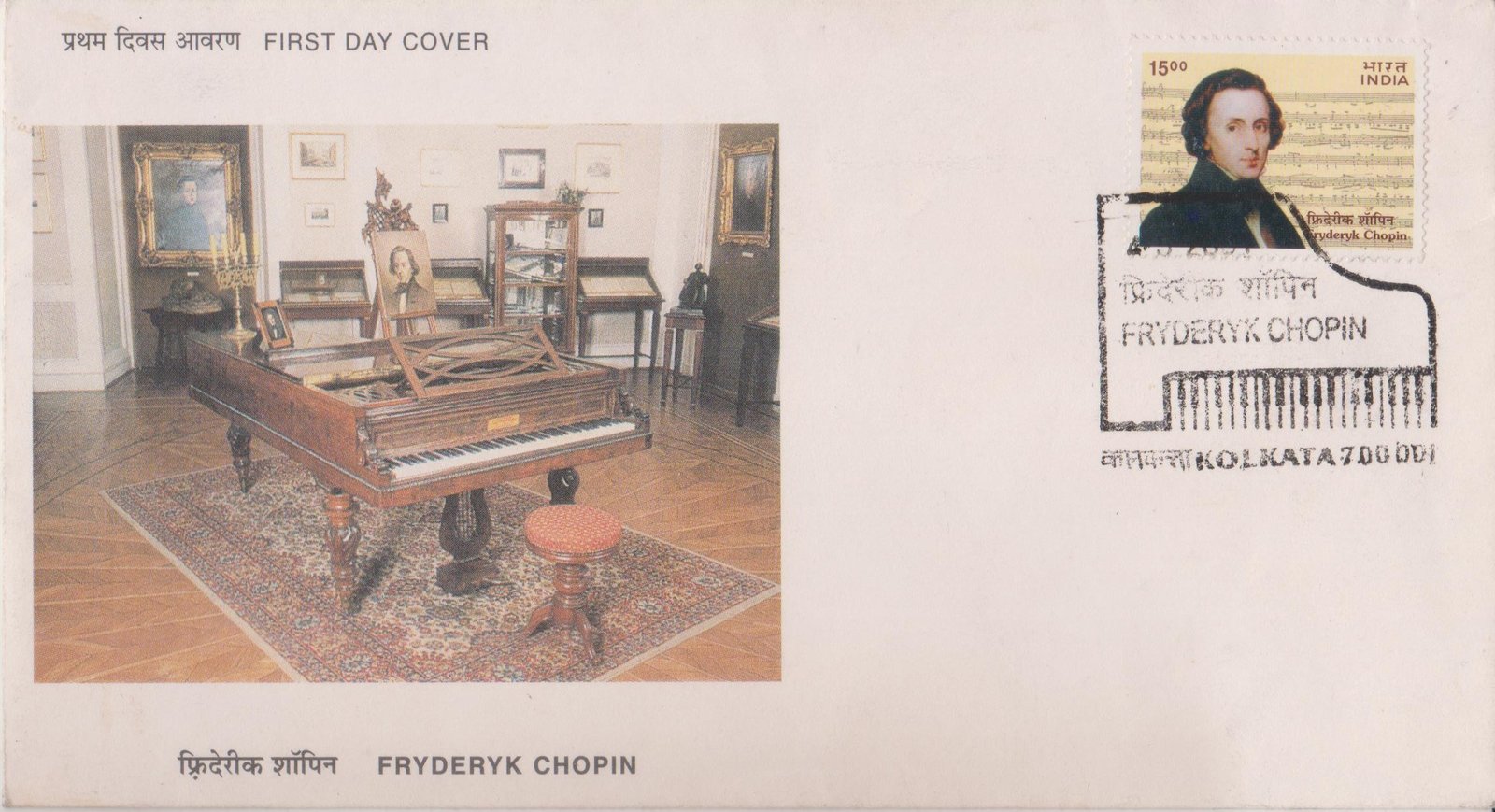
In recognition of his extraordinary contribution, the Department of Posts issued a commemorative postage stamp in his honour, celebrating his legacy as a musical genius.
First Day Cover