
Gaurishanker Dalmia

Technical Data
| Date of Issue | November 12, 2009 |
|---|---|
| Denomination | Rs. 5 |
| Quantity | 400,000 |
| Perforation | 13 |
| Printer | India Security Press, Nasik |
| Printing Process | Wet Offset |
| Watermark | No Watermark |
| Colors | Multicolor |
| Credit (Designed By) | Ms. Nenu Gupta |
| Catalog Codes |
Michel IN 2430 Stamp Number IN 2369 Stanley Gibbons IN 2653 WADP Numbering System - WNS IN083.2009 |
| Themes | Commemoration | Famous people | Headgear | Magazines | Men | Optical Instruments | Politicians | Publishers |
Freedom Fighter, Social Reformer and Philanthropist
Gaurishanker Dalmia was born on 12 November 1910 at Lakhisaray village in Munger district of Bihar. He received his education in Kolkata. At the young age of 17, following the death of his father, he assumed responsibility for the family business.
However, inspired by the call of Mahatma Gandhi, he renounced his business pursuits and dedicated himself to the service of the nation. He settled in Jasidih village in the Santhal Pargana region and became actively involved in India’s freedom struggle.
Role in the Freedom Movement
Deeply influenced by Gandhian ideals, Dalmia entered public life in 1926 and took a vow to wear khadi. He participated in the Salt Satyagraha (Namak Satyagrah) and was imprisoned in 1931 for his involvement in the movement.
In 1936, he was elected President of the Santhal Pargana District Congress Committee. The same year, he founded the Santhal Paharia Seva Mandal at Deoghar and served as its General Secretary. After independence, the Seva Mandal received recognition and awards, including honours from the Federation of Indian Chambers of Commerce & Industry (FICCI) and a National Award.
Legislative and Public Service
Gaurishanker Dalmia had a long and distinguished legislative career. He served as:
- Member of the Bihar Legislative Assembly (1937–1952)
- Member of the Bihar Legislative Council (1952–1972)
Beyond politics, he was associated with numerous business and educational institutions. He was a member of the Senate of Bhagalpur University and served on the Executive Committee of FICCI and the Indian Employers’ Association, New Delhi.
He also held key leadership positions, including:
- Chairman of the Bihar Industries Association, Patna (13 years)
- President of the Bihar Chamber of Commerce, Patna (two terms)
- Founder-President of the South Bihar Chamber of Commerce (served nearly 20 years)
Commitment to Social Welfare
Dalmia devoted his life to education, healthcare, and the upliftment of marginalized communities, especially Dalits, Adivasis, and the Paharia tribe across six districts of the Santhal Pargana Division.
His contributions include:
- Establishment of 30 primary schools in hilly areas
- 200 primary and night schools
- 3 high schools and 4 middle schools
- 4 hostels and 4 hospitals
- 24 Balbaries (crèches) and Sishu Palan Kendras
- 10 hospitals and multiple treatment centers for Adivasis
- 40 service centers for leprosy patients, along with 3 hospitals
He worked tirelessly for leprosy eradication, rehabilitation of handicapped children, and promotion of natural cures (Prakritik Chikitsa).
Contribution to Journalism and Language
Gaurishanker Dalmia had a deep interest in journalism. He published the Hindi weekly Prakash and the English weekly The Spark for nearly two decades. From 1950 onwards, he published several books in the Santhali language using the Nagri script and played a key role in securing government recognition for the Nagri script for Santhali.
Legacy
Gaurishanker Dalmia passed away on 16 June 1988, leaving behind a legacy of selfless service, social reform, and commitment to national development.
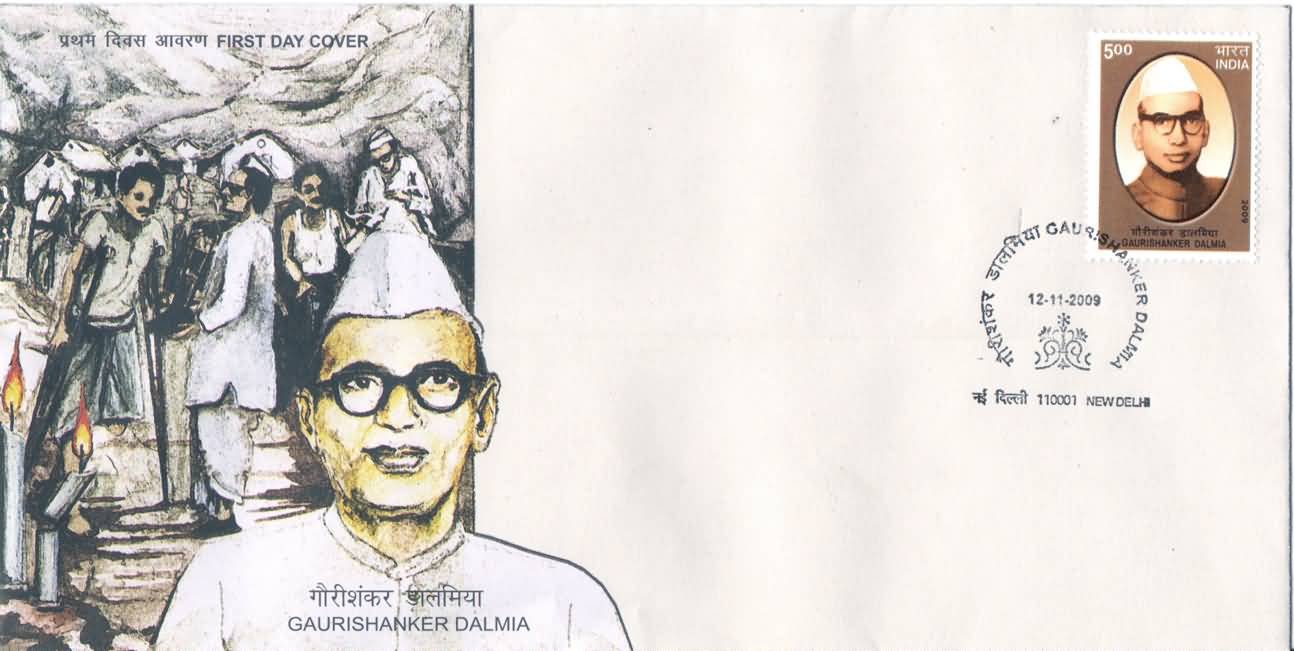
In recognition of his remarkable contributions to freedom struggle, public life, education, and social welfare, the Department of Posts issued a commemorative postage stamp in his honour.
First Day Cover
Leave a Comment
You must be logged in to post a comment.