
Indipex Asiana 2000 – Gems and Jewellery
Technical Data
| Date of Issue | December 7, 2000 |
|---|---|
| Denomination | Rs. 18 |
| Perforation | comb13½ |
| Printer | Calcutta Security Printers Ltd |
| Printing Process | Offset Lithography |
| Watermark | No Watermark |
| Colors | Multicolor |
| Credit (Designed By) | Shri Kamleshwar Singh |
| Catalog Codes |
Michel IN 1799-1804 Stamp Number IN 1863a Yvert et Tellier IN 1565-1570 Stanley Gibbons IN 1966a |
| Themes | Jewelery | Philatelic Exhibitions |
Stamps in this Se-Tenant
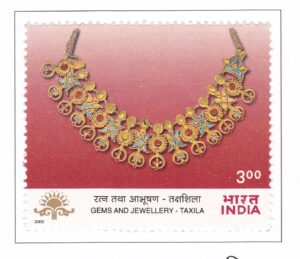
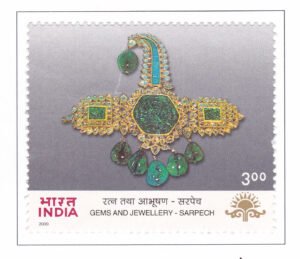
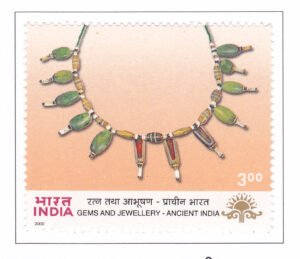
Indian Gems and Jewellery Stamp Series
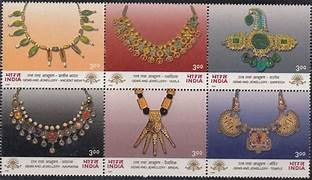
India has a jewellery tradition that extends back more than 5,000 years. To celebrate this rich heritage, the India Post issued a set of six commemorative postage stamps under the theme Indian Gems and Jewellery during Indepex–Asiana 2000, held in Kolkata. The series was also a tribute to 50 years of the Republic of India and the dawn of the new millennium.
The six stamps portray:
- Ancient Bead Necklace from the Indus Valley
- Gold Necklace from Taxila
- Turban Ornament (Sarpech)
- Navaratna Necklace
- Bridal Necklace (Tali) from South India
- Temple Necklace (Kanthla) from Rajasthan
Ancient Bead Necklace – Indus Valley (c. 2500 BC)
The first stamp depicts an ancient bead necklace from the Indus Valley Civilization. By 3000 BC, India had become a major centre for jewellery production. Precious and semi-precious stones such as lapis lazuli, turquoise, coral, carnelian, and jasper were imported into cities like Harappa, Mohenjo-daro, Lothal, and Kalibangan, where they were shaped into jewellery and traded across the world.
Gold Necklace from Taxila (c. 1st Century AD)
The second stamp features a gold necklace from Taxila dating to the 1st century AD. This ornament reflects the advanced craftsmanship of ancient Indian goldsmiths, who mastered techniques such as repoussé, filigree, granulation, and bezel settings. Excavations from sites linked with the Shunga Dynasty reveal that Indian jewellers were highly skilled in working with sheet gold and precious stones.
Turban Ornament (Sarpech)
The third stamp portrays a Sarpech, an ornate turban ornament popular during the Mughal Empire period. Mughal jewellery was distinguished by the use of meenakari, a decorative art combining enamel, gems, and precious metals. Sarpechs were worn by nobles and rulers as symbols of rank, elegance, and authority.
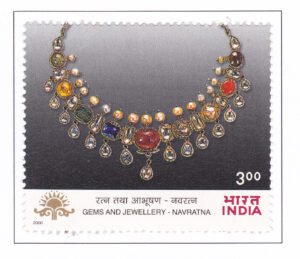
Navaratna Necklace (18th Century)
The fourth stamp depicts an 18th-century Navaratna necklace. The Navaratna concept includes nine gems—ruby, pearl, coral, emerald, topaz, diamond, sapphire, zircon, and cat’s eye—believed to represent the planets and their presiding deities. Such jewellery was thought to bring protection, health, and spiritual balance.
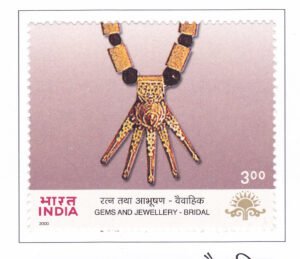
Bridal Necklace (Tali) from South India (19th Century)
The fifth stamp shows a traditional South Indian bridal necklace known as the Tali. In South Indian weddings, the tying of the mangalsutra or tali is an essential ritual symbolizing marriage and lifelong commitment 💍 The necklace reflects the close relationship between jewellery and ritual in Indian culture.
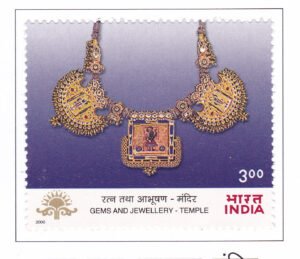
Temple Necklace (Kanthla) from Rajasthan (18th Century)
The sixth stamp portrays a Kanthla necklace from Rajasthan, dating to the 18th century. This ornament is part of India’s temple jewellery tradition, in which necklaces and ornaments were inspired by mythology, deities, and sacred symbols. Temple jewellery often served as a visual expression of devotion and artistic excellence.
India’s jewellery traditions are also described in ancient texts such as Ashtadhyayi, Arthashastra, and Natyashastra, which classify ornaments and explain their cultural and symbolic importance.
The Indepex–Asiana 2000 stamp series beautifully captures the evolution of Indian jewellery from the ancient Indus Valley to the Mughal and regional traditions of later centuries. It remains an important philatelic tribute to India’s artistic, cultural, and spiritual heritage.