
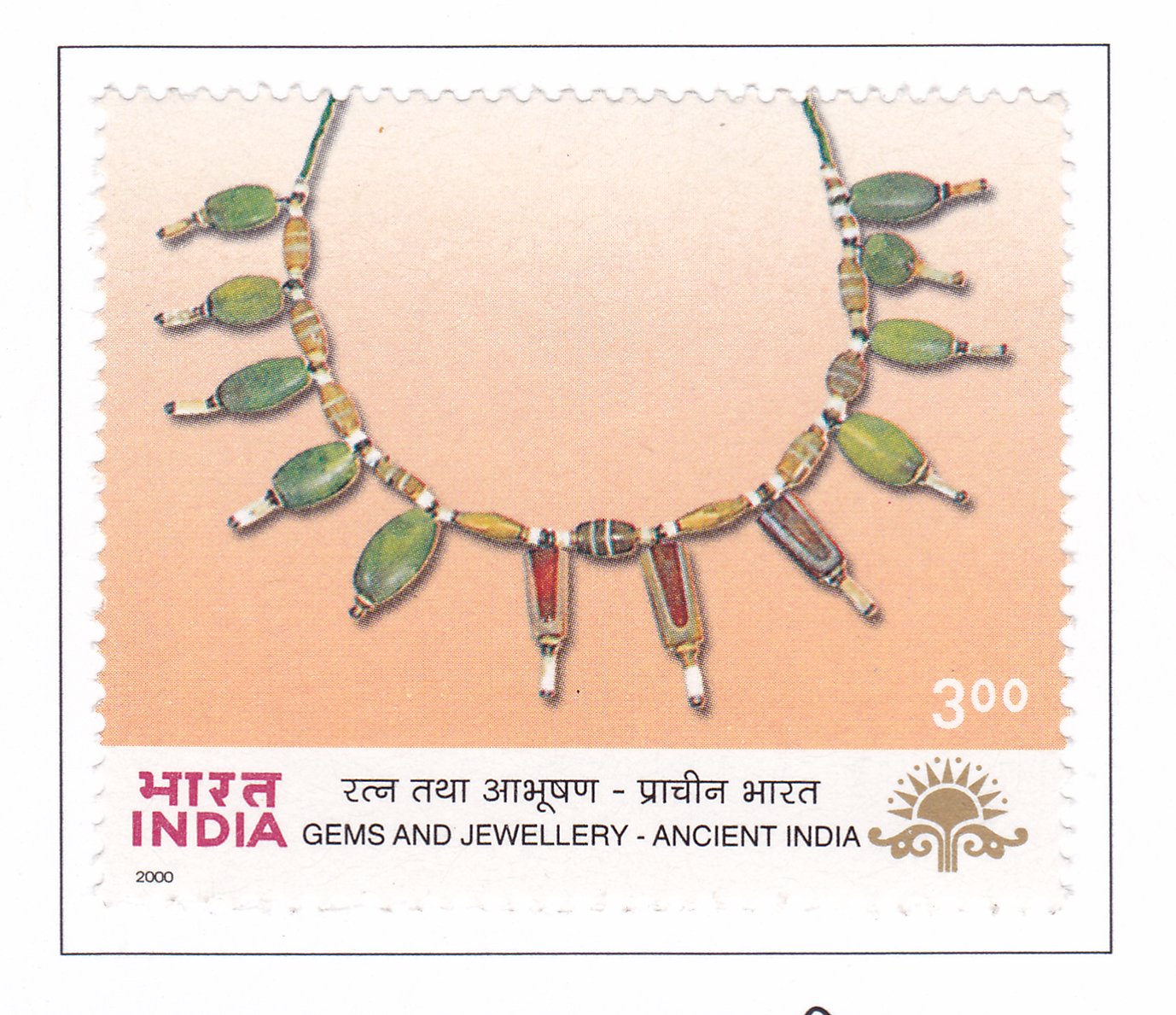
Ancient Bead Necklace from Indus Valley
Technical Data
| Date of Issue | December 7, 2000 |
|---|---|
| Denomination | Rs. 3 |
| Quantity | 3,000,000 |
| Perforation | comb 13½ |
| Printer | Calcutta Security Printers Ltd |
| Printing Process | Offset Lithography |
| Watermark | No Watermark |
| Colors | Multicolor |
| Credit (Designed By) | Shri Kamleshwar Singh |
| Catalog Codes |
Michel IN 1799 Stamp Number IN 1858 Yvert et Tellier IN 1565 Stanley Gibbons IN 1966 |
| Themes | Jewelery | Philatelic Exhibitions |
Indus Valley Jewellery Heritage
The Ancient Bead Necklace (c. 2500 BC) is one of the earliest examples of jewellery craftsmanship in India, originating from the Indus Valley Civilization. It has been featured in the commemorative stamp series “Indian Gems & Jewellery”, issued during the Indepex Asiana 2000.
Origin and Historical Significance
This bead necklace was discovered in prominent Indus Valley cities such as Harappa, Mohenjo-daro, Lothal, and Kalibangan. These urban centers were major hubs of trade and craftsmanship, making India one of the earliest global producers of jewellery.
The necklace reflects a highly developed culture of ornamentation and trade dating back over 4,000 years.
Materials and Craftsmanship
The Ancient Bead Necklace was made using a variety of imported semi-precious stones such as:
- Lapis lazuli
- Turquoise
- Carnelian
- Jasper
- Coral
These materials were carefully cut, shaped, and polished by skilled artisans. Advanced techniques ensured uniformity and aesthetic appeal, highlighting the sophistication of Indus Valley craftsmanship.
Trade and Global Influence
The Indus Valley Civilization had extensive trade networks, importing raw materials and exporting finished jewellery. The bead necklaces were traded beyond India’s maritime boundaries, indicating strong economic and cultural connections with other ancient civilizations.
Cultural Importance
Jewellery in ancient India was not merely decorative but also held social and cultural significance. The bead necklace likely symbolized status, identity, and artistic expression within the society.
Stamp Recognition
The Bead Necklace (Indus Valley, 2500 BC) is the first stamp in the “Indian Gems & Jewellery” series issued by India Post. This commemorative stamp celebrates India’s rich heritage in jewellery making and highlights the advanced skills of ancient artisans.
Conclusion
The Ancient Bead Necklace stands as a testament to India’s long-standing tradition of jewellery craftsmanship. It reflects not only artistic excellence but also the economic strength and global trade connections of the Indus Valley Civilization.