Centenary of Directorate General of Mines Safety
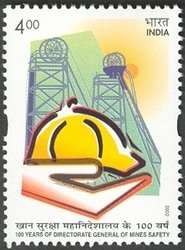
Technical Data
| Date of Issue | January 7, 2002 |
|---|---|
| Denomination | Rs. 4 |
| Quantity | 800,000 |
| Perforation | Syncopated 13 x 13¼ |
| Printer | Madras Security Printers |
| Printing Process | Offset Lithography |
| Watermark | No Watermark |
| Colors | Multicolor |
| Credit (Designed By) | Shri Kamleshwar Singh |
| Catalog Codes |
Michel IN 1889 Stamp Number IN 1942 Yvert et Tellier IN 1654 Stanley Gibbons IN 2054 WADP Numbering System - WNS IN001.02 |
| Themes | Anniversaries and Jubilees | Hands | Headgear | Occupational Safety and Health |
A Century of Safeguarding Miners
The Directorate General of Mines Safety (DGMS), headquartered in Dhanbad, is a key institution under the Union Ministry of Labour & Employment, Government of India. It is entrusted with the critical responsibility of ensuring the safety, health and welfare of workers employed in mines across the country.
Role and Importance of Mining Safety
Mining has been fundamental to human progress, providing essential resources for industrial and technological development. However, the process of extracting minerals from deep within the earth remains dangerous and complex, often described as a constant struggle against unpredictable natural forces. This makes safety regulation an essential aspect of the mining industry.
Historical Evolution
The organisation was originally established in 1902 as the Bureau of Mines Inspection in Calcutta (now Kolkata). In 1908, its headquarters was shifted to Dhanbad, a major mining hub. Later, in 1967, it was renamed the Directorate General of Mines Safety, reflecting its expanded role and responsibilities.
Organisational Structure
At its headquarters, the Director General is supported by experts in various disciplines, including:
- Mining engineering
- Electrical and mechanical engineering
- Occupational health
- Law, survey and statistics
- Administration and accounts
DGMS operates through a widespread field network divided into six geographical zones, each further split into regions and sub-regions, ensuring effective supervision across the country.
Scope of Work
India has a vast mining sector, including:
- Around 600 coal mines
- Approximately 6000 non-coal mines
- 32 oil mines
These mines employ hundreds of thousands of workers. DGMS plays a crucial role in monitoring their working conditions and enforcing safety standards, supported by a dedicated workforce of around 1100 personnel.
Key Functions
Over the past century, DGMS has contributed significantly by:
- Drafting and enforcing mining safety legislation
- Setting standards for occupational health and safety
- Promoting awareness and training programmes
- Supporting research and development in mining safety
Its efforts aim to minimize accidents, reduce occupational diseases and improve overall working conditions in mines.
Vision and Commitment
The vision of DGMS is to ensure nationally acceptable and internationally comparable standards of safety, health and welfare for mine workers. It continues to evolve with advancements in mining technology while addressing the challenges of a developing nation.
Commemorative Stamp
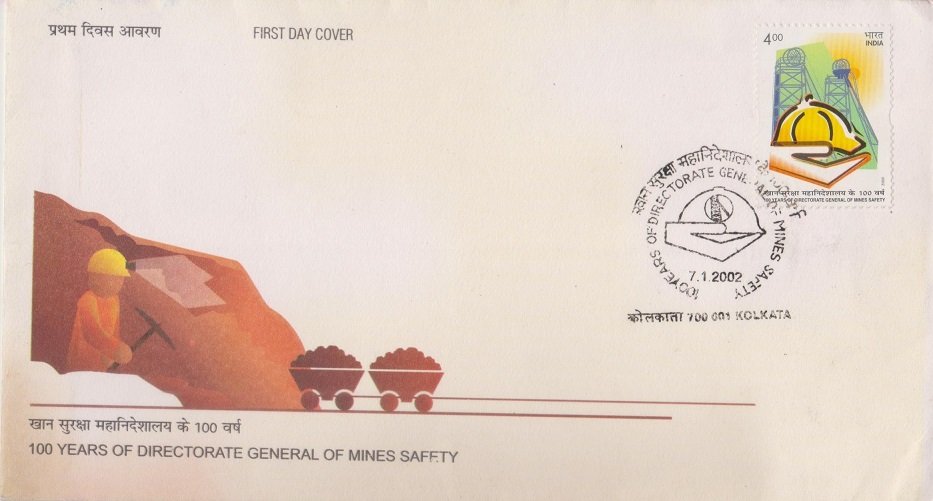
To mark 100 years of its dedicated service, India Post issued a commemorative postage stamp celebrating the centenary of DGMS. The stamp honours the organisation’s enduring commitment to protecting the lives of mine workers.
Conclusion
The Directorate General of Mines Safety stands as a guardian of the mining workforce in India. Its century-long journey reflects dedication, resilience and continuous efforts to make one of the most hazardous professions safer and more humane.
First Day Cover