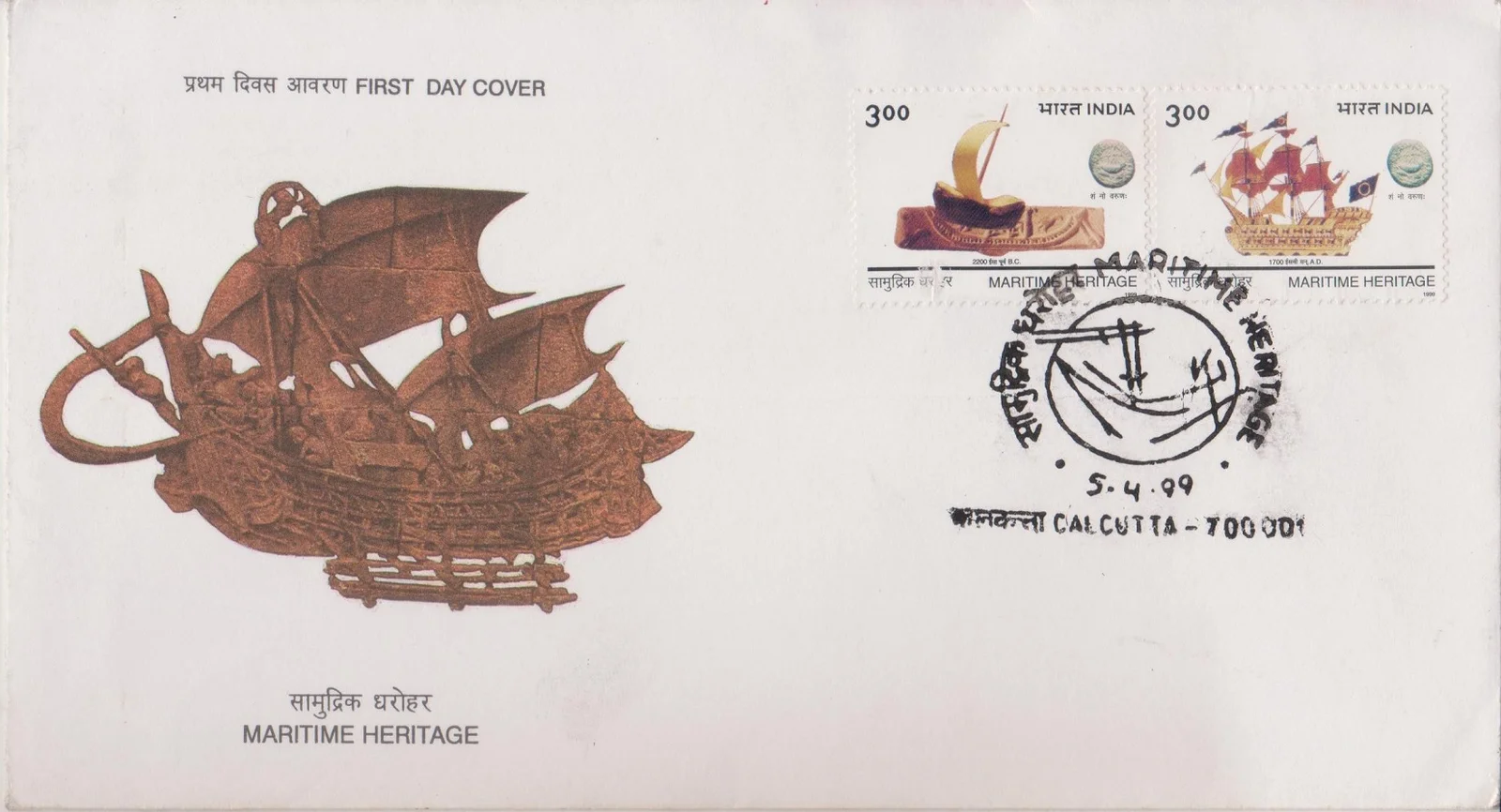
Ghurab (sailing ship) of Kanhoji Angre, 1700 and Seal

Technical Data
| Stamp Set | Maritime Heritage |
|---|---|
| Date of Issue | April 5, 1999 |
| Denomination | Rs. 3 |
| Quantity | 700,000 |
| Perforation | comb 13½ x 13 |
| Printer | Calcutta Security Printers Ltd |
| Printing Process | Offset Lithography |
| Watermark | No Watermark |
| Colors | Multicolor |
| Credit (Designed By) | |
| Catalog Codes |
Michel IN 1682 Stamp Number IN 1745 Yvert et Tellier IN 1449 Stanley Gibbons IN 1845 |
| Themes | Sailing Ships | Seals(Emblems) | Ships |
A Symbol of Maratha Naval Power
The Ghurab, a traditional sailing warship used by the fleet of Kanhoji Angre, represents a remarkable chapter in India’s maritime history. As one of the most powerful naval commanders of the 17th–18th century, Kanhoji Angre built a formidable Maratha navy that challenged European dominance along the western coast of India.
The Ghurab: Design and Purpose
The Ghurab was a fast and agile sailing vessel designed for both defense and attack. Unlike the large, heavily armed European ships, these vessels were well-suited for coastal navigation and swift maneuvers in the Arabian Sea.
Key features of the Ghurab included:
- Sleek structure for speed and flexibility
- Equipped with cannons for naval combat
- Ideal for surprise attacks and coastal defense
These ships enabled the Maratha navy to effectively counter foreign naval forces despite limited resources.
Kanhoji Angre and Maritime Resistance
Kanhoji Angre, often regarded as the “Admiral of the Maratha Navy,” used fleets of Ghurabs to establish control over large parts of India’s western coastline. From the late 17th century onward, he led successful campaigns against European powers, including the Portuguese and the British.
His naval strategy relied heavily on the mobility and tactical advantage offered by ships like the Ghurab, allowing him to defend Indian waters and assert regional dominance.
Representation in Commemorative Stamp
To honour India’s rich maritime heritage, the Department of Posts featured the Ghurab of Kanhoji Angre in a commemorative stamp issued on the occasion of National Maritime Day.
The stamp design:
- Depicts a Ghurab sailing ship based on historical illustrations (circa 1700 A.D.)
- Highlights the strength and resilience of indigenous naval forces
- Celebrates India’s legacy of maritime defense and shipbuilding
A Legacy of Naval Strength
The Ghurab stands as a symbol of India’s maritime resilience and innovation during a time of intense global naval competition. It reflects how indigenous knowledge and strategic leadership enabled Indian forces to hold their ground against powerful foreign fleets.
Through its depiction on the commemorative stamp, the Ghurab of Kanhoji Angre continues to remind us of India’s proud naval heritage and its enduring spirit of resistance and self-reliance.
First Day Cover