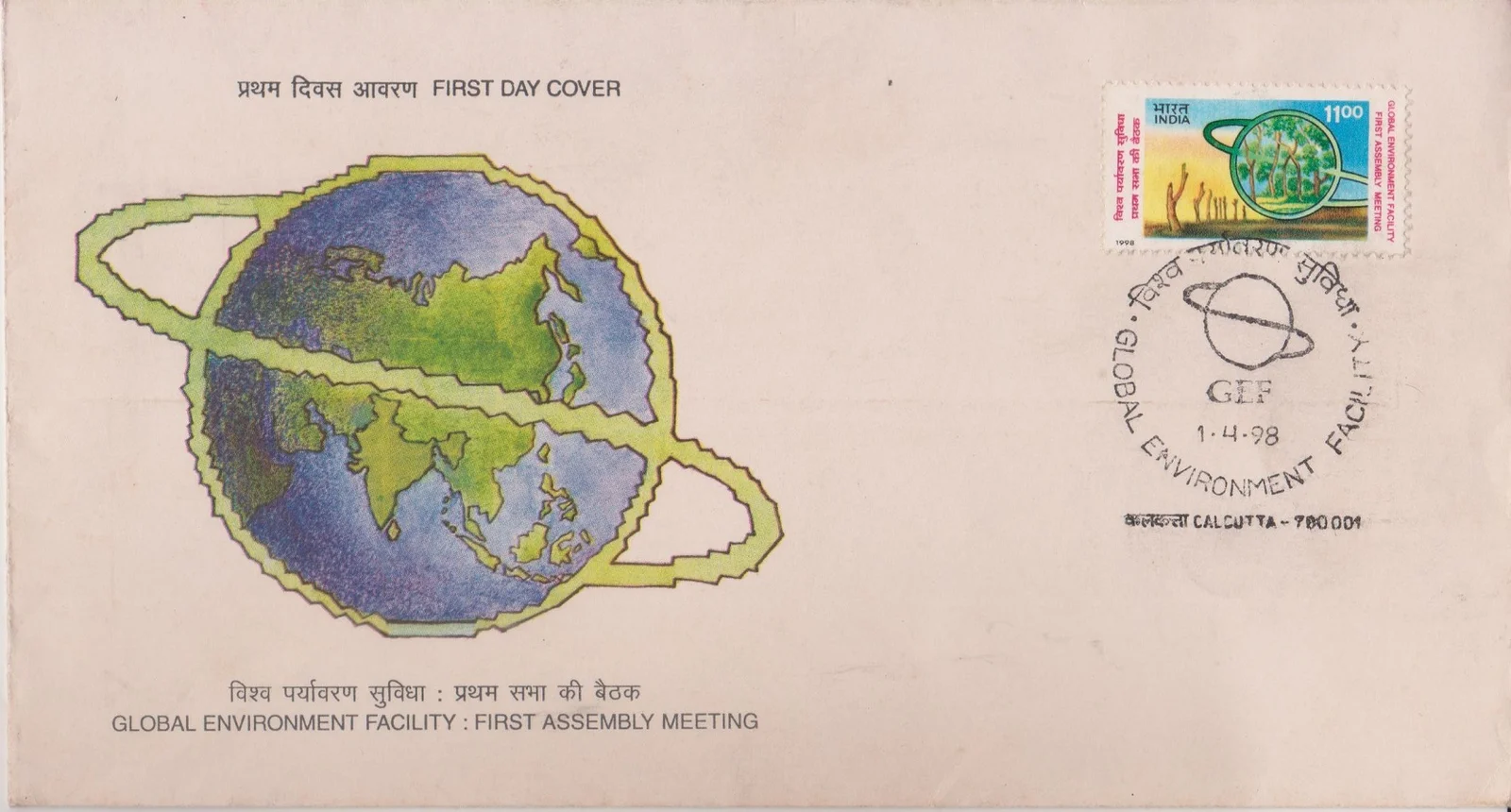
1st Assembly Meeting of Global Environment Facility, Delhi

Technical Data
| Date of Issue | April 1, 1998 |
|---|---|
| Denomination | Rs. 11 |
| Quantity | 700,000 |
| Perforation | comb 13 |
| Printer | Security Printing Press, Nashik |
| Printing Process | Photogravure |
| Watermark | No Watermark |
| Colors | Multicolor |
| Credit (Designed By) | Mr. R. N. Pasricha |
| Catalog Codes |
Michel IN 1619 Stamp Number IN 1680 Yvert et Tellier IN 1386 Stanley Gibbons IN 1783 |
| Themes | Conferences | Environment Protection | Forests | Globes | Plants (Flora) | Trees |
Introduction
The Global Environment Facility (GEF) is an international financial mechanism created to support cooperation among nations and promote actions for protecting the global environment. It provides grants and concessional funds for projects that combine development goals with environmental protection.
Purpose of GEF
The GEF helps countries meet the additional costs involved when development projects also focus on global environmental benefits. It complements traditional development assistance by supporting sustainable and eco-friendly initiatives.
Main Focus Areas
The GEF has identified four major focal areas for its programmes:
- Biological Diversity
- Climate Change
- International Waters
- Ozone Layer Depletion
It also encourages efforts to prevent land degradation related to these four areas.
Formation and Growth
After a three-year pilot phase, the Restructured Global Environment Facility became operational in 1994 with a pledged core fund of US$ 2 billion. By 1998, project approvals had steadily increased, reaching around US$ 1.6 billion.
Governance Structure
The governing body of the GEF is the GEF Council, consisting of 32 members representing developing countries, developed countries, and countries in transition.
Its implementing agencies are:
- United Nations Development Programme (UNDP)
- United Nations Environment Programme (UNEP)
- World Bank (also acts as trustee)
The Scientific and Technical Advisory Panel (STAP) provides independent scientific and technical advice.
Objectives of GEF
The GEF works to achieve several important goals:
- Become the principal mechanism for global environmental funding
- Ensure transparent and democratic governance
- Promote universal participation and cooperation
- Support country-driven projects
- Build capacity and assist countries in meeting climate and biodiversity commitments
- Encourage participation of local communities and NGOs
- Promote innovative technologies and effective solutions
- Support cost-effective environmental measures
- Encourage follow-up support from governments, NGOs, and private sectors
Importance of GEF
The GEF has played a major role in funding projects that conserve nature, combat climate change, protect water resources, and preserve the ozone layer. It encourages international teamwork for a healthier planet.
Commemorative Stamp
The Department of Posts is happy to release the stamp to commemorate the First Assembly Meeting of the Global Environment Facility held in India in April 1998.
Conclusion
The Global Environment Facility stands as an important global partnership for environmental protection. By supporting nations in sustainable development, it contributes greatly toward securing a better future for the world.
First Day Cover