
Global Iodine Deficiency Disorders Day
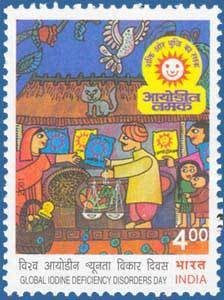
Technical Data
| Date of Issue | October 21, 2001 |
|---|---|
| Denomination | Rs. 4 |
| Quantity | 400,000 |
| Perforation | comb 13 |
| Printer | Eagle Press Ltd. |
| Printing Process | Offset Lithography |
| Watermark | No Watermark |
| Colors | Multicolor |
| Credit (Designed By) | Smt. Alka Sharma |
| Catalog Codes |
Michel IN 1870 Stamp Number IN 1924 Yvert et Tellier IN 1639 Stanley Gibbons IN 2035 |
| Themes | Healthcare |
Importance of Iodine and Global Health Awareness
The importance of iodine in the human body and the harmful effects of its deficiency are widely recognized. Even a very small amount of iodine—approximately a teaspoon consumed over a lifetime—is sufficient to prevent a wide range of health disorders, including goitre, stillbirths, and mental retardation. These conditions are collectively known as Iodine Deficiency Disorders (IDD).
Impact of Iodine Deficiency on Health
Research has shown that iodine deficiency is the leading preventable cause of mental retardation among children worldwide. This has led to increased global attention on eliminating IDD, which was previously under-recognized.
It is estimated that around 1.6 billion people globally are at risk of physical and mental impairment due to insufficient iodine intake. Among them, approximately 500 million are children. In India alone, nearly 10% of these cases are reported.
Universal Salt Iodisation: The Most Effective Solution
Iodising salt has proven to be the simplest, most cost-effective, and widely accessible method of iodine supplementation, as salt is consumed by almost all sections of society. Many developed countries have successfully eliminated iodine deficiency disorders through this approach.
India’s Efforts to Combat IDD
India adopted the policy of Universal Iodisation of edible salt in 1983 based on recommendations of the Technical Goitre Review Committee. Prior to this, the National Goitre Control Programme (NGCP) had been in operation since 1962 on a limited scale.
To strengthen global cooperation, the UNICEF supported the Government of India in implementing Universal Salt Iodisation (USI), focusing on child health and nutrition.
National Iodine Deficiency Disorders Control Programme
In 1992, the programme was renamed the National Iodine Deficiency Disorders Control Programme (NIDDCP), shifting its focus from visible goitre to broader and often invisible health impacts such as mental impairment and developmental disorders.
In 1993, the Government of India, in collaboration with UNICEF, launched a strengthened national initiative to promote iodised salt production and distribution. This effort successfully brought multiple stakeholders in the salt industry together.
As a result, iodised salt production increased significantly—from about 28 lakh tonnes in the early 1990s to 41 lakh tonnes by 1997—making iodised salt accessible to nearly 75% of the population.
Global Iodine Deficiency Disorders Day
Every year, Global Iodine Deficiency Disorders Day is observed on 21st October to raise awareness about progress made in eliminating IDD and to address remaining challenges in achieving universal iodine sufficiency.
Conclusion
UNICEF and governments worldwide continue to emphasize the importance of iodine nutrition as a key public health priority. Through initiatives like universal salt iodisation, significant progress has been made in reducing preventable mental and physical disabilities caused by iodine deficiency.
In recognition of this important global health initiative, the Department of Posts issued a commemorative postage stamp to spread awareness about iodine deficiency disorders and their prevention.
First Day Cover