
Golden Jubilee of Goa Liberation
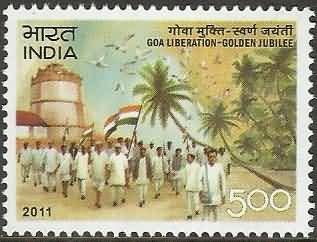
Technical Data
| Date of Issue | December 19, 2011 |
|---|---|
| Denomination | Rs. 5 |
| Quantity | 300,000 |
| Perforation | 13 |
| Printer | India Security Press, Nashik |
| Printing Process | Wet Offset |
| Watermark | No Watermark |
| Colors | Multicolor |
| Credit (Designed By) | Shri Kamleshwar Singh Smt. Alka Sharma |
| Catalog Codes |
Michel IN 2632 Stanley Gibbons IN 2846 WADP Numbering System - WNS IN056.2011 |
| Themes | Anniversaries and Jubilees | Flags | Fortresses / Strongholds | Lighthouses |
The history of Goa Liberation is a powerful chapter in India’s freedom movement. The Portuguese presence in India gained momentum in 1510 with the invasion of the western coastline and the annexation of territories including Goa. Although the people of Goa were peace-loving, they strongly resented foreign rule and the harsh reprisal measures imposed by the Portuguese administration.
Early Resistance Against Portuguese Rule
The first sparks of organized resistance came from the Rane leaders. In 1852, Dipaji Rane spearheaded a major revolt against Portuguese authority. Another uprising followed in 1885 under Dada Rane. The final major rebellion took place in 1912, led by Morya Sawant, Jill Sawant, and their associate Cutodio (Quistulo), who were martyred due to treachery.
In total, fourteen rebellions led by the Ranes were recorded, though each was eventually suppressed. As a result, freedom movement activities shifted beyond Goa’s borders, where leaders continued organizing resistance.
Rise of Organized Freedom Movements
Several organizations emerged to intensify the struggle for liberation, including:
- National Congress Goa
- Azad Gomantak Dal
- United Front of Goans
- Goa Liberation Council
- Goan People’s Party
- Quit Goa Organization
- Goa Vimochan Sahayak Samiti
Some groups adopted armed resistance, infiltrating Goa and targeting Portuguese troops and supply routes.
A major turning point came on 18 June 1946, when citizens gathered under the leadership of Ram Manohar Lohia to defy restrictions on civil liberties and demand democratic rights.
In October 1961, a seminar on Portuguese colonialism was held in New Delhi. Leaders from African nations urged Jawaharlal Nehru to take decisive steps toward liberating Portuguese colonies. Speaking at a public meeting in Mumbai, the Prime Minister declared that Goa would soon be free.
Operation Vijay and Liberation of Goa
On 18 December 1961, the Indian Armed Forces launched a coordinated military operation code-named Operation Vijay. The action involved the Indian Army, supported by the Air Force and Navy.
The liberation of Goa was successfully completed on 19 December 1961, marking the end of over 450 years of Portuguese rule.
On 20 June 1962, Goa, along with Daman and Diu, was granted the status of a Union Territory. In the 1967 Opinion Poll, the people of Goa voted to retain their separate identity, rejecting a proposed merger with Maharashtra.
Finally, on 30 May 1987, Goa attained full statehood, while Daman and Diu became a separate Union Territory.
Goa – The Land and Its Legacy
Situated along the scenic Konkan coast of India, Goa boasts a 105 km coastline and a network of rivers including Mandovi, Zuari, Sal, Terekhol, Chapora, and Talpona. Known for its pleasant climate and world-famous beaches, Goa attracts tourists from across the globe.
Beyond its natural beauty, Goa stands as a symbol of resilience, freedom, and democratic values.
Commemorative Stamp on the Golden Jubilee of Goa Liberation
To honor this historic milestone, India Post issued a Postage Stamp commemorating the Golden Jubilee of Goa Liberation. This special philatelic issue celebrates the courage, sacrifice, and determination of the people of Goa and the Indian Armed Forces who ensured the region’s integration into the Indian Union.
Through this commemorative stamp, the legacy of Goa’s liberation continues to inspire generations while preserving a significant chapter of India’s modern history.
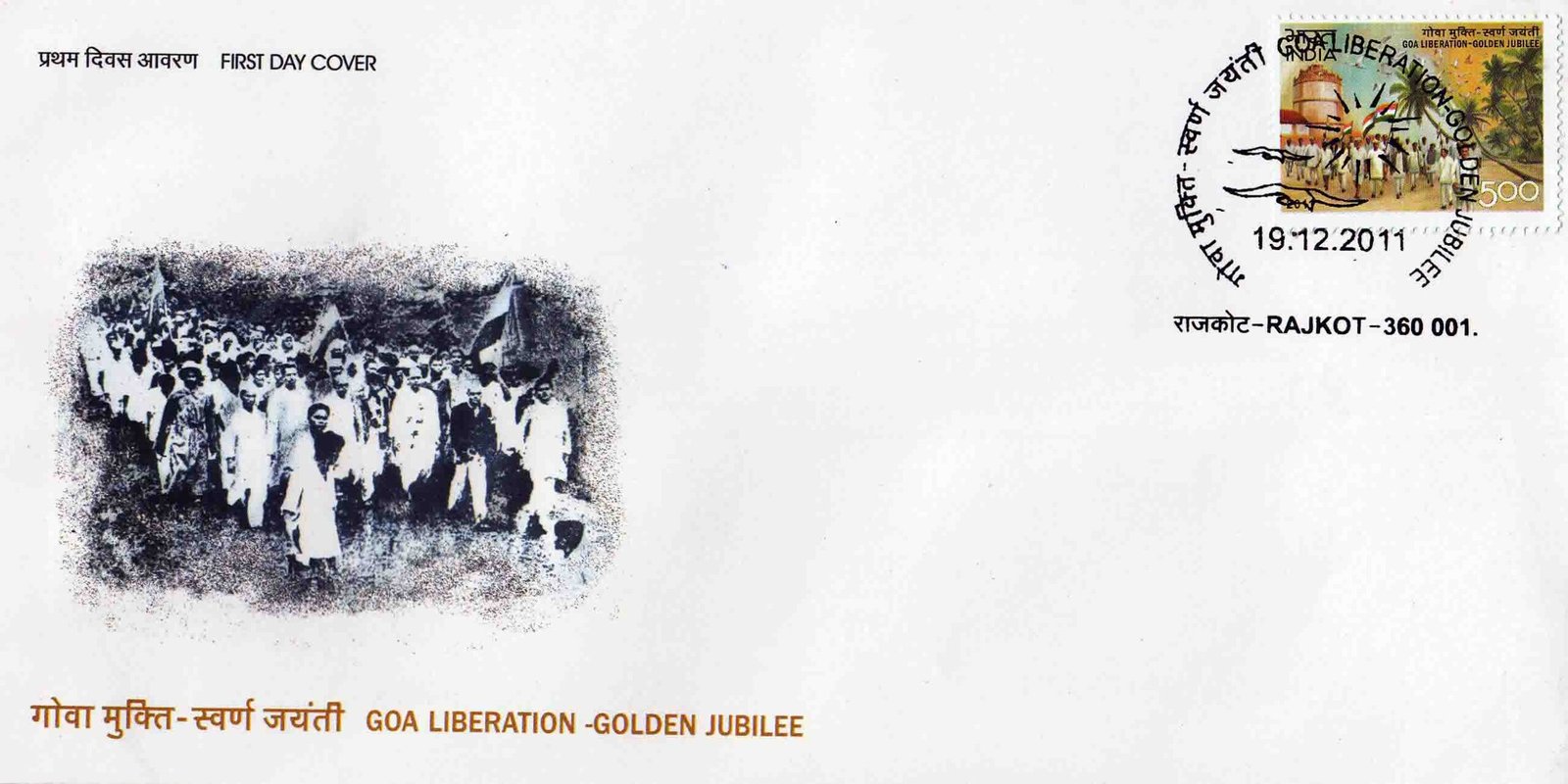
First Day Cover
Leave a Comment
You must be logged in to post a comment.