Golden Voices of Yesteryears

Technical Data
| Date of Issue | May 15, 2003 |
|---|---|
| Denomination | Rs. 20 |
| Quantity | 100,000 |
| Perforation | Syncopated13¼ x 13½ |
| Printer | Calcutta Security Printers Ltd |
| Printing Process | Offset Lithography |
| Watermark | No Watermark |
| Colors | Multicolor |
| Credit (Designed By) | Sh. Sankha Samanta |
| Catalog Codes |
Michel IN BL18 Stamp Number IN 2007a Yvert et Tellier IN BF17 Stanley Gibbons IN MS2133 |
| Themes | Famous people | Men | Optical Instruments | Singers |
Stamps in this Miniature Sheet



Legends of Indian Film Music
Film music is an inseparable part of life in India, resonating across urban and rural landscapes alike. Songs in multiple languages, rich in melody and emotion, accompany every occasion—from celebrations and cultural events to everyday moments. Blending classical, folk and modern influences, film music has truly become the “folk music” of the present generation.
A defining feature of Indian cinema is its songs. Since the 1930s, playback singing has enabled talented vocalists to lend their voices to actors, giving rise to legendary singers who became cultural icons. Among the greatest of these are Kishore Kumar, Mukesh, Mohammed Rafi, and Hemant Kumar—voices that defined the golden era of Indian film music.
Kishore Kumar – The Versatile Entertainer
Kishore Kumar (1929–1987) was a multi-talented personality—singer, actor, composer and director. Beginning with Ziddi (1948), he initially focused on acting, but his songs in Aradhana (1969) marked a spectacular return to playback singing. His unique yodelling style and expressive voice made him immensely popular. With a blend of humour, emotion and energy, he became one of the most loved voices in Indian cinema, winning several awards including eight Filmfare Awards.
Mukesh – The Voice of Emotion
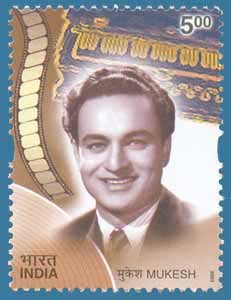
Mukesh (1923–1976) was known for his soulful and melodious singing. His early success came with “Dil jalta hai…” from Pehli Nazar (1945), and he went on to immortalise songs like “Awara hoon…” and “Mera joota hai japani…”. His voice, filled with pathos and simplicity, connected deeply with listeners. A versatile singer, he also rendered ghazals and bhajans, earning five Filmfare Awards and a National Award for “Kai baar yun dekha hai…”.
Mohammed Rafi – The Master of Versatility
Mohammed Rafi (1924–1980) rose to fame with Baiju Bawara and quickly became one of the most celebrated playback singers. Known for his smooth voice and extraordinary range, he could effortlessly move between genres—devotional songs, ghazals, romantic melodies and energetic numbers. His ability to maintain melody even at high pitch set him apart. He received the National Film Award for “Kya hua tera vaada…”.
Hemant Kumar – The Soulful Composer-Singer
Hemant Kumar (1920–1989), also known as Hemanta Mukherjee, was both a distinguished singer and composer. His deep, resonant voice created timeless melodies in films like Nagin, Kohraa and Bees Saal Baad. He also brought the essence of Rabindra Sangeet into film music. His innovative use of instruments, such as the clavichord in Nagin, showcased his creative brilliance.
Philatelic Tribute
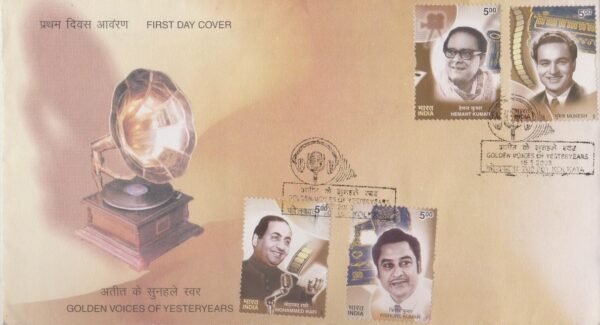
To honour these legendary artists, India Post issued a Miniature Sheet consisting of set of four commemorative postage stamps under the series “Golden Voices of Yesteryears.” These stamps celebrate the immense contribution of these singers, whose voices continue to inspire generations.
Legacy
The music of Kishore Kumar, Mukesh, Mohammed Rafi and Hemant Kumar transcends time. Their songs remain etched in the hearts of millions, symbolising the golden age of Indian cinema and the enduring power of melody.
First Day Cover