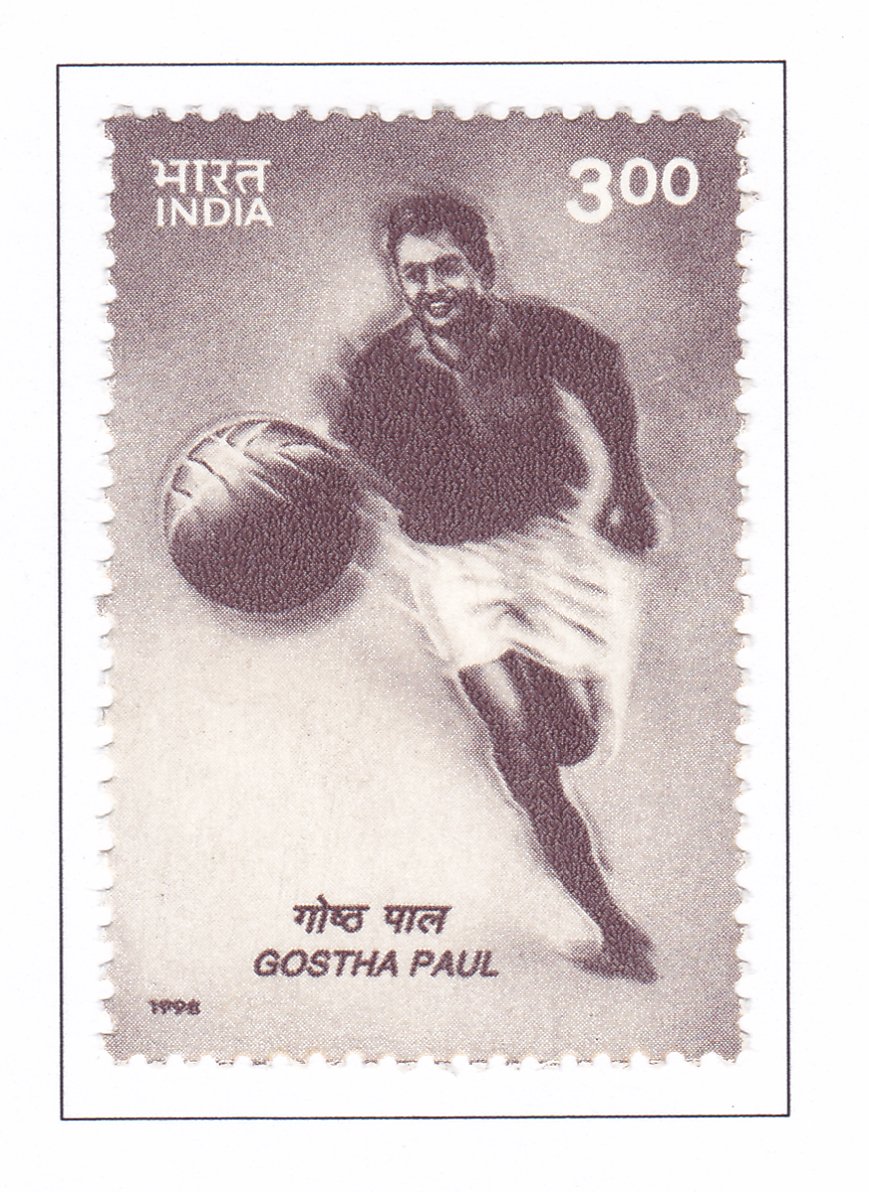
Gostha Paul (1896-1976)
Technical Data
| Date of Issue | August 20, 1998 |
|---|---|
| Denomination | Rs. 3 |
| Quantity | 400,000 |
| Perforation | comb 13 |
| Printer | Security Printing Press, Nashik |
| Printing Process | Photogravure |
| Watermark | No Watermark |
| Colors | Maroon |
| Credit (Designed By) | Sh. Bharati Mirchandani |
| Catalog Codes |
Michel IN 1641 Stamp Number IN 1702 Yvert et Tellier IN 1407 Stanley Gibbons IN 1805 |
| Themes | Commemoration | Famous people | Football (Soccer) | Men | Sports |
Legend of Indian Football
Gostha Behari Paul is remembered as one of the greatest pioneers in the history of Indian football. Revered as the doyen of Indian football, he became a symbol of national pride during the pre-independence era and inspired generations through skill, courage, and patriotism.
Known for his defensive brilliance, he was famously called “Chiner Pracheer” (Great Wall of China).
Early Life of Gostha Behari Paul
Gostha Behari Paul was born on 20 August 1896 at Bhojeshwar.
He moved to Kolkata in 1907, where he was introduced to football at Kumartuli Park in North Calcutta.
This was the beginning of a legendary sporting journey.
Rise of Indian Football After 1911
In 1911, Mohun Bagan became the first Indian team to win the IFA Shield, defeating the Yorkshire Regiment 2–1.
This historic victory gave Indians confidence during colonial rule and made football immensely popular, especially in West Bengal.
The later rise of Gostha Behari Paul further strengthened this passion for the sport.
Mohun Bagan Career
Discovered by Rajen Sen at Bhagyakul, Gostha Behari Paul played his first match for Mohun Bagan in 1913 at the age of 16 against Dalhousie F.C.
He continued to represent Mohun Bagan without interruption for 22 years, until 1935.
This remarkable loyalty made him one of the club’s most celebrated icons.
Defensive Greatness and Famous Titles
Gostha Paul was known for his exceptional defending, strength, and leadership.
After a match against D.C.L.I., Rangoon in the IFA Shield, the newspaper The Englishman praised him as:
“Gostha impregnable as Chinese Wall.”
This comparison led to his popular title:
Chiner Pracheer (Great Wall of China)
Another major compliment came after a Rovers Cup final, when The Times of India described him as:
“Paul, the finest back ever played in Bombay.”
Captaincy and International Leadership
Gostha Behari Paul captained Mohun Bagan from 1921 to 1926.
He also led the Indian football contingent on its first foreign tour to Sri Lanka in 1924.
However, in 1934, he refused to lead the IFA XI to South Africa, supporting Mahatma Gandhi and opposing apartheid.
This reflected his strong moral convictions.
Padma Shri and Recognition
On 27 April 1962, Gostha Behari Paul became the first footballer to receive the Padma Shri, awarded by Rajendra Prasad.
Other honors include:
- A 13-foot bronze statue in front of Akashbani Bhavan, Kolkata
- The VIP Gallery of Mohun Bagan Stadium named Gostha Paul Stand
These tributes reflect his unmatched place in Indian football history.
Patriotism and Legacy
Gostha Paul saw football as more than a sport. During colonial rule, he believed the football field was one of the few places where Indians could challenge British dominance.
His words captured that spirit:
“The football arena was the only place where we could fight them incessantly.”
He became a symbol of:
- Patriotism
- Dedication
- Discipline
- Courage
- National pride
Journalist Rakhal Bhattacharya famously said:
“India has produced many footballers of quality, but only one Gostha Paul.”
Death and Remembrance
Gostha Behari Paul passed away on 8 April 1976.
His legacy remains deeply respected among football lovers in India.
Commemorative Stamp
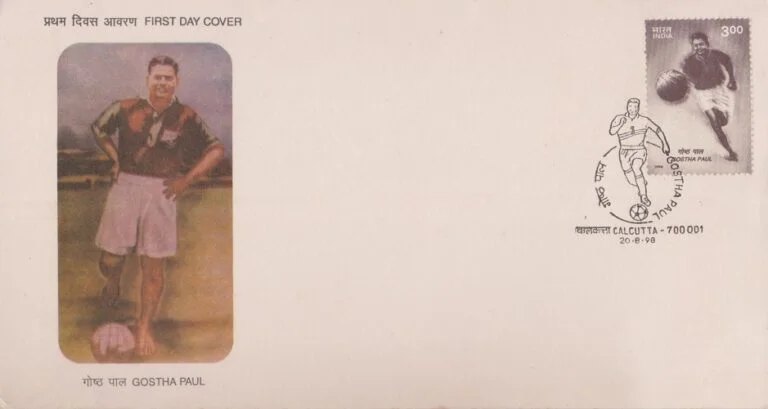
To honor his memory, the Department of Posts issued a commemorative postage stamp celebrating the birth anniversary of this legendary footballer.
Conclusion
Gostha Behari Paul was not only one of India’s greatest footballers but also a symbol of self-respect and resistance during colonial times. His achievements for Mohun Bagan, leadership in Indian football, and lifelong patriotism make him one of the most iconic names in Indian sports history.
First Day Cover