Government Museum, Chennai

Technical Data
| Date of Issue | June 19, 2003 |
|---|---|
| Denomination | Rs. 25 |
| Quantity | 100,000 |
| Perforation | comb13 x 13½ |
| Printer | Calcutta Security Printers Ltd |
| Printing Process | Offset Lithography |
| Watermark | No Watermark |
| Colors | Multicolor |
| Credit (Designed By) | Shri Kamleshwar Singh |
| Catalog Codes |
Michel IN BL20 Stamp Number IN 2012a Yvert et Tellier IN BF19 Stanley Gibbons IN MS2140 WADP Numbering System - WNS IN024MS.2003 |
| Themes | Architecture | Art | Coins | Museums | Musical Instruments | Sculptures | Statues | Theatre |
Stamps in this Miniature Sheet

A Dynamic Centre of Heritage
Museums today are no longer mere storehouses of antiques and artefacts; they have evolved into vibrant centres of knowledge, education and cultural engagement. They inform, inspire and even entertain, playing a vital role in preserving and presenting history in meaningful ways.
Evolution of Museums in India
Modern museums were introduced in India during the British period, beginning with the establishment of the Indian Museum in 1814. However, the concept of preserving and showcasing art and culture existed much earlier, as seen in prehistoric cave paintings like those at the Bhimbetka Caves. Over time, temple art, stupas and painting galleries contributed to a uniquely Indian tradition of visual storytelling.
Introduction to Government Museum, Chennai
The Government Museum Chennai is one of the oldest and largest museums in the country. Established in 1851 as a museum of practical geology, it gradually expanded into a comprehensive institution covering diverse fields of knowledge.
Collections and Sections
Today, the museum is a multipurpose institution with several specialised sections, including:
- Archaeology
- Art
- Anthropology
- Numismatics
- Zoology
- Botany
- Geology
- Children’s Museum
It also houses a Chemical Laboratory for conservation, an Education Section for outreach programmes and a Design and Display Section for exhibitions. These divisions collectively showcase the rich cultural and natural heritage of South India.
Cultural Significance
The museum plays a key role in presenting heritage within its social and historical context. By doing so, it promotes national integration and fosters a deeper understanding of India’s diverse traditions. Its well-curated galleries and professional management make it an institution of excellence.
Philatelic Tribute
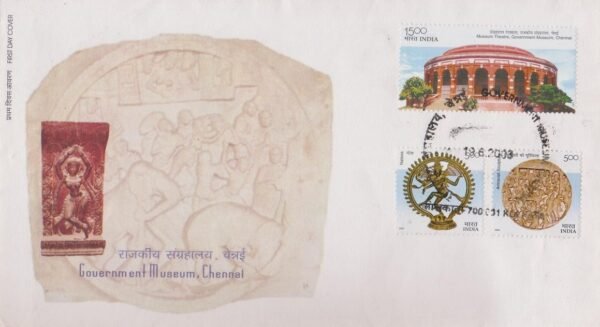
To celebrate the 151st anniversary of the museum, India Post issued a Miniature sheet consisting of a set of three commemorative stamps along with a miniature sheet. These stamps highlight some of the museum’s remarkable exhibits:
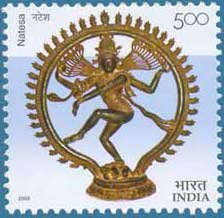
- A 12th-century bronze Nataraja (Natesa) from Thanjavur, noted for its intricate ornamentation
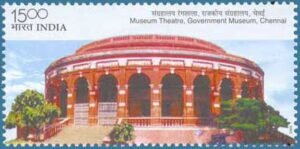
- The iconic Museum Theatre, a heritage building with a distinctive semi-circular architectural design
- A sculptured medallion from Amaravati (circa 150 A.D.), depicting a story related to King Bandhuma
The miniature sheet further showcases additional treasures from the museum’s vast collection.
Legacy
The Government Museum, Chennai stands as a testament to India’s rich cultural legacy. It demonstrates how museums, when effectively managed, can serve as powerful sources of education and inspiration—connecting people with their past while enriching the present and future.
First Day Cover