
Great Himalayan National Park

Technical Data
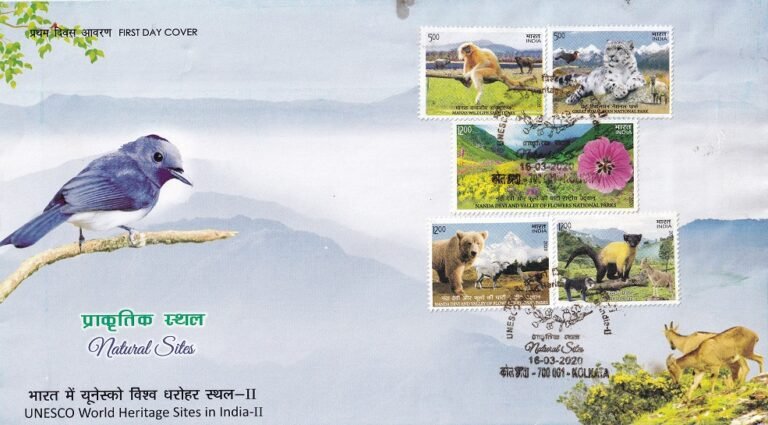
| Stamp Set | UNESCO World Heritage Sites in India - II |
|---|---|
| Date of Issue | March 16, 2020 |
| Denomination | Rs. 5 |
| Quantity | 500,000 |
| Perforation | 13¼ x 13¾ |
| Printer | Security Printing Press, Hyderabad |
| Printing Process | Offset Lithography |
| Watermark | No Watermark |
| Colors | Multicolor |
| Credit (Designed By) | Sh. Brahm Prakash Sh. Pallab Bose |
| Catalog Codes |
Michel IN 3663A Stamp Number IN 3214 Yvert et Tellier IN 3340 Stanley Gibbons IN 3733 Phila-India IN 3700 |
| Themes | Animals (Fauna) |
Introduction
The Great Himalayan National Park (GHNP), located in the state of Himachal Pradesh, is one of India’s most important protected natural areas. Renowned for its rich biodiversity and pristine Himalayan landscapes, the park represents the ecological wealth of the western Himalayas and plays a vital role in conservation.
Location and Extent
Established in 1984, the Great Himalayan National Park covers an area of 1,171 square kilometres. The park spans a wide altitudinal range from 1,500 metres to over 6,000 metres, encompassing diverse habitats such as temperate forests, alpine meadows and high mountain ecosystems.
UNESCO World Heritage Status
In June 2014, the Great Himalayan National Park was inscribed on the UNESCO World Heritage List. This recognition highlights its outstanding universal value, intact ecosystems and significance in conserving biodiversity unique to the Himalayan region.
Flora and Fauna
The park protects more than 800 species of plants, including numerous rare and medicinal herbs. It is home to 31 species of mammals and 209 species of birds, along with a wide variety of reptiles, amphibians and insects. This remarkable biological diversity makes the park a vital refuge for Himalayan wildlife.
Wildlife and High-Altitude Habitats
The remote valleys and rugged terrain of the park provide shelter to iconic species such as the Snow Leopard, Himalayan Brown Bear, Himalayan Tahr, Musk Deer and Blue Sheep. Treks of 35 to 45 kilometres through the park’s valleys lead to high-altitude habitats above 3,500 metres, where wildlife sightings are particularly rewarding during the autumn season (September–November).
Conservation Significance
The Great Himalayan National Park stands as a symbol of India’s commitment to protecting fragile mountain ecosystems. Its inclusion as a UNESCO World Heritage Site underscores the global importance of conserving natural landscapes that support biodiversity, ecological balance and sustainable environmental processes.
Commemorative Postage Stamps
In recognition of its natural heritage value, the Department of Posts is pleased to commemorate the Great Himalayan National Park through the issuance of Commemorative Postage Stamps, celebrating India’s rich natural legacy and its globally significant World Heritage Sites.
First Day Cover
Leave a Comment
You must be logged in to post a comment.