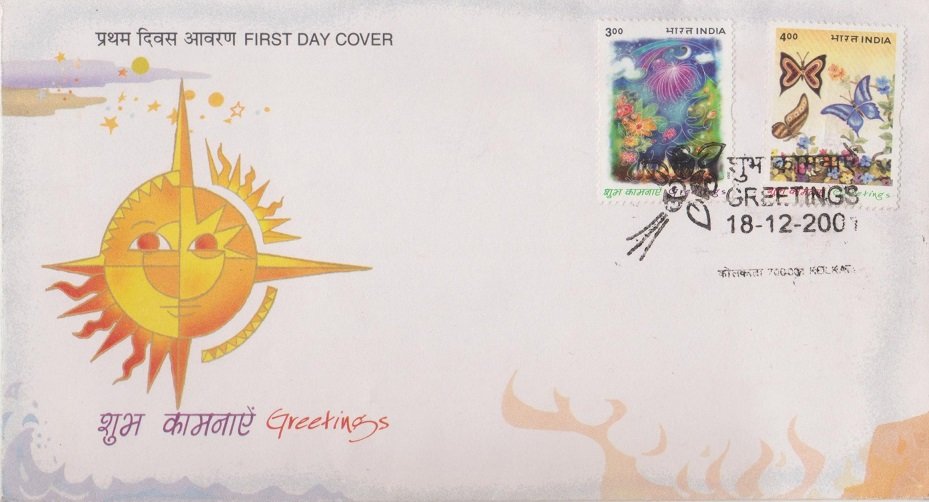
Greetings
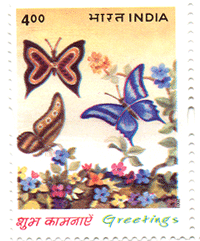
Technical Data
| Stamp Set | Greetings Stamps |
|---|---|
| Date of Issue | December 18, 2001 |
| Denomination | Rs. 4 |
| Quantity | 3,000,000 |
| Perforation | comb 13 |
| Printer | Calcutta Security Printers Ltd |
| Printing Process | Offset Lithography |
| Watermark | No Watermark |
| Colors | Multicolor |
| Credit (Designed By) | Shri Kamleshwar Singh |
| Catalog Codes |
Michel IN 1882 Stamp Number IN 1933 Yvert et Tellier IN 1647 Stanley Gibbons IN 2048 |
| Themes | Animals (Fauna) | Butterflies and Moths | Flowers | Greetings | Insects | Plants (Flora) |
History, Evolution, and Cultural Significance
Greetings cards have long been an important medium for expressing thoughts, emotions, and relationships. In a subtle yet meaningful way, they help celebrate special occasions and strengthen bonds between people across cultures and generations.
Importance of Greetings in Human Interaction
Greetings play a vital role in social interaction. They are not only used to mark important celebrations but also to convey emotions such as love, friendship, gratitude, sympathy, and congratulations. Over time, greetings cards have become an integral part of cultural traditions worldwide.
Evolution of Greetings Cards
The history of greetings dates back to ancient civilizations like Ancient Egypt and Ancient Rome, where people exchanged symbolic gifts such as scented items, laurel branches, and olive branches decorated with gold leaf during the New Year.
With the rise of Christianity, this practice evolved further. A major turning point came with the invention of the printing press, which made it easier to produce greeting messages. Later, the introduction of the penny post in 1840 made sending greetings cards more accessible, embedding them deeply into everyday social life.
Over the centuries, greetings have taken many forms—from messages written on leaf and bark scrolls to engravings on gold, silver, and copper plaques, and eventually to printed cards and modern electronic messages.
Greetings Cards in India
In India, the tradition of sending greetings cards has grown significantly over time. Today, greetings are exchanged during a wide range of festivals and occasions, including:
- Diwali
- Holi
- Pongal
- Durga Puja
- Baisakhi
- Christmas
- Eid
- Raksha Bandhan
- Valentine’s Day
These cards are used to express a wide spectrum of emotions and sentiments, making them an essential part of modern communication.
Modern Relevance of Greetings Cards
Despite the rise of digital communication, greetings cards continue to hold emotional value. Whether sent through traditional post or electronic means, they add a personal touch that strengthens relationships.
Recognizing their cultural importance, the Department of Posts has issued special commemorative postage stamps dedicated to greetings. These stamps enhance the message within the envelope, adding depth and meaning, and visually conveying the sender’s emotions at first glance.
Conclusion
From ancient symbolic exchanges to modern greetings cards, the tradition of sharing greetings has evolved significantly. Yet, its core purpose remains unchanged—to connect people, celebrate life’s moments, and express heartfelt emotions.
First Day Cover