
Guru Dutt – 40th Death Anniversary (1925-1964)
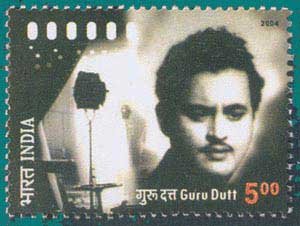
Technical Data
| Date of Issue | October 10, 2004 |
|---|---|
| Denomination | Rs. 5 |
| Quantity | 600,000 |
| Perforation | comb 13½ x 13¼ |
| Printer | Security Printing Press, Nashik |
| Printing Process | Photogravure |
| Watermark | No Watermark |
| Colors | Multicolor |
| Credit (Designed By) | Sh. Sankha Samanta Smt. Alka Sharma |
| Catalog Codes |
Michel IN 2052 Stamp Number IN 2080 Yvert et Tellier IN 1817 Stanley Gibbons IN 2231 WADP Numbering System - WNS IN038.04 |
| Themes | Anniversaries and Jubilees | Famous people | Men | Movies |
Legendary Filmmaker of Hindi Cinema
The 1950s are widely regarded as the golden era of Hindi cinema, marked by visionary filmmakers and talented artists who left a lasting impact on Indian films. Among them was Guru Dutt, born Guru Dutt Shivshankar Padukone, a remarkable director, actor, and producer who created a unique cinematic style. His films were known for their emotional depth, poetic storytelling, and striking visual compositions, making them instantly recognizable.
Early Life and Education
Guru Dutt was born on 9 July 1925 in Bangalore (now Bengaluru). His father, Shivshankar Padukone, worked as a school headmaster and later in a bank, while his mother Vasanthi Padukone was a school teacher. He grew up in a family with two brothers and two sisters.
He received his early education in Calcutta (now Kolkata). Due to financial difficulties, he could only complete his studies up to matriculation in 1941. However, from an early age he displayed strong artistic interests, particularly in photography, dance, and music, especially Hindi and Bengali folk traditions.
Training in Dance and Entry into Films
To pursue his passion for dance, Guru Dutt joined the Uday Shankar India Culture Centre in Almora. After completing his dance training, he entered the film industry.
He received his first major opportunity at Prabhat Film Company in Pune, where he worked for three years as a dance director. During this period, he also assisted film directors and occasionally appeared in small acting roles.
After completing his contract with Prabhat Films, Guru Dutt worked as an assistant director to Amiya Chakravarty in the film Girls School. Later, in 1950, he assisted Gyan Mukherjee in the Bombay Talkies production Sangram.
Breakthrough as a Director
Guru Dutt’s big break came in 1951 when his close friend Dev Anand invited him to direct the crime thriller Baazi. The film was a major success and became a trendsetter in the genre of crime films in India.
During the recording of songs for Baazi, Guru Dutt met the talented playback singer Geeta Dutt (then known as Geeta Roy). The two fell in love and were married on 26 May 1953.
Iconic Films and Creative Success
The 1950s and early 1960s were the most productive years of Guru Dutt’s career. He gained widespread acclaim as a director, actor, and producer with several landmark films.
Some of his most celebrated works include:
- Aar Paar
- Mr. & Mrs. 55
- Pyaasa
- Kaagaz Ke Phool
Although Kaagaz Ke Phool is now regarded as a cinematic classic, it was a box-office failure at the time. The disappointment deeply affected Guru Dutt, and he never directed another film afterward.
However, he continued working as a producer and actor. Soon after, he produced and starred in the successful film Chaudhvin Ka Chand, which recovered the financial losses from his previous film.
Another major success came with Sahib Bibi Aur Ghulam, which won the President’s Silver Medal and the Film of the Year Award from the Bengal Film Journalists Association and was screened at the Berlin International Film Festival.
Acting Career
Apart from his own productions, Guru Dutt also acted in films produced by other filmmakers, including:
- Twelve O’Clock
- Sautela Bhai
- Bahurani
- Bharosa
Filmmaking Style and Legacy
Guru Dutt was widely admired as a perfectionist filmmaker who refused to compromise on artistic quality. His films are remembered for:
- Innovative lighting techniques using light and shadow
- Creative song picturization
- Thoughtful dialogues and poetic storytelling
- Deeply emotional character development
- Striking cinematography and camera work
He was also among the early filmmakers in India to use long focal length lenses such as 100 mm and 75 mm for dramatic close-up shots.
According to his former assistant Raj Khosla, Guru Dutt aimed not merely to create successful films but to produce great and unforgettable cinema. Filmmaking, for him, was a passionate obsession.
Death and Recognition
The Hindi film industry suffered a profound loss when Guru Dutt passed away on 10 October 1964. Despite his relatively short career, his films remain timeless classics and continue to influence filmmakers around the world.
In recognition of his outstanding contribution to Indian cinema, India Post issued a commemorative postage stamp honoring the unique legacy of Guru Dutt, one of the most visionary filmmakers in the history of Indian cinema.
First Day Cover
