
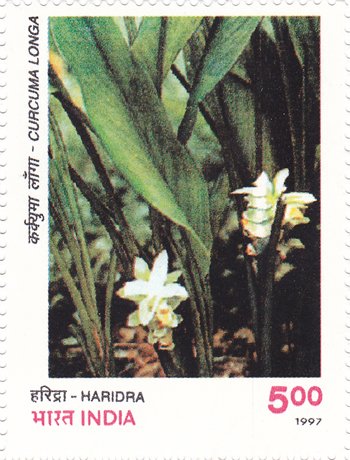
Haridra (Curcuma longa)
Technical Data
| Stamp Set | Indian Medicinal Plants |
|---|---|
| Date of Issue | October 28, 1997 |
| Denomination | Rs. 5 |
| Perforation | comb 14 |
| Printer | Security Printing Press, Nashik |
| Printing Process | Photogravure |
| Watermark | No Watermark |
| Colors | Multicolor |
| Credit (Designed By) | |
| Catalog Codes |
Michel IN 1584 Stamp Number IN 1641 Yvert et Tellier IN 1356 Stanley Gibbons IN 1748 |
| Themes | Plants (Flora) |
Haridra (Curcuma longa), commonly known as turmeric, is a highly valued medicinal plant belonging to the Zingiberaceae family. A perennial herb native to Southern Asia, it has been cultivated throughout India for centuries and occupies an important place in Ayurveda, traditional healing practices, and Indian daily life.
Haridra is widely recognized for its healing and protective properties. In traditional medicine, it is used as a carminative, helping in cases of diarrhoea and digestive discomfort. It has also been prescribed for intermittent fevers, disorders of the blood, liver ailments, and jaundice. In addition, Haridra is considered beneficial in treating certain non-tubercular respiratory diseases.
Externally, a decoction or paste made from the rhizome is applied to relieve catarrh, scabies, skin diseases, pains, and bruises. Internally, it has been used to purify the blood and restore balance in the body.
Haridra can grow in regions from sea level up to an altitude of about 1,220 metres, though it is sensitive to atmospheric temperature and climatic conditions.
Commemorative postage stamp
Known for its bright golden colour and remarkable medicinal qualities, Haridra remains one of India’s most important natural remedies. It was honoured by the Department of Posts through the commemorative postage stamp series on the Medicinal Plants of India.