
Henry Louis Vivian Derozio

Technical Data
| Date of Issue | December 15, 2009 |
|---|---|
| Denomination | Rs. 5 |
| Quantity | 400,000 |
| Perforation | 13 x 13½ |
| Printer | India Security Press, Nasik |
| Printing Process | Wet Offset |
| Watermark | No Watermark |
| Colors | Multicolor |
| Credit (Designed By) | Sh. Brahm Prakash |
| Catalog Codes |
Michel IN 2449 Stamp Number IN 2387 Stanley Gibbons IN 2676 WADP Numbering System - WNS IN102.2009 |
| Themes | Anniversaries and Jubilees | Famous people | Literary People (Poets and Writers) | Men |
Pioneer of the Bengal Renaissance
The nineteenth-century Bengal Renaissance marked a watershed in Indian intellectual history, when tradition encountered modernity in a powerful socio-cultural awakening. At the forefront of this transformation stood Henry Louis Vivian Derozio, widely regarded as one of the earliest pioneers of the movement. Born on 10 April 1809, Derozio’s radical ideas and fearless questioning challenged the obscurantist and superstitious orthodoxy of his time.
Radical Teacher and the Young Bengal Movement
Portuguese by descent and liberal-humanist by conviction, Derozio became a teacher at Hindu College (now Presidency University, Kolkata). His style of teaching went far beyond conventional classroom instruction. He encouraged students to question authority, debate social customs, discuss colonialism, and advocate women’s education and reform.
This spirit of free inquiry gave rise to the Young Bengal Movement, a group of students inspired by his progressive ideals. However, his radicalism alarmed conservative sections of society. The Governing Body of the College ultimately expelled him on charges of promoting atheism and encouraging disregard for traditional norms.
Yet, his influence endured, shaping the trajectory of socio-religious reform in Bengal during the latter half of the nineteenth century.
Literary Contributions and Modern Indian Writing
Derozio was equally distinguished as a poet. Writing under the pseudonym “Juvenis,” he contributed to the India Gazette and later became its Assistant Editor. At the age of eighteen, he published his first volume of poems, followed in 1827–28 by a second edition featuring notable works such as The Faqir of Jungeera.
He is regarded as one of the earliest modern Anglo-Indian poets writing in English, preceding literary figures such as Sarojini Naidu. His poetry addressed contemporary social concerns—widow remarriage, national pride, and the cultural heritage of India—while reflecting the tension between orthodoxy and emerging modern thought.
Alongside reformers like Raja Ram Mohan Roy, Derozio helped shape a new literary idiom in India, facilitating the transition from classical-vernacular traditions to modern English expression.
Intellectual Legacy and Reform Movements
Derozio’s intellectual legacy inspired later reformist initiatives such as Tattvabodhini Sabha founded by Debendranath Tagore. The ideals of rationalism and balanced reform also found resonance in movements like the Brahmo Samaj and the Ramakrishna Mission.
An intense nationalism permeated his writings, coupled with a bold critique of divisive social customs and rigid religious beliefs. His celebrated poem Harp of India reflects his deep longing for national awakening:
“Harp of my country, let me strike the strain…”
A Renaissance Spirit Remembered
Henry Louis Vivian Derozio passed away in December 1831 at the young age of 22. Though his life was brief, his ideas ignited a spirit of questioning and reform that profoundly influenced nineteenth-century India and continue to resonate in contemporary discourse.
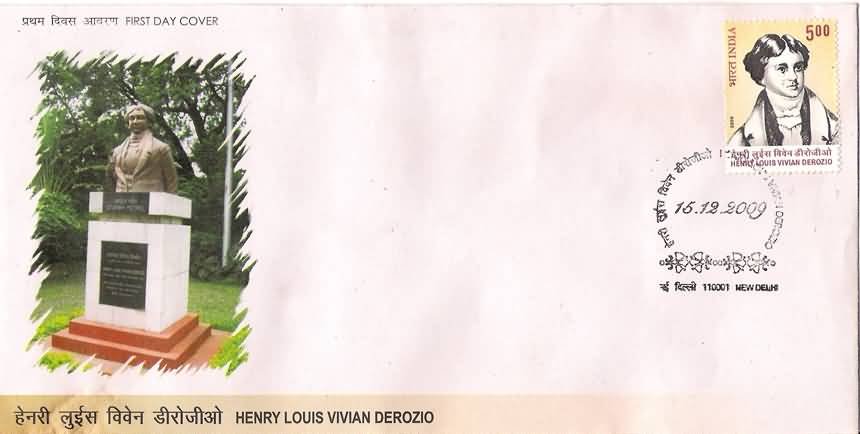
In tribute to his enduring contribution to literature, education, and national consciousness, the Department of Posts has issued a commemorative postage stamp in honour of Henry Louis Vivian Derozio—truly a Renaissance figure who helped awaken modern India.
First Day Cover
Leave a Comment
You must be logged in to post a comment.