
High Court of Jammu & Kashmir
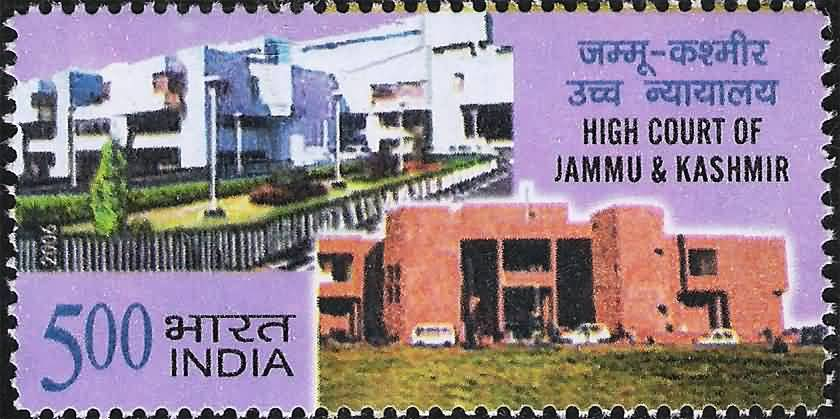
Technical Data
| Date of Issue | July 29, 2006 |
|---|---|
| Denomination | Rs. 5 |
| Quantity | 800,000 |
| Perforation | line13¼ |
| Printer | India Security Press, Nasik |
| Printing Process | Photogravure |
| Watermark | No Watermark |
| Colors | Multicolor |
| Credit (Designed By) | Sh. Brahm Prakash |
| Catalog Codes |
Michel IN 2149 Stamp Number IN 2160 Yvert et Tellier IN 1914 Stanley Gibbons IN 2336 WADP Numbering System - WNS IN029.2006 |
| Themes | Architecture | Buildings |
The High Court of Jammu and Kashmir is the highest judicial authority of the former state of Jammu and Kashmir. The full-fledged High Court was formally established in 1928, although the region had earlier systems of judicial administration under the rule of the Maharajas.
Early Judicial Administration
Before the establishment of the High Court, the Maharaja (ruler of the state) was the final authority in the administration of justice.
In 1889, the British Government advised Maharaja Pratap Singh to appoint a State Council. The Judicial Member of this Council exercised appellate powers in both civil and criminal cases.
At that time, the state had two provinces—Jammu and Kashmir—each with Chief Judges who administered justice under the supervision of the Council’s Law Member. Later, the Council was abolished and a Minister designated as Judge of the High Court was appointed by the ruler to deal with judicial matters.
Establishment of the High Court (1928)
In 1927, a new constitution for the state was adopted, creating a Ministry in the Judicial Department. Soon after, by Order No. 1 dated 26 March 1928, the High Court of Judicature for Jammu and Kashmir was formally established.
The court initially consisted of one Chief Justice and two Judges. On 26 March 1928, the Maharaja appointed:
- Lala Kanwar Sein – First Chief Justice
- Lala Bodh Raj Sawhney – Puisne Judge
- Aga Syed Hussain – Puisne Judge
The High Court holds its sittings mainly in Jammu and Srinagar.
Constitutional Developments
In 1939, the ruler promulgated the Constitution Act of 1996 (1939 A.D.), which strengthened the High Court’s independence and authority. The court was given superintendence and control over the subordinate judiciary.
The Act also created a Board of Judicial Advisers, similar to the Judicial Committee of the Privy Council, to advise the ruler in appeals against High Court decisions.
Role of the Supreme Court
When the Board of Judicial Advisers was abolished by the Constitution Act of 1956, 17 appeals were still pending. At the request of the Chief Justice, the Supreme Court of India constituted a special bench to decide these cases.
The bench consisted of:
- Mehar Chand Mahajan
- S. R. Das
- Ghulam Hassan
The bench heard the appeals in Srinagar and upheld the High Court’s decisions in all 17 cases. This was a historic event, as it marked the first time the Supreme Court held sittings outside New Delhi.
Integration with the Indian Constitution
In 1954, through the Constitution Application Order, the jurisdiction of the Supreme Court of India was extended to Jammu and Kashmir. Under Article 32 (2-A) of the Constitution, the High Court gained the power to issue writs for enforcement of fundamental rights applicable to the state.
Later, the Constitution of Jammu and Kashmir established an independent judicial system with the High Court at the top.
Present Structure
Today, the High Court has a sanctioned strength of 14 judges, consisting of:
- 9 Permanent Judges
- 5 Additional Judges
The court follows a bi-annual shifting system:
- May to October – Headquarters at Srinagar
- November to April – Headquarters at Jammu
However, both wings continue functioning throughout the year.
Commemoration
In recognition of its historical importance and contribution to the administration of justice, the Department of Posts issued a commemorative postage stamp on the High Court of Jammu & Kashmir.
First Day Cover

Leave a Comment
You must be logged in to post a comment.