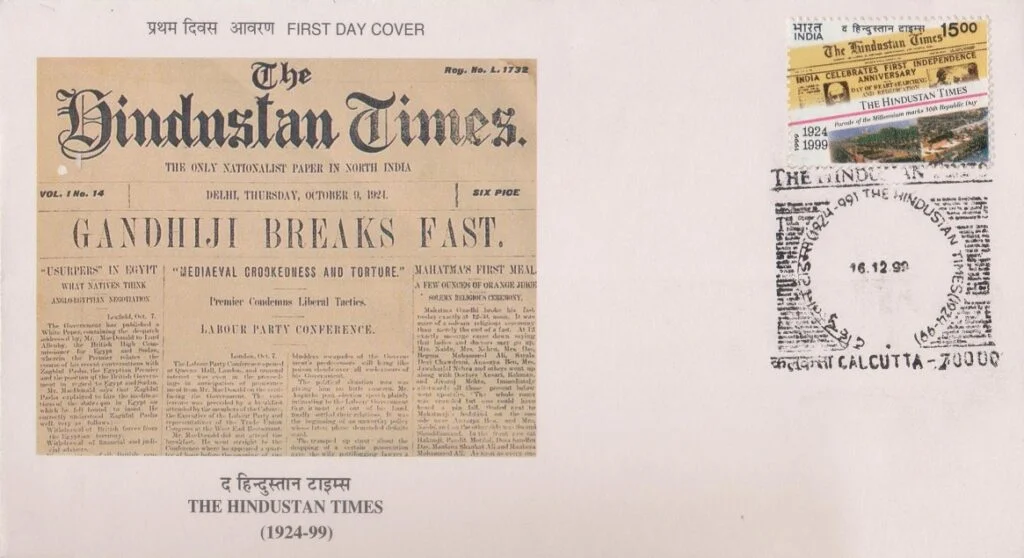
“Hindustan Times” Newspaper

Technical Data
| Date of Issue | December 16, 1999 |
|---|---|
| Denomination | Rs. 15 |
| Quantity | 1,000,000 |
| Perforation | comb 13½ x 13¼ |
| Printer | Security Printing Press, Nashik |
| Printing Process | Photogravure |
| Watermark | No Watermark |
| Colors | Multicolor |
| Credit (Designed By) | |
| Catalog Codes |
Michel IN 1728 Stamp Number IN 1789 Yvert et Tellier IN 1495 Stanley Gibbons IN 1891 |
| Themes | Anniversaries and Jubilees | Newspapers |
Hindustan Times is one of India’s most prominent and respected newspapers, with a rich legacy rooted in the country’s freedom struggle and nation-building journey. Founded as an evening daily in Delhi in 1924, its first issue was inaugurated by Mahatma Gandhi on September 24, 1924, and featured contributions from eminent leaders such as Motilal Nehru, Muhammad Ali Jinnah, and Jawaharlal Nehru.
In 1925, ownership of the newspaper was taken over by Madan Mohan Malaviya, further strengthening its nationalist foundation.
Role in India’s Freedom Movement
Due to its strong patriotic stance, the Hindustan Times frequently faced opposition from British authorities. In 1930, it suspended publication in protest against strict anti-press laws during the Salt Satyagraha.
In defiance of censorship, the newspaper took bold steps—such as secretly printing and distributing speeches by Jawaharlal Nehru when authorities attempted to suppress them. These acts led to direct confrontations with the colonial government and financial pressures due to imposed penalties.
Growth Under Visionary Leadership
At a critical juncture, when financial difficulties threatened its survival, G. D. Birla stepped in and transformed the newspaper into a leading media institution. Under his guidance, the paper attracted top editorial talent and introduced modern journalistic practices.
The Hindustan Times pioneered:
- Short, impactful editorials
- Bold front-page headlines
- Wide-ranging news coverage
It soon became an influential voice that both the British rulers and Indian intellectuals could not ignore.
Contribution to Nation-Building
After independence, the Hindustan Times actively supported India’s growth and development. Upholding values of democracy, free enterprise, and liberal thought, it earned a reputation for fairness and credibility among readers.
A notable initiative was the “Our Village Chhatera” project in the 1970s, where the newspaper directly contributed to rural development by supporting education, healthcare, and livelihood initiatives. This innovative social effort gained recognition both nationally and internationally.
Adapting to Modern Media
Over the years, The Hindustan Times has embraced technological advancements in journalism. With modern printing systems, full computerization, and visually engaging formats such as colour supplements and feature pages, it continues to evolve with changing reader preferences.
Commemorative Stamp Recognition
To celebrate its enduring legacy, the Department of Posts issued a commemorative postage stamp. The stamp and First Day Cover creatively depict historic moments through headline-style designs, symbolizing the newspaper’s role in documenting India’s journey through time.
A Legacy of Journalism and Impact
The Hindustan Times remains a cornerstone of Indian journalism. From its active role in the freedom movement to its continued contribution to public discourse, it has consistently upheld the values of truth, integrity, and social responsibility.
The commemorative stamp stands as a tribute to its remarkable journey and its lasting influence on India’s media landscape.
First Day Cover