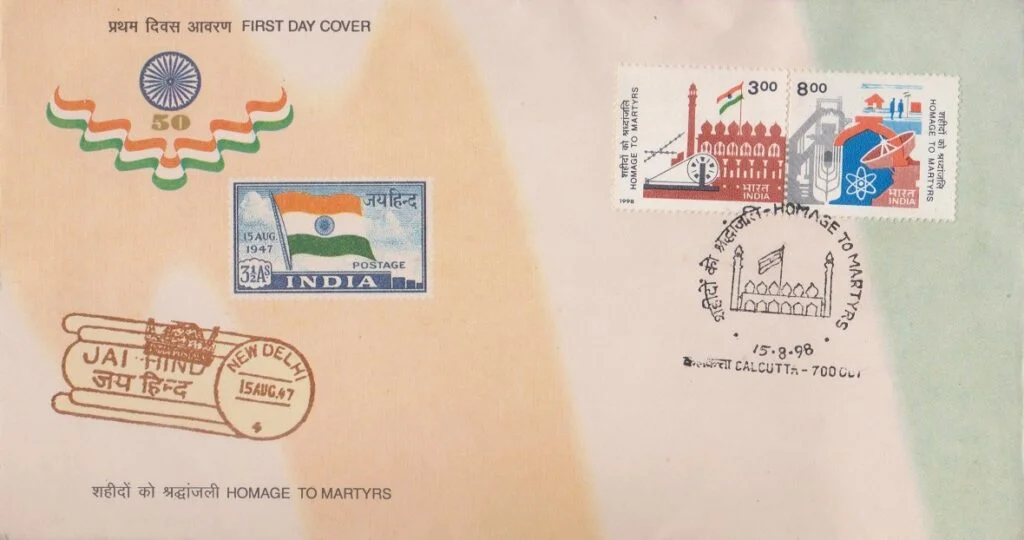
Homage To Martyrs
Technical Data
| Date of Issue | August 15, 1998 |
|---|---|
| Denomination | Rs. 11 |
| Quantity | 700,000 |
| Perforation | comb 14 |
| Printer | Security Printing Press, Nashik |
| Printing Process | Photogravure |
| Watermark | No Watermark |
| Colors | Multicolor |
| Credit (Designed By) | Smt. Vinita Sinha |
| Catalog Codes |
Michel IN 1639-1640 Stamp Number IN 1701a Yvert et Tellier IN 1405-1406 Stanley Gibbons IN 1803a |
| Themes | Industry | Science |
Stamps in this Se-Tenant
India’s Freedom Struggle and the Journey to Independence
India’s emergence as an independent nation on 15 August 1947 was the result of one of the largest and most powerful mass movements in world history. The struggle for freedom lasted nearly a century and involved sacrifices by millions of men and women across the country.
From armed uprisings to peaceful protests, from peasant revolts to national movements, India’s road to independence was marked by courage, unity, and determination.
Early Resistance Against British Rule
From the beginning of United Kingdom rule in India, people resisted foreign domination.
Several groups rose in rebellion, including:
- Peasants
- Tribal communities
- Local rulers and chiefs
- Workers and ordinary citizens
These revolts took place in many parts of India and laid the foundation for later nationalist movements.
The Revolt of 1857
The year 1857 witnessed the first large-scale armed uprising against British rule in India.
Indian Rebellion of 1857 shook the foundations of colonial authority.
Although the British suppressed the revolt through brutal force, the spirit of resistance continued to grow across the nation.
The uprising is widely regarded as the first major war of independence.
Rise of the National Movement
As the 19th century progressed, new political forces emerged and gave birth to a nationwide freedom movement.
After the end of the First World War, India entered a new era of mass struggle demanding:
Self-Rule (Swaraj)
At this stage, common people became active participants in politics, and Mahatma Gandhi emerged as the greatest leader of India’s freedom struggle.
Jallianwala Bagh Massacre (1919)
One of the darkest events of the 20th century occurred on 13 April 1919, during the festival of Baisakhi.
At Jallianwala Bagh Massacre in Amritsar, troops led by General Dyer opened fire without warning on a peaceful and unarmed gathering.
The massacre shocked the nation and became a turning point in India’s struggle for freedom.
Non-Cooperation Movement
After Jallianwala Bagh, Mahatma Gandhi launched the Non-Cooperation Movement.
This movement inspired nationwide protests and intensified peasant struggles in:
- Uttar Pradesh
- Bihar
- Rajasthan
- Andhra Pradesh
- Bengal
It marked the rise of peaceful mass resistance.
Revolutionary Movement of the 1920s and 1930s
Alongside non-violent movements, revolutionary groups also played an important role.
Many revolutionaries gradually shifted focus from violent methods to organizing:
- Workers
- Peasants
- Youth groups
- Public resistance movements
They became an important part of the larger freedom struggle.
Simon Commission Boycott and Civil Disobedience
The arrival of the Simon Commission led to widespread protests across India.
Soon after, the Indian National Congress launched the:
Civil Disobedience Movement
Its goal was:
Purna Swaraj (Complete Independence)
This movement included protests, marches, refusal to pay taxes, and mass arrests.
Quit India Movement
The Quit India Movement became the third major phase of India’s mass freedom struggle.
Launched in 1942, it called for the immediate end of British rule.
Millions of Indians participated through:
- Demonstrations
- Strikes
- Boycotts
- Courting arrest
The nation rose in one united voice demanding freedom.
Subhas Chandra Bose and Azad Hind Fauj
During the Second World War, Subhas Chandra Bose formed the Provisional Government of Azad Hind.
He led the Indian National Army with the slogan:
Jai Hind
The INA inspired Indians with military resistance and nationalist pride.
The trials of INA officers later triggered massive public protests across the country.
Naval Mutiny and Final Collapse of British Rule
In 1946, unrest spread to sections of the armed forces.
The most serious was the:
Royal Indian Navy Mutiny
These developments convinced the British government that their empire in India could no longer continue.
Negotiations for transfer of power accelerated.
India Becomes Independent – 15 August 1947
After generations of sacrifice, India finally became free on:
15 August 1947
India emerged as an independent nation.
At the historic Constituent Assembly session, Rajendra Prasad paid tribute to all known and unknown freedom fighters who gave their lives for the nation.
Building Modern India After Independence
After freedom, India began building a strong modern nation through progress in:
- Industry
- Science
- Technology
- Education
- Agriculture
- Space and polar research
Indian scientists later reached Antarctica, symbolizing the spirit of exploration and achievement.
Commemorative Stamp
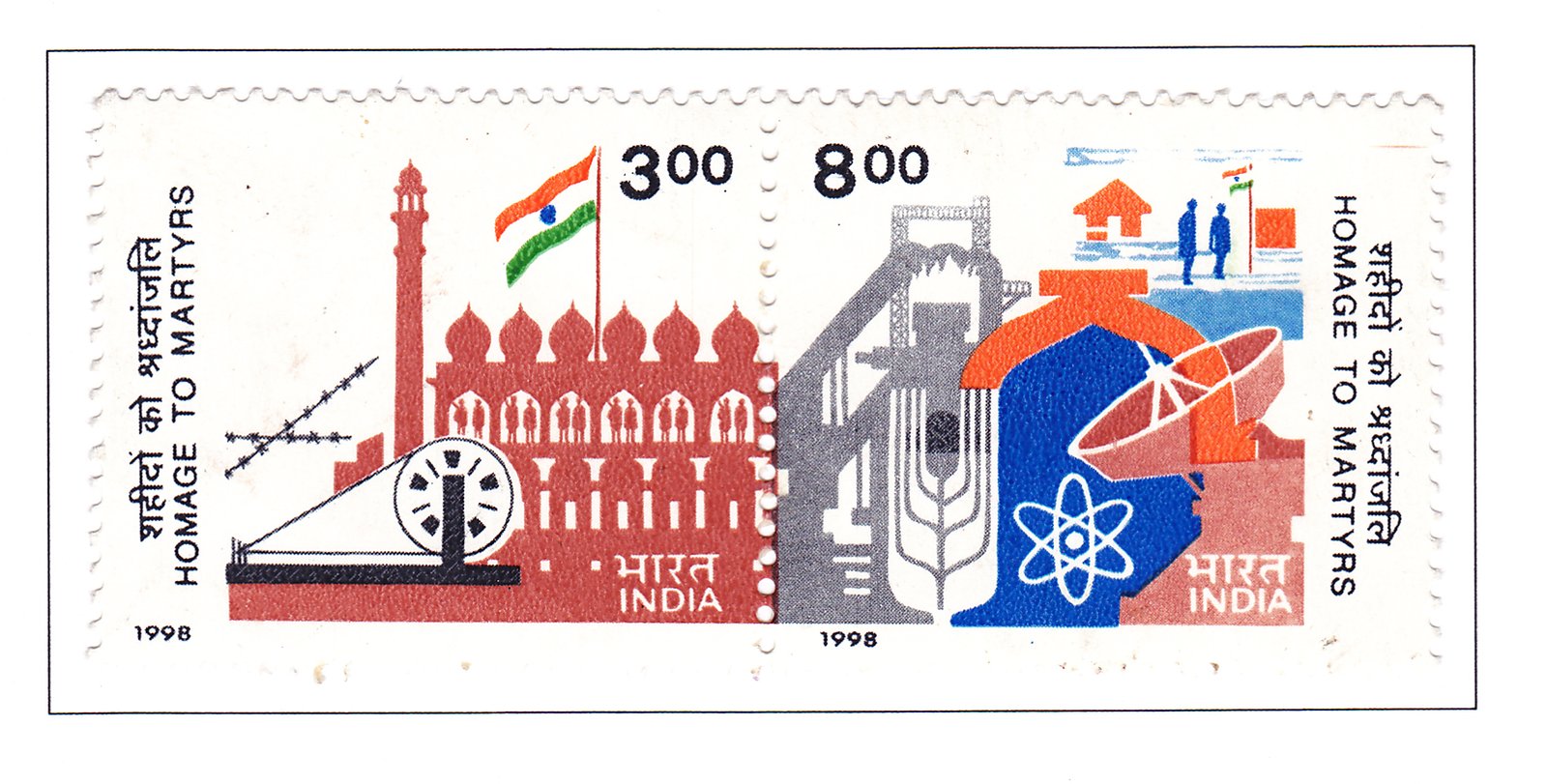
To mark the 50th Anniversary of Independence, the Department of Posts issued a special commemorative se-tenant set of two stamps honoring:
- The long freedom struggle
- The attainment of independence
- India’s achievements after 1947
Conclusion
India’s independence was won through unmatched sacrifice, unity, and determination. From the Revolt of 1857 to Quit India, from Gandhi’s non-violence to Bose’s military leadership, every phase shaped the nation’s destiny. The freedom struggle remains one of the proudest chapters in Indian history and continues to inspire generations.
First Day Cover