
Horses of India
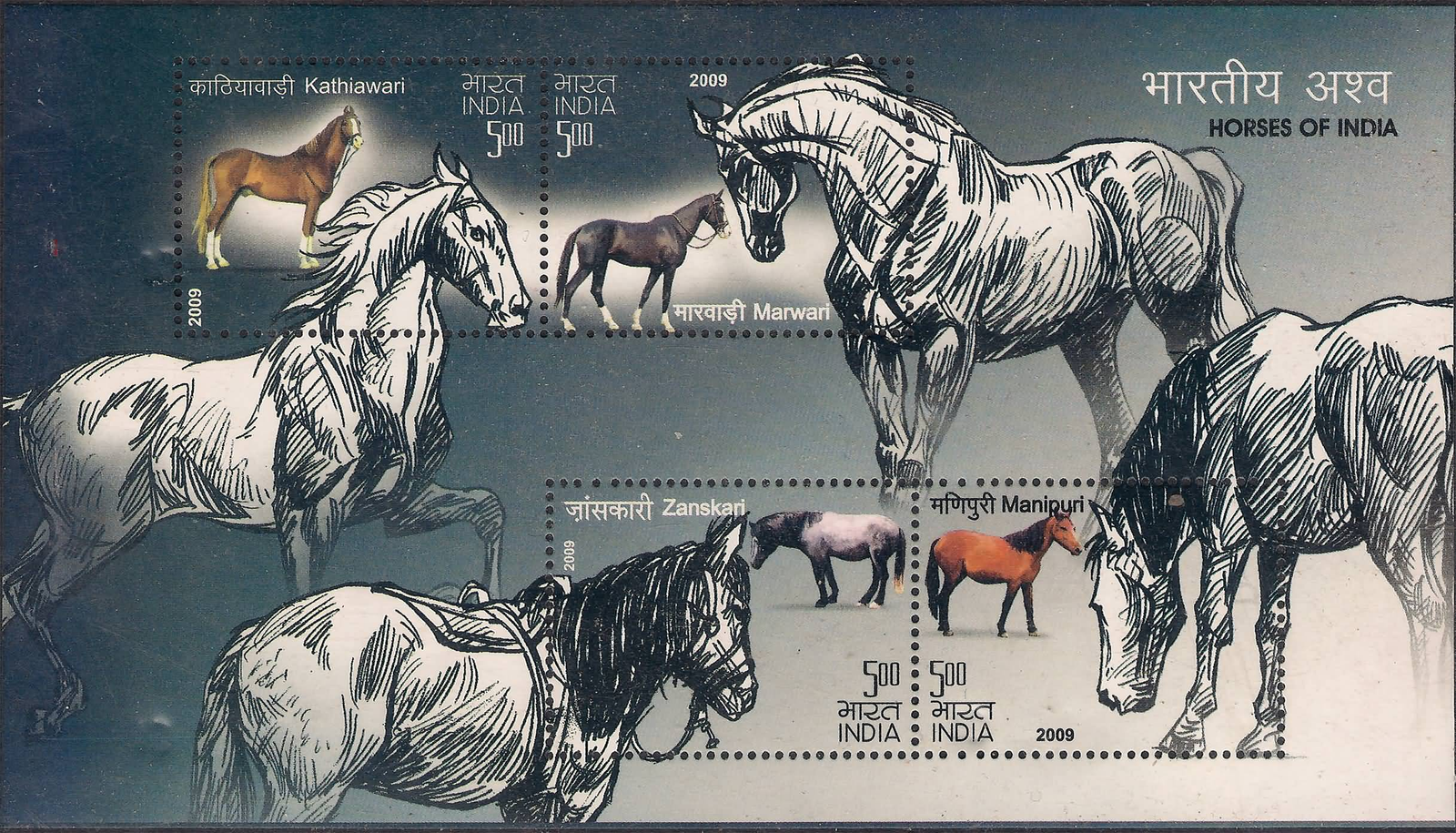
Technical Data
| Date of Issue | November 9, 2009 |
|---|---|
| Denomination | Rs. 20 |
| Quantity | 400,000 |
| Perforation | 13½ |
| Printer | Security Printing Press, Hyderabad |
| Printing Process | Wet Offset |
| Watermark | No Watermark |
| Colors | Multicolor |
| Credit (Designed By) | Shri Kamleshwar Singh |
| Catalog Codes |
Michel IN BL73 Stamp Number IN 2367a Stanley Gibbons IN MS2651 WADP Numbering System - WNS IN081MS.2009 |
| Themes | Animals (Fauna) | Horses | Mammals |
Stamps in this Miniature Sheet
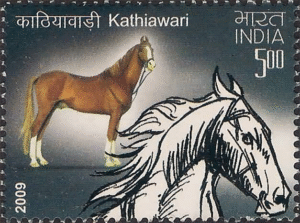
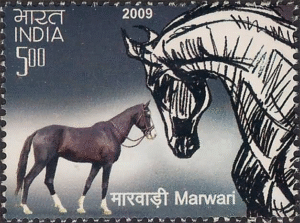
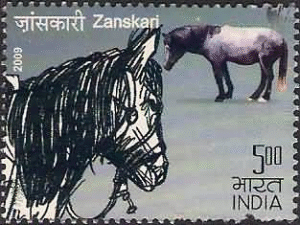
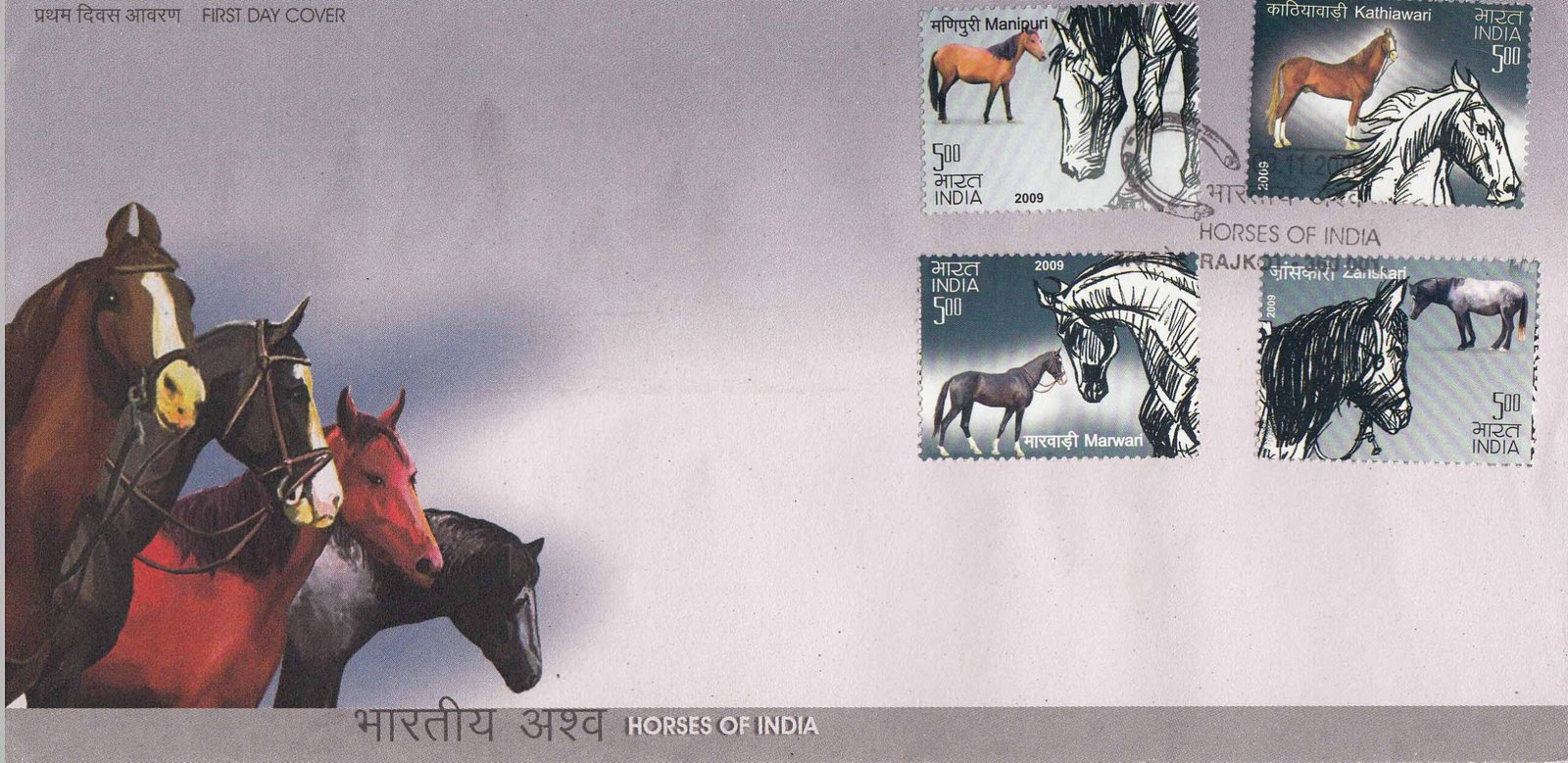
Marwari, Kathiawari, Manipuri and Zanskari
Horses have been an integral part of India’s cultural and historical heritage for centuries. From mythological references—such as the celestial chariot of the Sun God—to the warhorses that carried kings and warriors into battle, horses have symbolized strength, loyalty, and prestige in Indian ethos.
Today, Indian horses continue to play important roles in equestrian sports, polo, ceremonial occasions, rural transport, and even traditional weddings where the groom rides to his ceremony on horseback.
The Government of India officially recognizes five indigenous horse breeds: Marwari, Kathiawari, Manipuri, Spiti, and Zanskari. Among these, the Marwari and Kathiawari are celebrated for their beauty and speed, while the Zanskari and Spiti are hardy mountain horses of the Himalayas. The Manipuri pony uniquely blends endurance, intelligence, and agility.
Marwari horse
The Marwari horse originates from the Marwar region of Rajasthan. Historically bred by Rajput rulers as warhorses, Marwaris were admired for their bravery, loyalty, and endurance in battle.
Key Features:
- Height: 152–160 cm
- Long body and deep chest
- Slender legs with well-formed hooves
- Distinctive inward-turning pointed ears
- Natural pacing gait known as revaal
Although predominantly brown, Marwaris are also found in roan, chestnut, bay, grey, palomino, and piebald colors. Once declining in numbers, the breed is regaining popularity thanks to conservation efforts by organizations such as the Indigenous Horse Society of India.
Kathiawari horse
Believed to have descended from wild horses of Kathiawar in Gujarat, the Kathiawari is often regarded as one of the oldest indigenous horse breeds of India. Rajput rulers and Kathi tribesmen prized it as a desert warhorse capable of surviving harsh conditions with minimal food and water.
Distinct Characteristics:
- Average height: 147 cm
- Concave facial profile with fine muzzle
- Large, expressive eyes
- Inward-curving ears that can rotate 180 degrees
- Iridescent coat sheen
- Zebra markings on front legs and black eel stripe on back
The Kathiawari is known for stamina, endurance, sharp eyesight, and hearing. Today, it is frequently used in Indian Army and Police stables, and conservation groups are actively working to preserve the breed.
Zanskari horse
The Zanskari horse is a hardy Himalayan breed found primarily in the Leh and Ladakh regions of Jammu & Kashmir. Genetically related to the Spiti breed, it is adapted to extreme altitudes and harsh climatic conditions.
Key Traits:
- Height: 120–140 cm
- Predominantly grey, also black and copper shades
- Prominent eyes and long, heavy tail
- Fine, glossy body hair
- Strong, uniform gait
Due to crossbreeding with non-descript ponies, the Zanskari breed faces endangerment. The Animal Husbandry Department of Jammu & Kashmir has initiated conservation and selective breeding programs to protect it.
Manipuri pony
The Manipuri pony, developed in Northeast India, is believed to have ancient lineage connected to Mongolian wild horses and Arabian stock. It is famously associated with the origin of modern polo.
Notable Features:
- Height: 11–13 hands
- Light head with straight profile
- Well-formed neck and deep chest
- Small pointed ears and alert eyes
- Colors: bay, chestnut, grey, brown, white
Renowned for intelligence, endurance, and agility, the Manipuri pony is ideal for racing and polo. It remains deeply embedded in the socio-economic life of Manipur’s hilly regions. However, declining numbers have raised concerns, prompting organizations such as the Manipuri Horse Riding and Polo Association to promote breed preservation.
Preserving India’s Indigenous Horse Heritage
Several lesser-known breeds like Bhutia, Chummarti, and Sikang are also facing the threat of extinction. Conservation initiatives are crucial to protect India’s equine diversity, which represents centuries of cultural evolution, adaptation, and tradition.
Recognizing the historical and cultural significance of Indian horses, India Post issued a Miniature Sheet of four commemorative postage stamps celebrating the country’s indigenous horse breeds. This philatelic tribute honors the enduring legacy of Indian horses in history, warfare, sport, and society.
First Day Cover
Leave a Comment
You must be logged in to post a comment.