
I. K. Gujral
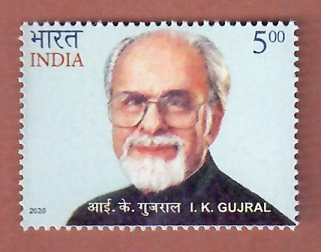
Technical Data
| Date of Issue | December 4, 2020 |
|---|---|
| Denomination | Rs. 5 |
| Quantity | 300,000 |
| Perforation | 13¼ x 13¾ |
| Printer | Security Printing Press, Hyderabad |
| Printing Process | Wet Offset |
| Watermark | No Watermark |
| Colors | Multicolor |
| Credit (Designed By) | Sh. Bharati Mirchandani Sh. Pallab Bose Smt. Alka Sharma |
| Catalog Codes |
Michel IN 3708 Stamp Number IN 3241 Yvert et Tellier IN 3385 Stanley Gibbons IN 3770 Phila-India IN 3770 |
| Themes | Famous people | Ms. Bharati Mirchandani | Optical Instruments | Politicians |
Statesman and Prime Minister of India
Inder Kumar Gujral (4 December 1919 – 30 November 2012) was the 12th Prime Minister of India, leading the nation during 1997–1998. Born in Jhelum in the undivided Punjab of British India, he was a distinguished scholar with qualifications including M.A., B.Com., Ph.D. and D.Litt. (Honoris Causa).
Early Life and Freedom Struggle
I. K. Gujral hailed from a family deeply rooted in the freedom movement. His parents, Avtar Narain Gujral and Pushpa Gujral, actively participated in the national struggle. Inspired by this legacy, Gujral joined the movement at the young age of eleven and was imprisoned in 1942 during the Quit India Movement.
Political Career after Independence
Gujral’s post-independence political journey began in 1958 as Vice-President of the New Delhi Municipal Committee. He entered mainstream politics by joining the Indian National Congress in 1964. Between 1967 and 1976, he served as Union Minister in several key portfolios, including Communications, Parliamentary Affairs, Information & Broadcasting, Works & Housing, and Planning.
From 1976 to 1980, he served as India’s Ambassador to the U.S.S.R., holding the rank of a Cabinet Minister, strengthening India’s diplomatic presence during a crucial period of the Cold War.
Leadership in Foreign Affairs and Prime Ministership
In the 1980s, Gujral joined the Janata Dal and served as Union Minister for External Affairs (1989–1990). He later held ministerial responsibilities in the Ministry of External Affairs and the Ministry of Water Resources in 1996.
In 1997, he emerged as the consensus candidate for Prime Minister under the United Front Government. During his tenure, he articulated a set of guiding principles for India’s relations with its immediate neighbours—later known as the Gujral Doctrine. These principles emphasized non-reciprocity, trust, and good neighbourly relations, shaping India’s regional diplomacy and were further refined during his prime ministership.
Scholar, Author and Cultural Enthusiast
Beyond public office, I. K. Gujral held several prestigious positions, including Chairman of the Indian Council of South Asian Co-operation, President of the Institute of Defence Studies & Analysis (IDSA), and Chairman of the Committee for Promotion of Urdu (Gujral Committee).
A writer and commentator on national and international affairs and theatre, he was deeply fond of Urdu language and poetry. His notable works include “A Foreign Policy for India” (1998), outlining his diplomatic vision, and “Matters of Discretion: An Autobiography” (2011).
Demise and Legacy
I. K. Gujral passed away on 30 November 2012 at the age of 93. He is remembered as a principled statesman, freedom fighter, diplomat and thinker who contributed significantly to India’s political and foreign policy landscape.
Commemorative Postage Stamp
To honour his life and distinguished service to the nation, the Department of Posts is pleased to issue a Commemorative Postage Stamp on I. K. Gujral, celebrating his enduring legacy in Indian public life.
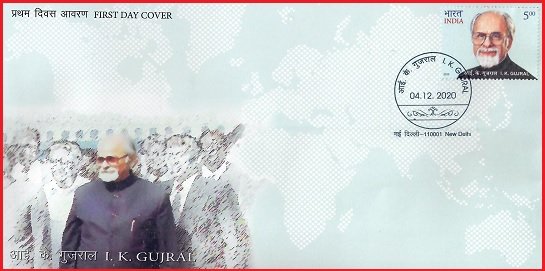
First Day Cover
Leave a Comment
You must be logged in to post a comment.