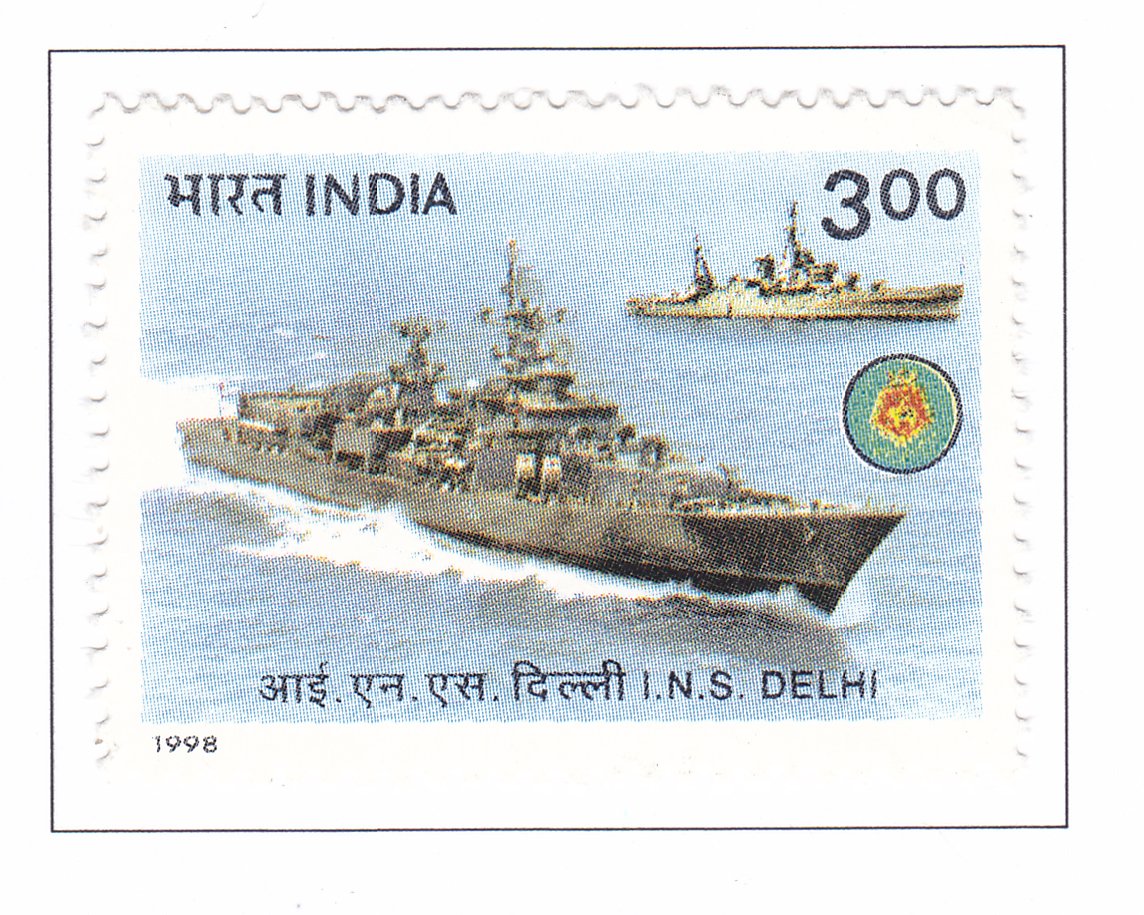
INS Delhi
Technical Data
| Date of Issue | November 15, 1998 |
|---|---|
| Denomination | Rs. 3 |
| Quantity | 700,000 |
| Perforation | comb 13½ x 13 |
| Printer | Security Printing Press, Nashik |
| Printing Process | Photogravure |
| Watermark | No Watermark |
| Colors | Multicolor |
| Credit (Designed By) | |
| Catalog Codes |
Michel IN 1653 Stamp Number IN 1726 Yvert et Tellier IN 1418 Stanley Gibbons IN 1816 |
| Themes | Military Forces | Navies | Ships | Warships |
History, Legacy, and India’s Indigenous Naval Power
The INS Delhi is one of the most prestigious names in the history of the Indian Navy. Revived for India’s largest indigenously built warship of its time, the name carries forward the legacy of an earlier vessel that served the nation with distinction for three decades.
The story of INS Delhi represents India’s naval heritage, maritime diplomacy, and growing defense manufacturing capabilities.
The Original INS Delhi
The first INS Delhi was commissioned into the Indian Navy on 5 July 1948 at Chatham Dockyard.
Before joining India, the ship had served as the British cruiser HMS Achilles. It was formally handed over as HMIS Delhi by the Commander-in-Chief Nore to V. K. Krishna Menon.
The ship arrived in Mumbai (then Bombay) on 15 September 1948, where it was received by Jawaharlal Nehru.
Transition to INS Delhi
When India became a republic on 26 January 1950, HMIS Delhi was redesignated as INS Delhi.
Later that year, on 1 June 1950, A. K. Chatterjee became the first Indian commanding officer of the ship.
This marked an important step in the Indianization of the Navy after independence.
INS Delhi as India’s Naval Ambassador
The original INS Delhi became a roving ambassador of India, visiting countries across the world and representing the nation with pride.
It carried several prominent Indian leaders, including:
- Rajendra Prasad
- Jawaharlal Nehru
- Indira Gandhi
These voyages included important domestic and international visits.
Participation in Ceremonial and Naval Events
The ship also represented India at major international events, including:
- Naval Review for the coronation of Queen Elizabeth II in 1953
- Independence celebrations of Mauritius in 1968
In addition to diplomacy, INS Delhi also served in military operations.
One notable role was during the liberation of Portuguese-held territories in December 1961, including operations connected with Diu.
Decommissioning of the Original INS Delhi
After participating in numerous fleet exercises and serving under 26 commanding officers, the original INS Delhi was decommissioned on 5 July 1978.
Its long and honorable service made it one of the most respected ships in Indian naval history.
Revival of the Name: New INS Delhi
Naval tradition holds that the soul of a ship never dies. Therefore, when India commissioned a new indigenous warship, the historic name INS Delhi was revived.
The new INS Delhi was the largest indigenously built warship in India at the time of commissioning.
It represented a major leap in Indian naval shipbuilding and defense technology.
Features of the New INS Delhi
The modern INS Delhi was designed for advanced maritime warfare and long-range operations.
Its capabilities included:
- Powerful offensive and defensive systems
- Ability to conduct independent high-seas operations
- Extended endurance for prolonged deployments
- Modern indigenous warship design and engineering
The vessel stood as a symbol of India’s technological progress and strategic strength.
Historic Commissioning in 1997
The new INS Delhi entered operational service in the Indian Navy on 15 November 1997.
This milestone marked a historic moment for India’s naval modernization and indigenous defense production.
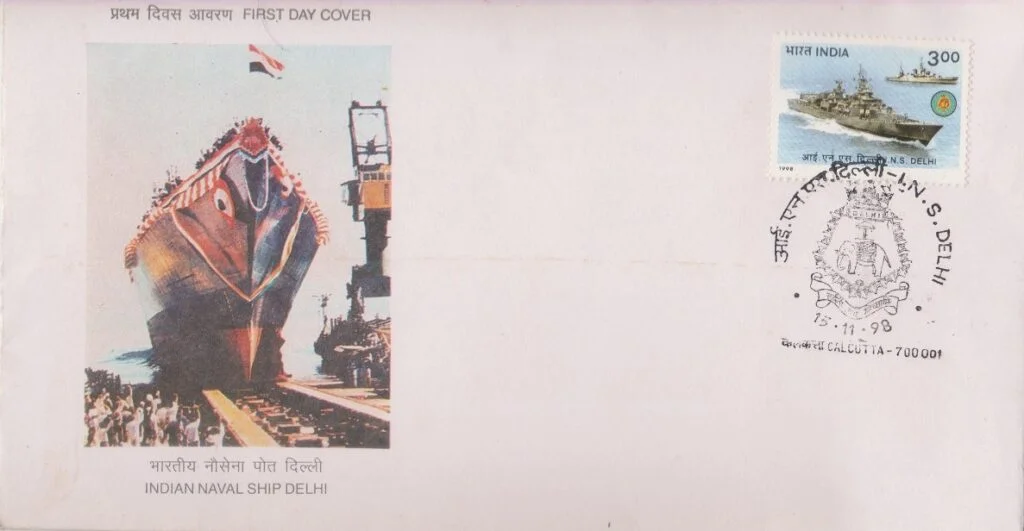
To commemorate the occasion, the Department of Posts issued a special postage stamp.
Conclusion
The name INS Delhi represents continuity, pride, and progress in the Indian Navy. From the original cruiser that served as India’s maritime ambassador to the modern indigenous destroyer symbolizing technological advancement, INS Delhi remains an enduring icon of India’s naval strength and maritime legacy.
First Day Cover