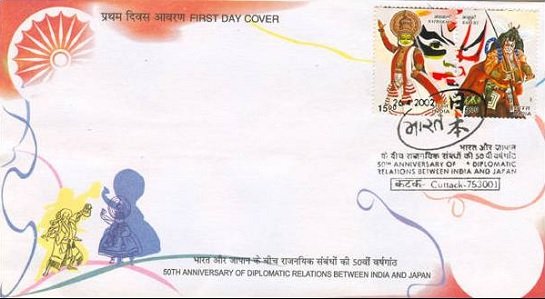
India-Japan : Joint Issue

Technical Data
| Date of Issue | April 26, 2002 |
|---|---|
| Denomination | Rs. 30 |
| Quantity | 100,000 |
| Perforation | comb13½ x 13 |
| Printer | Calcutta Security Printers Ltd |
| Printing Process | Offset Lithography |
| Watermark | No Watermark |
| Colors | Multicolor |
| Credit (Designed By) | Shri Kamleshwar Singh |
| Catalog Codes |
Michel IN BL13 Stamp Number IN 1953c Yvert et Tellier IN BF12 Stanley Gibbons IN MS2068 |
| Themes | Actors | Anniversaries and Jubilees | Dance | Diplomacy | Suits and Costumes | Swords | Traditions |
Stamps in this Miniature Sheet
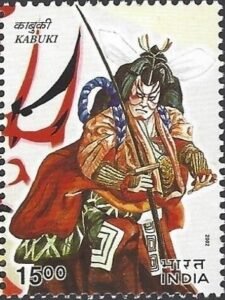

Kabuki and Kathakali Stamps
The enduring relationship between India and Japan is deeply rooted in history, culture, and shared values. Inspired by the teachings of Gautama Buddha, who spread the message of peace and non-violence, Japan has long regarded India as a sacred land of spiritual wisdom. In return, India has admired Japan’s remarkable recovery and growth following World War II.
Historical and Cultural Connections
The bond between the two nations strengthened during the 19th century through economic exchanges, particularly India’s export of cotton and iron ore, which supported Japan’s industrialization. Cultural and intellectual interactions also played a key role, such as the meeting between Rabindranath Tagore and Okakura Kakuzō.
Political ties were further enriched by leaders like Subhas Chandra Bose and Rash Behari Bose, who maintained close connections with Japan during India’s freedom movement.
Establishment of Diplomatic Relations
Formal diplomatic relations between India and Japan were established on April 28, 1952. This partnership was further strengthened through significant events such as Japan’s participation in the Asian Games 1951 and the visit of India’s first Prime Minister, Jawaharlal Nehru, to Japan in 1957.
Over the years, frequent high-level visits and cooperation have reinforced this cordial relationship.
Expanding Bilateral Relations
Today, India–Japan relations span a wide range of sectors, including:
- Trade and investment
- Science and technology
- Education and culture
- Defence and information technology
Shared democratic values and a commitment to peace and global stability continue to strengthen this partnership.
Philatelic Tribute: Kabuki and Kathakali
To commemorate the 50th Anniversary of Diplomatic Relations between India and Japan, India Post issued a special Miniature sheet featuring two iconic classical performing arts:
- Kabuki – A classical Japanese dance-drama known for its stylized performances, elaborate costumes, and expressive storytelling.
- Kathakali – A traditional Indian dance form famous for its intricate makeup, vibrant costumes, and dramatic expressions.
These stamps beautifully highlight the rich cultural heritage of both nations and symbolize their artistic excellence.
Conclusion
The India–Japan relationship is a unique blend of spiritual connection, historical interaction, and modern collaboration. From ancient Buddhist ties to contemporary global partnerships, the friendship continues to grow stronger. The commemorative stamps featuring Kabuki and Kathakali serve as a cultural bridge, celebrating the shared artistic traditions and enduring bond between the two nations.
First Day Cover