
India Mexico Joint Issue
Technical Data
| Date of Issue | December 15, 2010 |
|---|---|
| Denomination | Rs. 25 |
| Quantity | 300,000 |
| Perforation | 13 |
| Printer | India Security Press, Nashik |
| Printing Process | Wet Offset |
| Watermark | No Watermark |
| Colors | Multicolor |
| Credit (Designed By) | Shri Kamleshwar Singh |
| Catalog Codes |
Michel IN BL89 Stamp Number IN 2474a Stanley Gibbons IN MS2776 |
| Themes | Anniversaries and Jubilees | Dance | Folklore | Joint Issues | Music | Musical Instruments | Musicians | Suits and Costumes |
Stamps in this Miniature Sheet
A Celebration Through Dance
Shared Civilizational Heritage and Democratic Values
India and Mexico are ancient civilizations that today stand as vibrant, pluralistic democracies—multi-ethnic, multi-lingual, and multi-religious. Their relationship has traditionally been marked by warmth, friendship, and shared views on global and developmental issues.
During India’s freedom struggle, M. N. Roy found refuge in Mexico and co-founded the Mexican Communist Party. Cultural ties deepened further when Satish Gujral refined his artistic skills in Mexico in close association with renowned muralists like Diego Rivera, David Alfaro Siqueiros, and José Clemente Orozco.
Nobel Laureate Octavio Paz, who served as Mexico’s Ambassador to India from 1962 to 1968, offered a profound and authentic interpretation of Indian civilization in his celebrated book, In Light of India.
Agricultural Cooperation and the Green Revolution
Mexico made a landmark contribution to India’s Green Revolution by introducing the high-yielding “Sonora” wheat variety, which significantly enhanced agricultural productivity. Pandurang Khankhoje also achieved international recognition in Mexico for his pioneering work in developing high-yield food crops, particularly improved varieties of corn.
Establishment of Diplomatic Relations
India and Mexico established diplomatic relations in 1950. Since then, the partnership has grown steadily across political, economic, scientific, and cultural spheres.
In 1984, a bilateral Joint Commission at the Minister of State (External Affairs) level was established to comprehensively oversee and strengthen cooperation. Over the decades, this institutional framework has played a crucial role in expanding engagement between the two nations.
Miniature Sheet
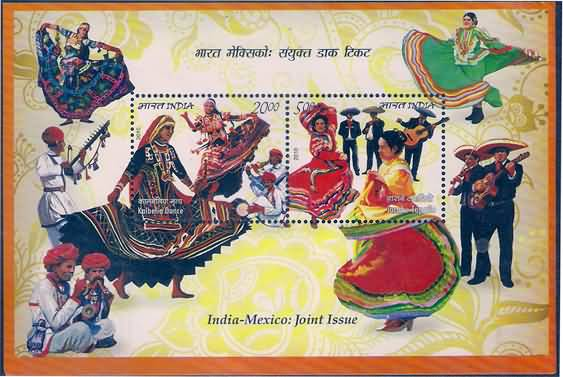
To commemorate 60 years of diplomatic relations, a joint issue of two commemorative postage stamps was released, celebrating the vibrant dance traditions of both countries. Along with the individual stamps, a Miniature Sheet was also issued, bringing together both designs in a single philatelic presentation. The miniature sheet serves as a symbolic representation of unity, cultural harmony, and enduring friendship between the two nations.
Kalbelia Dance of Rajasthan
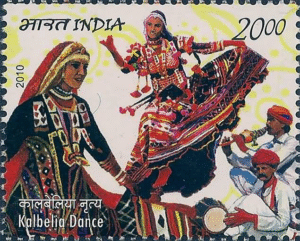
One stamp depicts the Kalbelia Dance of Rajasthan, India. This vigorous and graceful dance form, performed by women of the Kalbelia community, is known for movements that resemble the fluid motion of a snake. The dancers wear traditional black skirts adorned with intricate silver embroidery, moving rhythmically to folk music.
Male musicians accompany the performance using instruments such as the pungi, dafli, been, khanjari, morchang, and dholak, gradually increasing the tempo and intensity of the dance.
Jarabe Tapatío – The Mexican Hat Dance
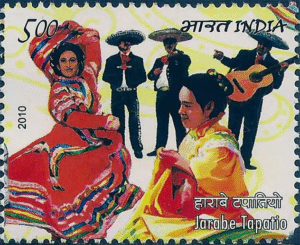
The second stamp features the Jarabe Tapatío, widely regarded as Mexico’s national dance. Each region of Mexico presents this beloved dance form in a style reflecting its own customs and traditions.
Women wear the traditional china poblana dress, consisting of a fringed blouse, skirt, and shawl, while men are dressed in ornate charro (cowboy) suits. The dance gained international popularity when the legendary ballerina Anna Pavlova incorporated it into her repertoire, introducing Mexican folk dance to global audiences.
A Symbol of Cultural Diplomacy
The issuance of the Miniature Sheet stands as a philatelic tribute to six decades of diplomatic engagement between India and Mexico. More than postal memorabilia, they represent shared heritage, mutual respect, and the continuing journey of cooperation between two great civilizations.
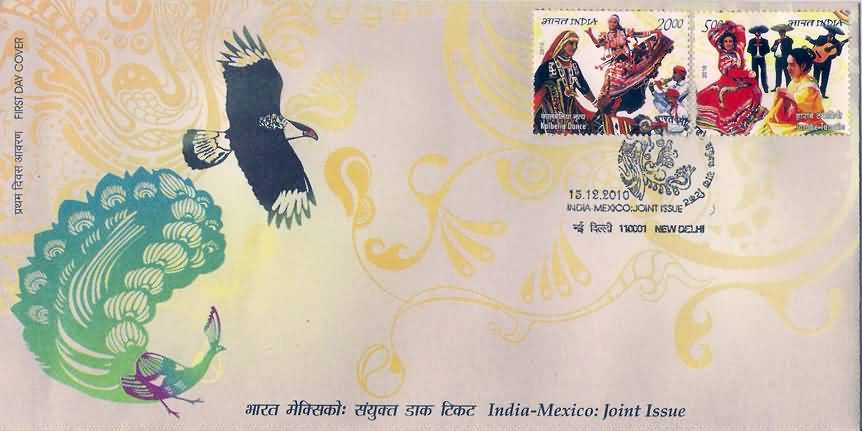
First Day Cover
Leave a Comment
You must be logged in to post a comment.