
Indian Agricultural Research Institute

Technical Data
| Date of Issue | March 30, 2006 |
|---|---|
| Denomination | Rs. 5 |
| Quantity | 800,000 |
| Perforation | comb13½ x 13¼ |
| Printer | India Security Press, Nasik |
| Printing Process | Photogravure |
| Watermark | No Watermark |
| Colors | Multicolor |
| Credit (Designed By) | Shri Kamleshwar Singh |
| Catalog Codes |
Michel IN 2137 Stamp Number IN 2149 Yvert et Tellier IN 1902 Stanley Gibbons IN 2322 WADP Numbering System - WNS IN017.2006 |
| Themes | Agriculture | Anniversaries and Jubilees | Buildings | Cereals | Microscopes | Towers |
The Indian Agricultural Research Institute (IARI), popularly known as the Pusa Institute, is one of India’s premier institutions for agricultural research, education, and innovation. It was originally established in 1905 at Pusa with financial support from the American philanthropist Henry Phipps, who donated £30,000 for its foundation.
Relocation and Development
After a devastating 1934 Bihar–Nepal earthquake, the institute was shifted from Pusa to its present location in New Delhi. Since then, it has provided strong leadership in building agricultural research infrastructure and developing modern technologies that helped transform India into a food-sufficient nation.
Role in Agricultural Research and Education
The institute has played a crucial role in agricultural research, education, and extension activities across the country. Because of its strong emphasis on training agricultural scientists and researchers, IARI was granted the status of a Deemed-to-be University in 1958.
Along with basic research, the institute focused heavily on applied and commodity research, leading to the development of high-yielding varieties of major crops and improved management technologies. These innovations significantly increased national food and agricultural production.
Expansion of Infrastructure
From its original structure of five divisions, the institute has expanded into a vast research network that includes:
- Twenty divisions
- Eleven specialised units
- Six National Coordinating Centres
- Five multidisciplinary research centres
- Nine regional research stations
- Two off-season nurseries
Its library houses the largest collection of agro-biological literature in South Asia, serving as an important resource for researchers. The institute also operates the National Phytotron Facility, the only controlled-environment research and containment facility in South Asia.
Modern Research Focus
In recent years, the institute has increased its focus on strategic and basic scientific research to strengthen India’s competitiveness in the modern scientific era. Major research areas include:
- Molecular Biology and Biotechnology
- **Microbiology and Virology
- **Plant Physiology and Biochemistry
- Agrochemicals, precision farming, and organic agriculture
- Bio-fuel research
The institute also works on advanced breeding strategies such as heterosis exploitation, hybrid development, gene identification for stress resistance, and the creation of pre-breeding stocks with multiple desirable traits.
Contribution to the Seeds Industry
The institute has made a significant contribution to the Indian seeds industry by developing and distributing quality seeds of nearly 175 varieties of field and vegetable crops. It has also pioneered new research methodologies, national network projects, and technology transfer initiatives to benefit farmers.
Role in the Green Revolution
The institute is widely recognized as a flagship institution of Indian agriculture and a major driving force behind the Green Revolution in India. The increased food production achieved through Green Revolution technologies became the foundation of India’s food security and agricultural progress.
Commemoration
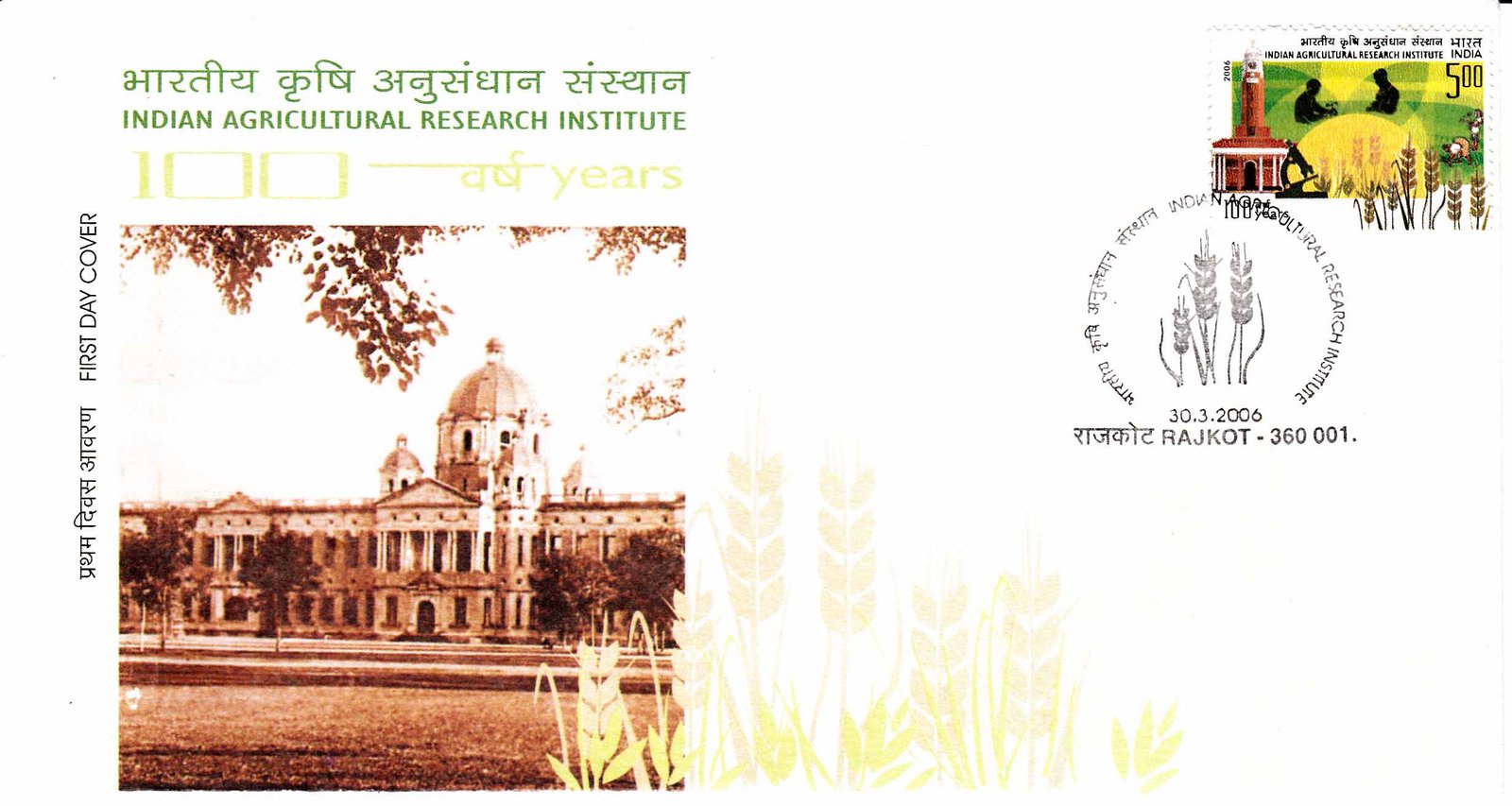
To celebrate the institute’s remarkable contributions, the India Post issued a commemorative postage stamp marking the centenary of the Indian Agricultural Research Institute, honouring its vital role in strengthening India’s agriculture and food security.
First Day Cover
Leave a Comment
You must be logged in to post a comment.