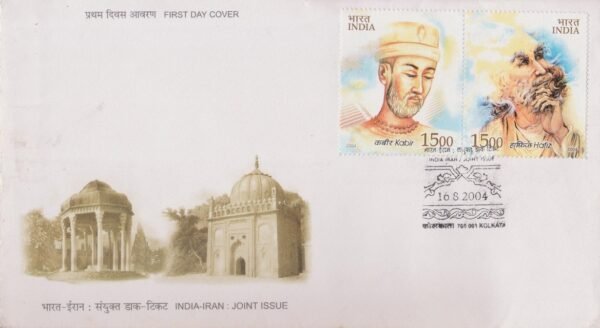
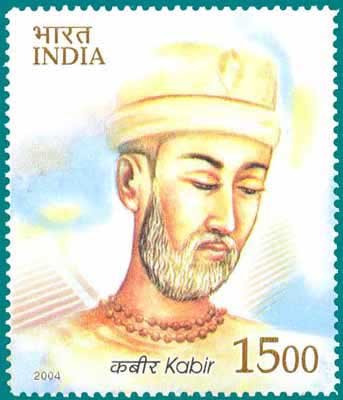
Kabir (15th-century Indian Mystic Poet)
Technical Data
| Date of Issue | August 16, 2004 |
|---|---|
| Denomination | Rs. 15 |
| Perforation | comb 13 |
| Printer | Security Printing Press, Nashik |
| Printing Process | Photogravure |
| Watermark | No Watermark |
| Colors | Multicolor |
| Credit (Designed By) | Sh. Sankha Samanta Smt. Alka Sharma |
| Catalog Codes |
Michel IN 2037 Stamp Number IN 2070a Yvert et Tellier IN 1802 Stanley Gibbons IN 2216 WADP Numbering System - WNS IN023.04 |
| Themes | Authors | Famous people | Headgear | Joint Issues | Literary People (Poets and Writers) | Literature | Men |
Introduction
Kabir, widely known as Sant Kabir Das, was one of the greatest mystic poets and philosophers of India. His teachings and poetry played a significant role in shaping Indian spiritual thought. A commemorative postage stamp was issued by India Post as part of the India–Iran Joint Issue of Postage Stamps, celebrating the cultural and philosophical connections between India and Iran.
India–Iran Cultural Relations
India and Iran share centuries-old cultural and civilisational ties that have influenced each other in areas such as literature, art, architecture, and language. In modern times, these relations have been strengthened through regular high-level visits and cooperation between the two nations.
Leaders such as P. V. Narasimha Rao and Atal Bihari Vajpayee visited Iran in 1993 and 2001 respectively, while Seyyed Mohammad Khatami visited India in 2003 and was honoured as the Chief Guest at the Republic Day Parade.
The New Delhi Declaration signed during this visit highlighted the vision of a strategic partnership between the two countries aimed at regional stability, security, and prosperity.
Kabir and the Bhakti Movement
Kabir lived during the early 15th century, a period marked by the Bhakti Movement. This movement brought religious philosophy closer to ordinary people by encouraging a personal relationship with the Almighty rather than ritualistic practices.
Kabir, who worked as a weaver by profession, became one of the most influential voices of this spiritual awakening. His teachings promoted equality, devotion, and moral values, and also encouraged social reform.
Philosophy and Poetry
Kabir is renowned for his Doha (couplets), which convey deep philosophical ideas in simple yet powerful language. His poetry was composed in Hindi and was rooted in everyday life, making his teachings easily understandable to common people.
Kabir openly criticised social evils and religious hypocrisy, advocating harmony and spiritual awareness. His poetry carries a universal message that touches the soul and inspires reflection about life and morality.
Influence on Religious Literature
Kabir’s influence extends across different religious traditions. Over 500 verses of Kabir are included in the Guru Granth Sahib, the sacred scripture of Sikhism. His teachings continue to inspire people across communities and generations.
Legacy and Commemorative Stamp
Sant Kabir Das remains one of the most quoted and respected mystic poets in India. His teachings of simplicity, truth, and spiritual awareness continue to guide people in both social and spiritual life.
To honour his lasting legacy and to celebrate cultural links between India and Iran, India Post issued a commemorative postage stamp on Sant Kabir Das as part of the India–Iran Joint Issue, symbolising the shared appreciation of poetry, philosophy, and mysticism between the two nations.
First Day Cover