
Indian Mathematical Society
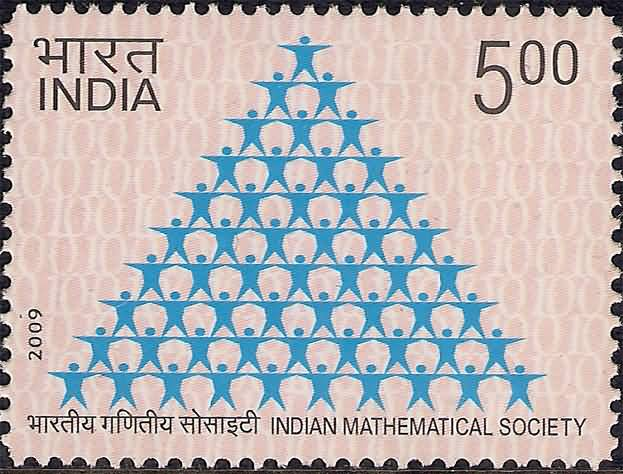
Technical Data
| Date of Issue | December 27, 2009 |
|---|---|
| Denomination | Rs. 5 |
| Quantity | 400,000 |
| Perforation | 13 |
| Printer | India Security Press, Nasik |
| Printing Process | Wet Offset |
| Watermark | No Watermark |
| Colors | Multicolor |
| Credit (Designed By) | Mr. Suresh Kumar |
| Catalog Codes |
Michel IN 2453 Stamp Number IN 2391 Stanley Gibbons IN 2682 WADP Numbering System - WNS IN106.2009 |
| Themes | Geometric Shapes | Mathematics | Stylized Figures / Persons |
A Pioneer of Mathematical Excellence in India
The Indian Mathematical Society (IMS) is the oldest scientific society in India devoted to mathematics. It was founded on 14 April 1907 by V. Ramaswamy Aiyar, then a Deputy Collector in the Madras Province, along with twenty members. Its headquarters was established at Pune.
Initially known as the “Analytic Club,” it was later renamed the “Indian Mathematical Club.” In 1910, after adopting a revised constitution, the Society assumed its present name, “The Indian Mathematical Society.” Today, IMS stands as the oldest and one of the largest mathematical societies in the country. Professor B. Hanumantha Rao served as its first President from 1907 to 1912.
Objectives and Vision
The principal objective of the Society is the promotion of mathematical study and research in India. It strives to inspire and encourage researchers, teachers, students, and all lovers of mathematics.
One of the crowning achievements associated with the Society was the early recognition and encouragement of Srinivasa Ramanujan, widely regarded as one of the greatest mathematical geniuses of modern India.
The IMS Library
The Society’s Library was established in 1907 at Fergusson College, Pune. In 1950, it was shifted to Chennai and is presently housed on the campus of the Ramanujan Institute for Advanced Study in Mathematics, University of Madras.
The Library possesses a rich collection of mathematical literature, including numerous international journals received on an exchange basis, as well as valuable back volumes of reputed mathematical periodicals from around the world.
Publications of the Society
The IMS publishes two prominent periodicals:
- Journal of the Indian Mathematical Society (JIMS)
- The Mathematics Student (MS)
From its inception, the Society published “Progress Reports,” which were renamed as the Journal in 1909. Initially published bi-monthly until 1933, the Journal was edited by M.T. Narasinga Iyengar until 1927 and later by R. Vaidyanathaswamy until 1950.
In 1934, a new series of JIMS was launched as a quarterly journal. Under its pioneering editors, JIMS established itself as a leading international journal, a distinction it continues to maintain. Only high-quality research papers are published in the Journal.
Significantly, the 1911 volume of JIMS contains the earliest published contributions of Srinivasa Ramanujan. These included questions and a notable fifteen-page paper titled “Some Properties of Bernoulli Numbers.”
In 1933, the Society initiated another periodical, The Mathematics Student, with A. Narasinga Rao as its first editor. Over the years, it published book reviews, announcements, news, notices, problems and solutions, and reports of the Society’s conferences.
Encouraging Young Researchers
To nurture young and emerging researchers, the Society organizes special paper presentation competitions during its Annual Conferences. Awards are presented to the best research papers in specified areas, forming an integral part of the academic programme and encouraging excellence in mathematical research.
Commemorative Postage Stamp
In recognition of its pioneering role in advancing mathematical research and education in India, the Department of Posts has issued a commemorative postage stamp on the Indian Mathematical Society, honouring its enduring contribution to the nation’s scientific and academic heritage.
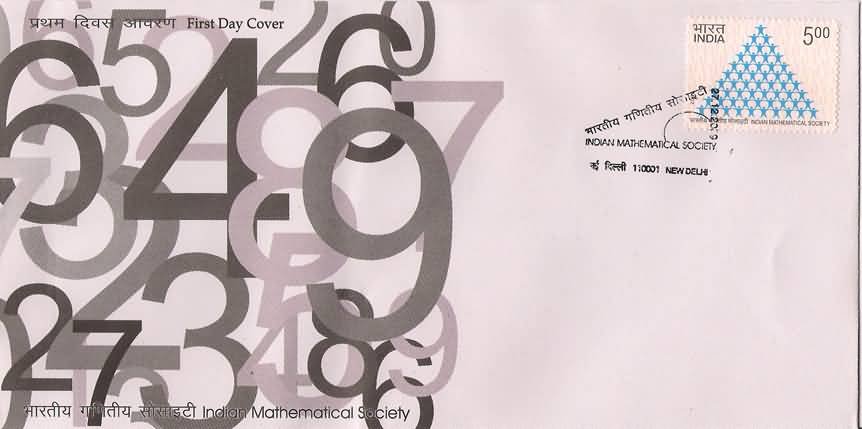
First Day Cover
Leave a Comment
You must be logged in to post a comment.